
Wholesale robot coffee maker manufacturer and supplier in 美国
- The Growing U.S. Market Demand for Robotic Coffee Kiosks in Wholesale Channels
- EXPOCCINO Manufacturing Capabilities and Wholesale Supply Infrastructure
- Bulk Shipping, Logistics, and Total Landed Cost Calculations for U.S. Buyers
- Sourcing Comparison: Direct Factory vs. Domestic Wholesaler for Robot Coffee Makers in the U.S.
- Conclusion: Why EXPOCCINO Is the Right Wholesale Manufacturing Partner for U.S. Buyers
- Frequently Asked Questions
For U.S. distributors, venue operators, and large-scale procurement teams actively sourcing a robot coffee maker at wholesale volume, the critical decision is not simply which product to buy — it is which manufacturing partner can deliver consistent quality, scalable output, regulatory compliance, and competitive per-unit pricing across repeated bulk orders. EXPOCCINO, headquartered in Foshan, China, is a vertically integrated manufacturer and supplier of advanced robotic coffee kiosks purpose-built for commercial deployment. With direct factory pricing, full OEM and ODM customization capabilities, and an established export infrastructure serving North American clients, EXPOCCINO addresses every core concern of the serious wholesale buyer: minimum order quantities, lead times, ocean and air freight logistics to U.S. ports, CE and FCC certification alignment, and long-term after-sales support. The robotic coffee kiosk category is no longer a novelty — it is a rapidly maturing segment of the unattended retail and specialty coffee industries, and procurement professionals who lock in reliable factory partnerships now will hold a decisive competitive advantage in their regional markets.
The Growing U.S. Market Demand for Robotic Coffee Kiosks in Wholesale Channels
Why American Distributors Are Prioritizing Automated Coffee Solutions
The United States remains the world's largest single-country coffee market by consumption volume. According to the National Coffee Association's National Coffee Data Trends report, more than 66% of American adults drink coffee daily, a figure that has grown consistently over the past decade. Within this landscape, specialty and High Quality coffee consumption is outpacing standard drip coffee, creating a clear commercial opportunity for high-quality automated dispensing systems that can replicate barista-grade output without the labor overhead. Wholesale buyers — particularly those supplying airports, convention centers, university campuses, corporate office parks, and tourist attractions — are under increasing pressure to offer High Quality beverage experiences while managing tightening labor budgets. A robotic coffee maker directly solves this operational tension. It operates 24 hours a day, seven days a week, requires no shift scheduling, and delivers a consistent, programmable product every single time. For a distributor placing units across 20 or 50 locations, the unit economics of a fully automated system versus a staffed espresso bar are transformative.
Unattended Retail as a Structural Trend, Not a Fad
The broader unattended retail sector — encompassing smart vending, robotic kiosks, and autonomous checkout — is experiencing structural, not cyclical, growth. The global vending machine and automated retail market is projected to surpass $25 billion by 2030, with robotic and AI-integrated units representing the fastest-growing subsegment. Post-pandemic consumer behavior has normalized touchless, self-service transactions, and venue operators have discovered that well-designed automated kiosks can actually increase customer dwell time and average transaction value when the experience is sufficiently engaging. A robotic coffee kiosk with a visible mechanical arm, a multilingual touchscreen interface, and real-time social media integration is not merely a vending machine — it is an experiential retail installation that generates organic foot traffic and brand impressions. For wholesale buyers evaluating product lines to distribute across the U.S., this positions the robotic coffee maker as a high-margin, high-visibility SKU with strong repeat procurement potential.
Regional Deployment Scenarios Driving Bulk Purchase Decisions
Understanding where robotic coffee kiosks are being deployed at scale helps wholesale buyers identify their most viable end-customer segments. In the United States, the highest-volume deployment environments currently include: international and domestic airports (where 24/7 operation and multilingual interfaces are operationally essential), large convention and exhibition centers hosting trade shows and corporate events, hotel lobbies and resort common areas targeting both business and leisure travelers, hospital and healthcare campus common areas where staffing constraints are acute, and high-footfall retail malls and entertainment complexes seeking experiential anchor tenants. Each of these environments represents a procurement decision made at the facilities management or hospitality operations level — meaning wholesale distributors who can offer turnkey supply, installation guidance, and ongoing parts support will consistently win contracts over those offering equipment alone. This is precisely why sourcing from a manufacturer with genuine turnkey capability, rather than a trading company, is the strategically correct procurement decision.
EXPOCCINO Manufacturing Capabilities and Wholesale Supply Infrastructure
Vertically Integrated Production in Foshan's Advanced Manufacturing Ecosystem
Foshan, Guangdong Province, is one of China's most sophisticated manufacturing hubs, with particular depth in robotics, precision metalwork, industrial design, and consumer electronics integration — exactly the disciplines required to produce a world-class robotic coffee kiosk. EXPOCCINO's production facility combines in-house robotics engineering, proprietary algorithm development for beverage dispensing precision, and a dedicated commercial design studio. This vertical integration means that wholesale buyers are not dealing with an assembler sourcing components from disparate third parties; they are dealing with an engineering-led manufacturer that controls quality at every stage of production. The robotic arm systems used in EXPOCCINO kiosks are developed and calibrated in-house, ensuring that the interaction choreography — the visual spectacle that drives consumer engagement and social sharing — is consistent across every unit shipped. For a distributor placing a bulk order of 10, 50, or 200 units, this consistency is non-negotiable. Variance in unit performance across a deployed fleet creates support nightmares and damages the end-client relationship.
OEM and ODM Customization for U.S. Brand Partners
A significant proportion of wholesale buyers in the U.S. market are not simply reselling equipment under the manufacturer's brand — they are supplying branded installations to corporate clients, venue operators, or franchise networks that require custom livery, proprietary menu programming, and localized user interface design. EXPOCCINO's ODM and OEM capabilities are structured to accommodate these requirements at scale. Custom exterior wrapping and structural color schemes can be specified at the order level. The multilingual user interface supports English, Spanish, French, and additional languages relevant to diverse American consumer demographics. Menu configurations — including espresso-based drinks, cold brew options, flavored lattes, and seasonal specials — are programmable via the central management software. For wholesale buyers supplying hospitality groups or retail chains, this means a single factory relationship can serve multiple end-client brand requirements without sourcing from multiple vendors. Lead times for standard configurations run approximately 25 to 35 business days from order confirmation; custom ODM projects typically require 45 to 60 business days depending on specification complexity.
Quality Certifications and Compliance for the U.S. Market
Wholesale buyers supplying commercial equipment to U.S. venues must navigate a specific compliance landscape. Electrical equipment deployed in American commercial settings is expected to meet UL (Underwriters Laboratories) certification standards or equivalent recognized safety marks, and food-contact components must align with FDA food safety guidance for materials in contact with beverages. EXPOCCINO's export units for the North American market are engineered to meet these requirements, with electrical systems designed for 110V/60Hz operation standard in the United States. The company maintains documentation packages supporting customs clearance, including HS code classification, material safety data, and CE marking for components where applicable. Wholesale buyers should request a full compliance documentation package as part of their initial sourcing inquiry — a reputable factory will provide this without hesitation. EXPOCCINO's quality management processes are aligned with ISO 9001 quality management principles, ensuring that production consistency, defect tracking, and corrective action protocols meet internationally recognized standards.
Bulk Shipping, Logistics, and Total Landed Cost Calculations for U.S. Buyers
Ocean Freight from Foshan to Major U.S. Ports
For wholesale buyers placing orders of five units or more, ocean freight via full container load (FCL) or less-than-container load (LCL) from the Pearl River Delta region to major U.S. West Coast ports (Los Angeles, Long Beach) or East Coast ports (New York/New Jersey, Savannah) is the standard and most cost-effective shipping method. Transit times from Foshan via Nansha or Yantian port to Los Angeles typically range from 14 to 18 days under normal shipping conditions. Buyers should factor in U.S. Customs clearance time (typically 3 to 7 business days for commercial equipment shipments) and final-mile delivery to their warehouse or end-deployment site. EXPOCCINO packages all kiosk units in custom export-grade crating with foam and structural bracing designed to withstand ocean freight handling. Each unit ships with a full installation manual, wiring diagrams, and a commissioning checklist. For buyers new to importing commercial equipment from China, working with a licensed U.S. customs broker is strongly recommended to manage HTS code classification and any applicable Section 301 tariff considerations that may apply to robotic equipment imports.
Understanding Total Landed Cost and Margin Modeling
Sophisticated wholesale buyers evaluate supplier proposals not on FOB unit price alone, but on total landed cost — the sum of product cost, international freight, insurance, import duties, customs brokerage fees, and domestic delivery. For robotic coffee kiosks imported from China to the U.S., buyers should model the following cost components: FOB factory price per unit (which decreases with volume tiers), ocean freight per unit (which decreases significantly as order volume fills container capacity), U.S. import duty rate applicable to the relevant HTS classification, customs brokerage and port handling fees (typically $300 to $600 per shipment regardless of unit count), and domestic trucking from port to warehouse. When these components are aggregated, the per-unit landed cost advantage of ordering at FCL volume (typically 20 or 40 units depending on kiosk dimensions) versus LCL volume can be substantial — often 15% to 25% lower per unit. This is the fundamental economic argument for bulk procurement from a direct factory supplier versus sourcing through a domestic U.S. intermediary, who must embed their own margin on top of an already higher per-unit import cost.
After-Sales Support Infrastructure for Distributed U.S. Deployments
One of the most frequently cited concerns among U.S. wholesale buyers sourcing commercial equipment from overseas manufacturers is after-sales support: what happens when a unit requires maintenance, a component fails, or software requires updating across a deployed fleet? EXPOCCINO addresses this through a multi-layered support architecture. Remote diagnostics and software updates are delivered via the kiosk's integrated connectivity module, allowing EXPOCCINO's engineering team to push firmware updates and troubleshoot operational issues without requiring a technician on-site. A consumables and spare parts inventory — including critical wear components such as brew group seals, grinder burrs, and pump assemblies — can be pre-positioned in the U.S. at the wholesale buyer's warehouse, with recommended stocking quantities provided based on fleet size. For larger fleet deployments, EXPOCCINO can provide technical training to the buyer's designated service technicians, enabling first-line maintenance to be handled domestically. This support model is designed to give U.S. distributors the operational confidence to commit to large-scale deployments without dependency on international service dispatch for routine maintenance.
Sourcing Comparison: Direct Factory vs. Domestic Wholesaler for Robot Coffee Makers in the U.S.
<table style=width:100%; border-collapse:collapse; border:1px solid #ccc;>
Conclusion: Why EXPOCCINO Is the Right Wholesale Manufacturing Partner for U.S. Buyers
The decision to source a robot coffee maker at wholesale volume for the U.S. market is ultimately a decision about which manufacturing partner can deliver the right combination of product quality, pricing discipline, customization capability, compliance readiness, and long-term supply reliability. Intermediaries and trading companies can fill short-term gaps, but they cannot offer the engineering depth, OEM flexibility, or total landed cost advantage that comes from working directly with the factory that designs and builds the product. EXPOCCINO is that factory. As a leading manufacturer and supplier of advanced robotic coffee kiosks headquartered in Foshan, China, EXPOCCINO brings together proprietary robotics and algorithm expertise, professional commercial advertising planning capability, and superior design and manufacturing infrastructure to deliver turnkey coffee experience centers that perform in the most demanding commercial environments. Whether the deployment scenario is a major U.S. airport, a national convention center, a hotel chain, or a high-traffic retail complex, EXPOCCINO's kiosks are engineered to generate revenue, attract foot traffic, and build brand visibility from day one of operation. The 24/7 fully unattended operation model eliminates labor dependency, the multilingual user interface serves America's diverse consumer demographics, and the sophisticated robotic arm interaction technology creates the kind of shareable, memorable experience that drives organic marketing value far beyond the cost of the equipment itself. For U.S. wholesale buyers and regional distributors ready to build a scalable, high-margin robotic coffee business, EXPOCCINO offers the production capacity, the export infrastructure, and the commercial partnership model to make it happen.
Frequently Asked Questions
What is the minimum order quantity (MOQ) for wholesale robot coffee makers from EXPOCCINO?
EXPOCCINO offers flexible MOQ structures designed to accommodate buyers at different stages of market entry. Trial or evaluation orders can typically be arranged from 1 to 3 units, allowing distributors to assess product performance and market reception before committing to volume. Volume pricing tiers begin at 5 units and scale progressively, with the most competitive per-unit pricing available at full container load quantities. Prospective wholesale buyers are encouraged to contact EXPOCCINO directly to receive a tiered pricing schedule tailored to their projected annual procurement volume.
What are the lead times for bulk orders of robotic coffee kiosks destined for the U.S. market?
For standard configuration units, production lead time from confirmed purchase order to factory-ready shipment is approximately 25 to 35 business days. Custom ODM orders requiring bespoke exterior branding, proprietary user interface design, or non-standard menu programming typically require 45 to 60 business days. Ocean freight transit from Foshan to U.S. West Coast ports (Los Angeles, Long Beach) adds approximately 14 to 18 days under normal shipping conditions, with U.S. Customs clearance adding a further 3 to 7 business days. Buyers should plan total procurement timelines of 7 to 12 weeks for standard orders and 10 to 14 weeks for custom ODM projects.
Are EXPOCCINO robotic coffee kiosks compliant with U.S. electrical and food safety standards?
Yes. EXPOCCINO's export units for the North American market are engineered for 110V/60Hz electrical operation standard in the United States. The company provides full technical documentation packages to support U.S. Customs clearance and compliance verification, including CE marking for applicable components, material safety data for food-contact parts aligned with FDA food safety guidance, and electrical system documentation supporting UL certification review processes. Wholesale buyers are advised to request the full compliance documentation package during the initial sourcing inquiry phase to facilitate their own due diligence and any required third-party certification processes in their target deployment states.
Can EXPOCCINO provide OEM or ODM customization for U.S. brand partners placing wholesale orders?
EXPOCCINO offers comprehensive OEM and ODM customization capabilities for wholesale buyers and brand partners. Customization options include custom exterior color schemes and branded graphic wrapping, proprietary logo and brand identity integration on the user interface, custom menu programming to reflect the buyer's or end-client's beverage offering, and multilingual interface configuration supporting English, Spanish, French, and other languages relevant to U.S. consumer demographics. ODM projects are managed by EXPOCCINO's in-house commercial design studio and engineering team, ensuring that brand specifications are executed with manufacturing precision. Minimum quantities for ODM customization projects are discussed on a case-by-case basis depending on the scope of specification changes required.
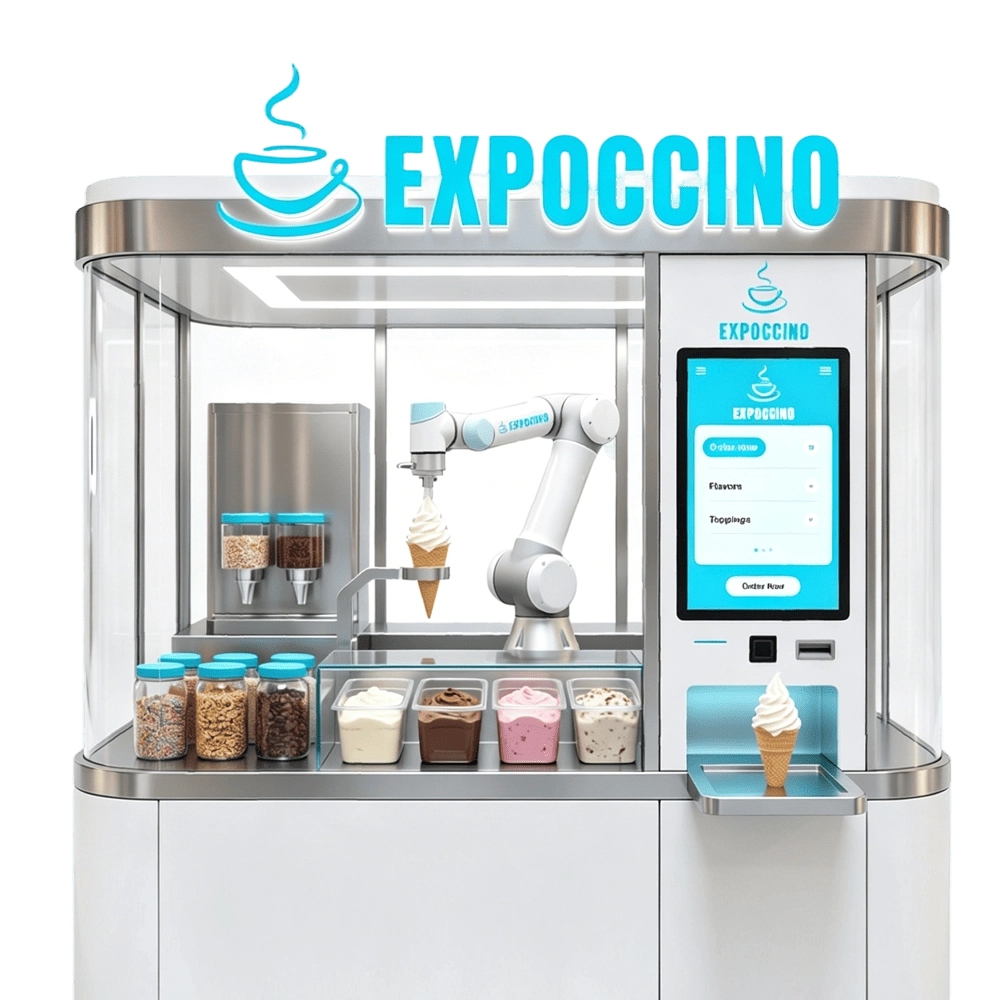
Expoccino Swirl is an AI-powered fancy ice cream robot that delivers ritual-worthy treats in paper cups. Robotic arms replicate handcrafted swirling layers and delicate textures directly inside paper cups, creating eye-catching, Instagram-worthy servings. Choose between classic soft-serve or light, refreshing frozen yogurt for diverse taste preferences.
With a compact 1.5 m² footprint and a 30-inch OLED interactive screen, it enables engaging human-machine interaction, perfect for high-end venues. Operating 24/7 unattended with an energy-efficient and low-maintenance design, it brings delightful frozen treats to customers anytime.
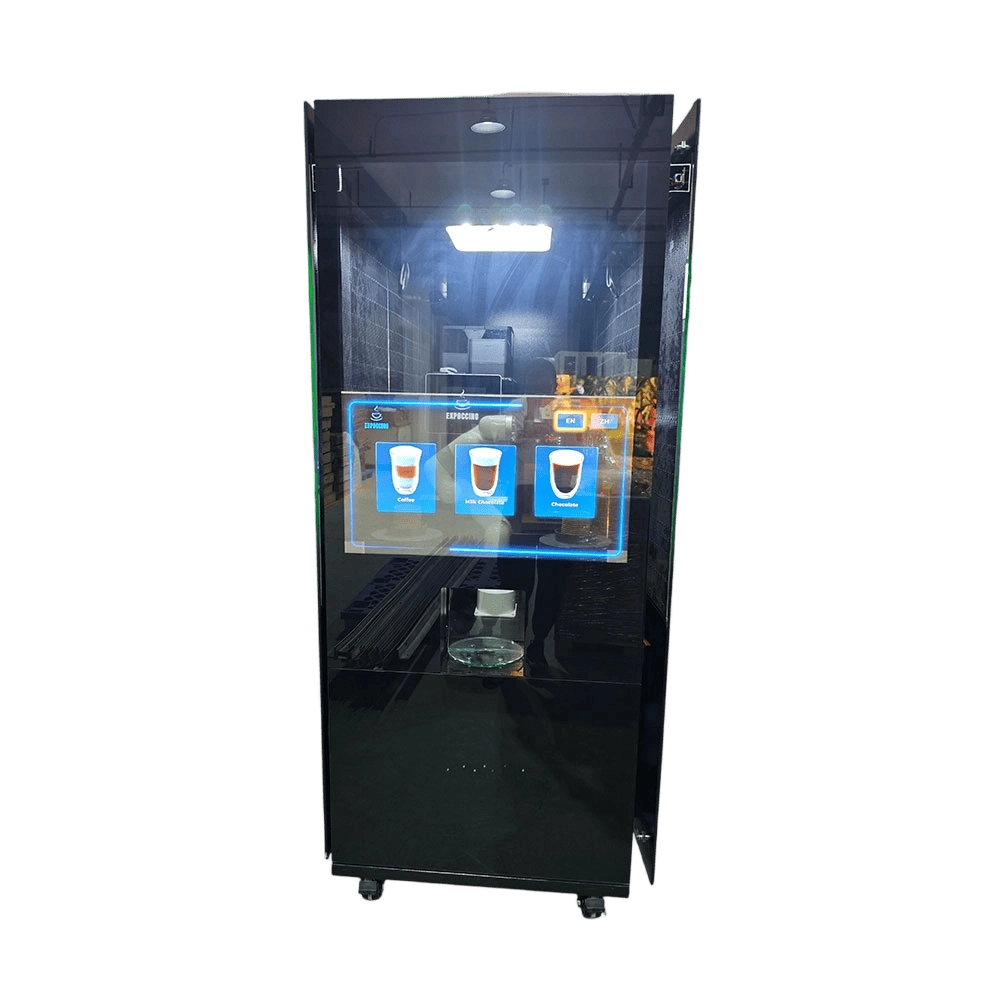
EXPOCCINO creates an immersive, futuristic coffee experience center. More than just a piece of equipment, it is a revenue-generating asset that enhances foot traffic and venue appeal through sophisticated robotic arm interaction and delivery technology, a multilingual user interface, and 24/7 fully unattended operation.
It aligns perfectly with public interest in specialty coffee and artificial intelligence, while helping brands gain extensive visibility, recognition, and market influence.
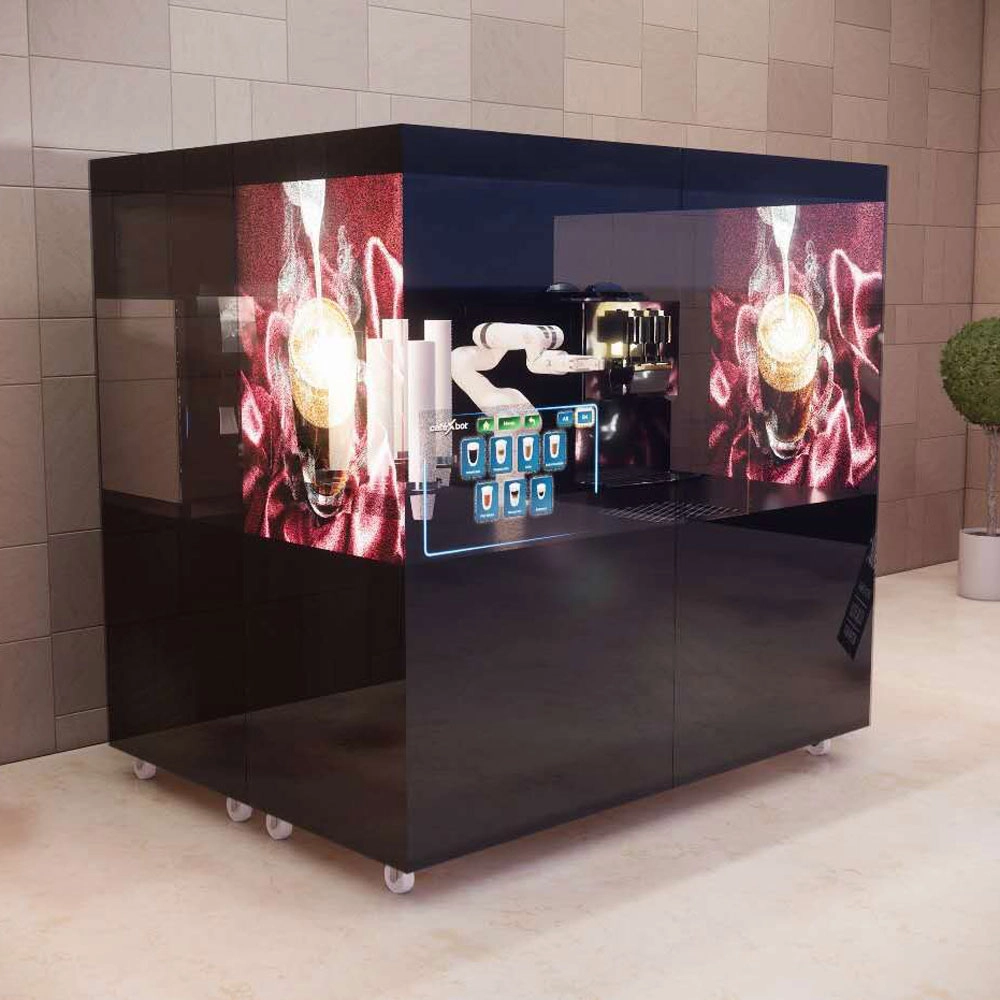
Enjoy doing your business with 100% automation. It is the only robotic kiosk serving multiple products, including hot and iced coffee, hot chocolate, ice cream with toppings, snacks, and tea.
It features a talking robotic kiosk equipped with AI speech recognition. The robot jokes with visitors to attract attention and invite them to buy. Additionally, it is the only robotic kiosk capable of serving up to 4 cups in a single order.
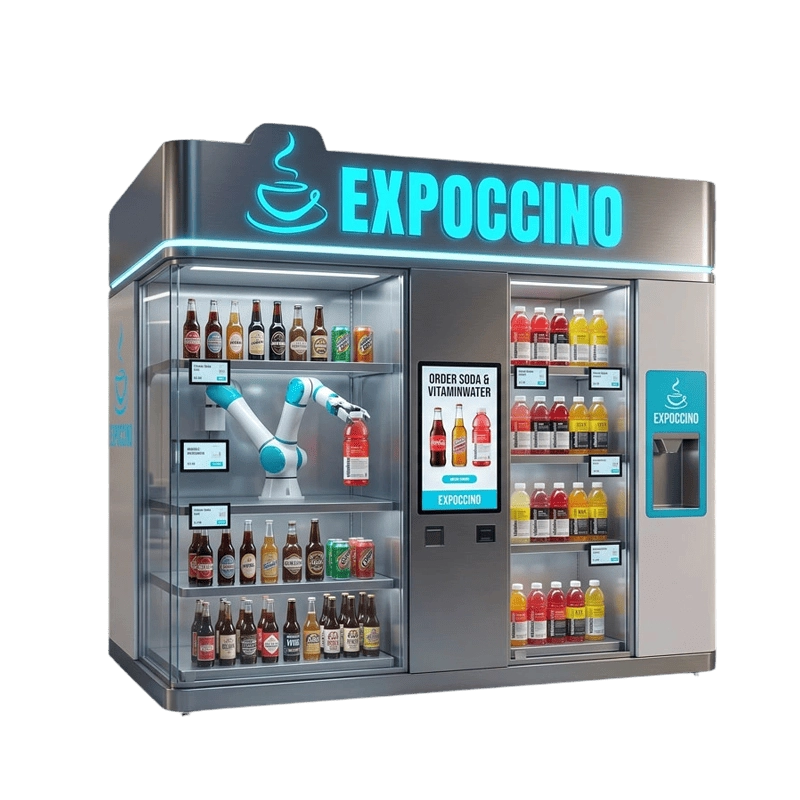
Expoccino Surge, the compact unmanned beverage kiosk, covers less than 5 m². Built with integrated robotic arms and a transparent OLED interactive screen, it offers 24-hour convenient service for everyone.
We carefully source natural fermented fruit & vegetable extracts and multivitamin ingredients, paired with freshly infused bubbles. Zero sugar and preservative-free, our drinks free you from the burden of traditional sugary sodas.
With an acid-resistant design, constant-temperature preservation, and smart cloud management, it is easy to maintain. Its sleek look fits malls, offices, campuses, and scenic spots, bringing healthy sparkling drinks closer to daily life.
Delivering hospitality experiences that reduce costs, boost sponsor value, and drive engagement.
Email: sales@expoccino.com
WhatsApp:+86 137 1745 4543
Tian’an Center, Jihua Dong Rd., Guicheng District, Nanhai, Foshan City, Guangdong Province, China.
 Scan QR Code
Facebook
Linkedin
Instagram
Linkedin
Twitter