
What Is an Ice Cream Robot? How Robotic Soft Serve Kiosks Work
- The Core Engineering Behind Robotic Soft Serve Kiosks
- How Unattended Robotic Kiosks Manage Food Safety and Hygiene
- Comparing Traditional Manual Service vs. AI-Driven Robotic Kiosks
- Economic Impact and the Rise of Robots in Restaurants
- Expanding Beyond Soft Serve: The Multi-Disciplinary Robotic Beverage and Dessert Ecosystem
- Frequently Asked Questions
An ice cream robot is an autonomous, food-safe robotic system engineered to dispense, swirl, top, and serve soft-serve ice cream or frozen yogurt without human intervention. Leveraging precision multi-axis robotic arms, integrated refrigeration units, IoT telemetry, and computer vision, these automated kiosks streamline commercial food preparation while ensuring strict portion control and continuous microbiological safety compliance. Over my 15 years working as an industrial automation and smart kitchen consultant, I have evaluated dozens of commercial implementations, witnessing firsthand how robotic soft-serve kiosks transform high-footfall entertainment centers, airports, and commercial restaurants into frictionless revenue engines.
The Core Engineering Behind Robotic Soft Serve Kiosks
When I inspect an unattended automated dessert kiosk, my attention immediately gravitates toward the kinetic mechanics. Unlike a human operator who relies on subjective touch and visual estimation, an automated kiosk standardizes the delicate physics of liquid-to-solid crystallization and fluid extrusion. These machines do not merely pour ice cream; they control viscosity, ambient temperature balance, and mechanical movement within sub-millimeter tolerances.
Multi-Axis Articulated Arms and End-Effectors
At the center of most automated kiosks sits a 6-axis articulated industrial or collaborative arm. In my integration projects, choosing between a collaborative robot (cobot) and an enclosed delta or SCARA arm boils down to speed versus safety clearance. The arm holds a custom-engineered, food-grade end-effector designed to grasp paper or waffle cones and disposable cups. Using programmable trajectory curves, the arm moves in an ascending, spiral motion beneath the dispensing nozzle, creating the iconic soft-serve curl with structural stability and aesthetic symmetry that human operators struggle to replicate over an eight-hour shift.
Refrigeration Dynamics and Viscosity Control
The heart of any frozen dessert machine is its refrigeration cylinder and scraper blade assembly. Soft-serve mix requires rapid freezing to maintain microcrystalline ice structures, ensuring a velvety texture. Automated kiosks utilize brushless DC motors equipped with torque sensors on the auger shaft. By measuring the rotational resistance (torque) of the motor, the onboard controller precisely gauges the ice cream mix's viscosity. If torque drifts outside the programmed operating window, PID refrigeration controllers adjust refrigerant flow in milliseconds, preventing freeze-up or watery product delivery.
Sensor Arrays and Machine Vision
Modern kiosks rely on a dense sensor layer including time-of-flight (ToF) depth sensors, photoelectric sensors, and high-definition optical cameras. During my field tests, machine vision models identify whether a dropped cup landed upright, detect toppings dispensing accuracy, and ensure customer collection windows are clear of obstructions before lowering security hatches. Standards defined by the IEEE for safe human-robot interaction guarantee that pinch points and motor torque limits protect end-users throughout the collection sequence.
How Unattended Robotic Kiosks Manage Food Safety and Hygiene
Throughout my career consulting on food-contact robotics, the primary concern raised by public health inspectors is sanitary design. Serving dairy products without continuous human monitoring requires ironclad hygiene automation. Unattended operations cannot afford a single point of failure in their sanitary chain.
Automated Clean-in-Place (CIP) Regimes
State-of-the-art robotic systems incorporate automated Clean-in-Place (CIP) cycles. Rather than requiring nightly teardowns by manual labor, modern units run internal high-temperature heat treatment or caustic sanitizing flush cycles. These systems pump heated water and chemical sanitizers through all fluid paths, manifold blocks, and dispensing valves at preset intervals. Adhering to the FDA Food Code guidelines, internal temperature probes log verification telemetry to onboard databases, proving that thermal pasteurization thresholds are met and maintained consistently.
HACCP Monitoring via Embedded IoT
Hazard Analysis Critical Control Point (HACCP) management is automated through real-time telemetry. Sensors monitor product hoppers, cylinder walls, and ambient temperatures every 200 milliseconds. If power fluctuates or hopper temperatures exceed 41°F (5°C) for longer than permissible limits, the software executes a hard lock, disabling dispensing to protect consumers from bacterial pathogens such as Listeria monocytogenes. As an automation engineer, having cloud dashboards report machine status remotely eliminates surprise regulatory infractions.
Cross-Contamination Prevention
Dry topping dispensers utilize positive displacement augers and vibration trays isolated behind pneumatic gates. Liquid sauces use peristaltic pumps that prevent toppings from contacting external machinery parts. By keeping the sauce inside food-grade silicone tubing until it drops into the serving cup, kiosks eliminate cross-contact and maintain allergen separation between nuts, chocolates, and fruit purées.
Comparing Traditional Manual Service vs. AI-Driven Robotic Kiosks
To quantify the operational shift, I frequently compare legacy counter service with automated operations across high-traffic retail venues. The productivity improvements stem directly from consistent cycle times and negligible ingredient waste.
| Comparison Factor | Traditional Approach | AI-Driven Approach |
|---|---|---|
| Average Service Time per Order | 60 to 90 seconds (subject to staff fatigue) | 25 to 35 seconds (consistent 24/7) |
| Portion Control Accuracy | ±15% variance based on operator technique | ±1.5% volumetric and mass precision |
| Labor Requirement | 2 to 3 shift workers per counter | 0.1 FTE (periodic cleaning and refilling) |
| Sanitation Logging | Manual paper logbooks prone to human oversight | Automated digital IoT sensor auditing (FDA compliant) |
| Ingredient Wastage Rate | 8% to 12% via over-portioning and spillage | Less than 1.2% total recipe loss |
| Uptime Availability | Limited to store staffing shifts (8-12 hrs/day) | Continuous unattended operation (up to 24 hrs/day) |
Economic Impact and the Rise of Robots in Restaurants
Commercial food service margins are notoriously tight, squeezed by escalating wage rates, high turnover, and utility costs. The National Restaurant Association consistently reports staffing recruitment and retention as top operational hurdles. Integrating automated kiosks allows hospitality groups to offset repetitive tasks and redistribute labor into hospitality-focused roles.
Return on Investment (ROI) Modeling
When modeling capital expenditure for clients, a typical commercial soft-serve robotic kiosk exhibits an ROI payback window of 8 to 14 months. By operating across 18 to 24 hours daily in venues like transit hubs, colleges, and shopping arcades, revenue generation continues long after traditional dining outlets shutter. The reduction of over-pouring errors alone saves significant dairy ingredient costs over an annual operating cycle.
Customer Experience and Entertainment Value
Robotics provides theater. A robotic arm executing choreographed arcs, waving to children through transparent polycarbonate panels, and crafting customized layered sundaes generates organic social media engagement. In my consulting engagements, locations installing dynamic robotic exhibits see a marked increase in foot traffic conversion rates compared to static vending units.
Expanding Beyond Soft Serve: The Multi-Disciplinary Robotic Beverage and Dessert Ecosystem
The underlying kinematics, computer vision, and IoT infrastructure powering robotic ice cream are virtually identical to those driving the broader revolution of robots in restaurants. In recent years, my consulting work has expanded from frozen confections into full beverage automation, where precision extraction and thermal management present even higher technical demands.
Convergence of Frozen Confections and Automated Baristas
A natural evolution in automated retail is pairing ice cream dispensing with high-end coffee automation to produce affogatos, specialty blended drinks, and custom lattes. Operating a commercial-grade robot coffee machine requires integrating precision grinders, dual-boiler extraction systems, and automated milk texturing wands into a synchronized robotic workflow. Just as an ice cream robot calculates motor torque for viscosity, an advanced robot coffee maker dynamically measures water flow rates, tamping pressure, and brew temperature to achieve optimal extraction yields.
Engineering Precision in Espresso Machine Robotics
Deploying an industrial robot espresso machine involves complex thermal stability. Professional baristas understand that grind size must shift throughout the day based on ambient humidity. Modern espresso machine robot platforms utilize machine learning algorithms that evaluate liquid flow time and weight metrics on real-time scales, auto-calibrating grinder burrs across service shifts. These unified robotic islands demonstrate the maturity of food-service robotics, combining hot beverage extraction and cold dessert handling in single, cohesive micro-retail pods.
Scalability and Fleet Management
Operating a distributed network of commercial food robots demands centralized enterprise fleet software. Modern operators track ingredient inventory levels, cycle counts, preventive maintenance intervals, and cash/card reconciliation from single cloud management suites. When predictive maintenance alerts signal that an actuator or peristaltic tube is nearing its fatigue limit, technicians resolve the issue before unscheduled downtime occurs.
If you are exploring the technical feasibility or commercial integration of autonomous kiosks for your retail footprint, please contact us to schedule an engineering consultation.
Frequently Asked Questions
How does an ice cream robot maintain hygiene and prevent bacterial growth?
Robotic soft serve kiosks utilize automated Clean-in-Place (CIP) systems that flush food contact lines with high-temperature sanitizing solutions. Embedded IoT temperature sensors continuously monitor the hoppers and refrigeration cylinders in accordance with FDA standards, automatically disabling dispensing if temperatures exceed 41°F (5°C).
How fast can a robotic soft serve kiosk complete a customer order?
On average, a robotic soft serve kiosk dispenses, tops, and serves an ice cream cup or cone in 25 to 35 seconds. This cycle time remains consistent throughout the day without the fatigue or pacing variations common with human labor.
What maintenance is required for an automated ice cream robot?
Daily maintenance involves topping up dry and liquid ingredients and restocking cones and cups, which takes approximately 15 to 20 minutes. Routine maintenance includes inspecting seals, running monthly sanitization validation checks, and checking robotic arm joints and actuators every 6 to 12 months.
Can an ice cream robot handle custom toppings and sauces?
Yes. Advanced robotic kiosks feature precision dispensers that measure dry ingredients like nuts, cookies, and sprinkles via vibrating augers, as well as peristaltic liquid pumps for syrups. Customers can select customized combinations via touchscreens or mobile apps.
Are robotic kiosks safe for public interaction in open retail venues?
Robotic kiosks are housed in secure food-grade enclosures with transparent polycarbonate or tempered glass barriers. Safety interlocks, optical light curtains, and torque-limited collaborative joints instantly halt robotic motion if an obstruction or unauthorized access is detected at the delivery hatch.
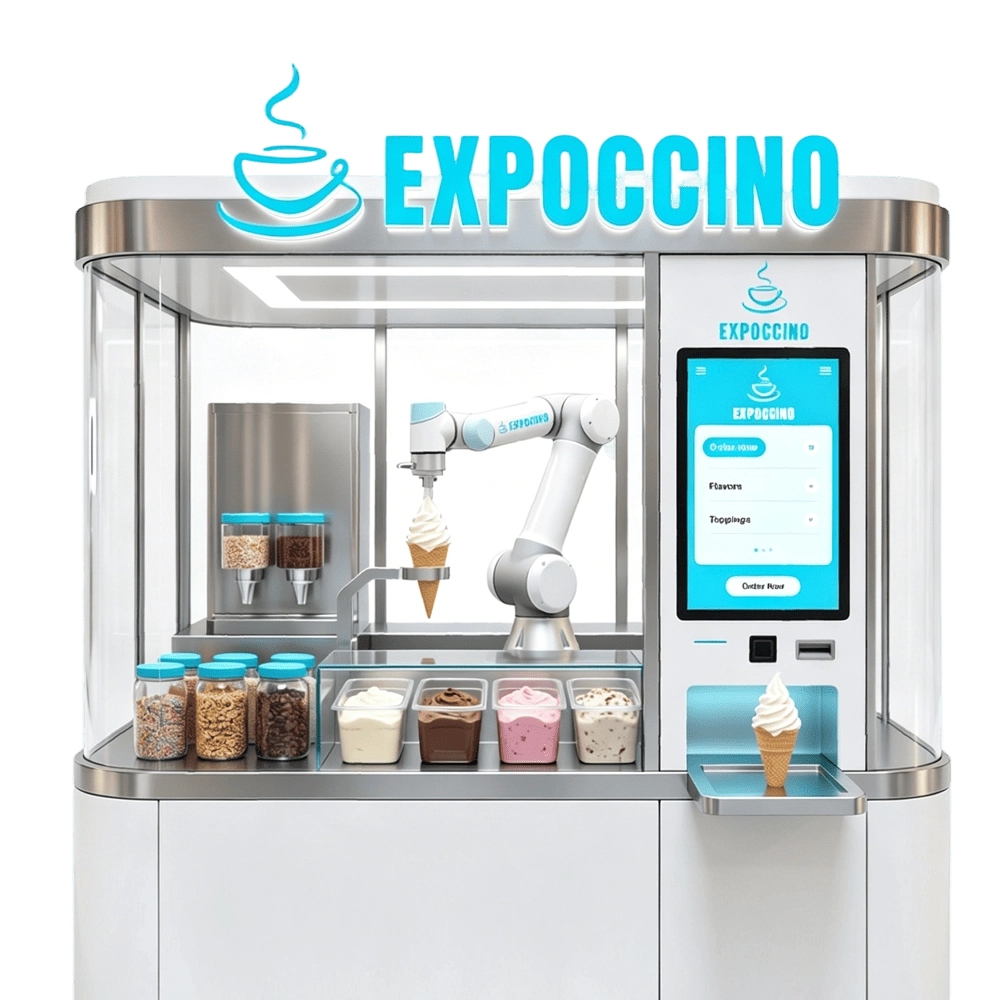
Expoccino Swirl is an AI-powered fancy ice cream robot that delivers ritual-worthy treats in paper cups. Robotic arms replicate handcrafted swirling layers and delicate textures directly inside paper cups, creating eye-catching, Instagram-worthy servings. Choose between classic soft-serve or light, refreshing frozen yogurt for diverse taste preferences.
With a compact 1.5 m² footprint and a 30-inch OLED interactive screen, it enables engaging human-machine interaction, perfect for high-end venues. Operating 24/7 unattended with an energy-efficient and low-maintenance design, it brings delightful frozen treats to customers anytime.
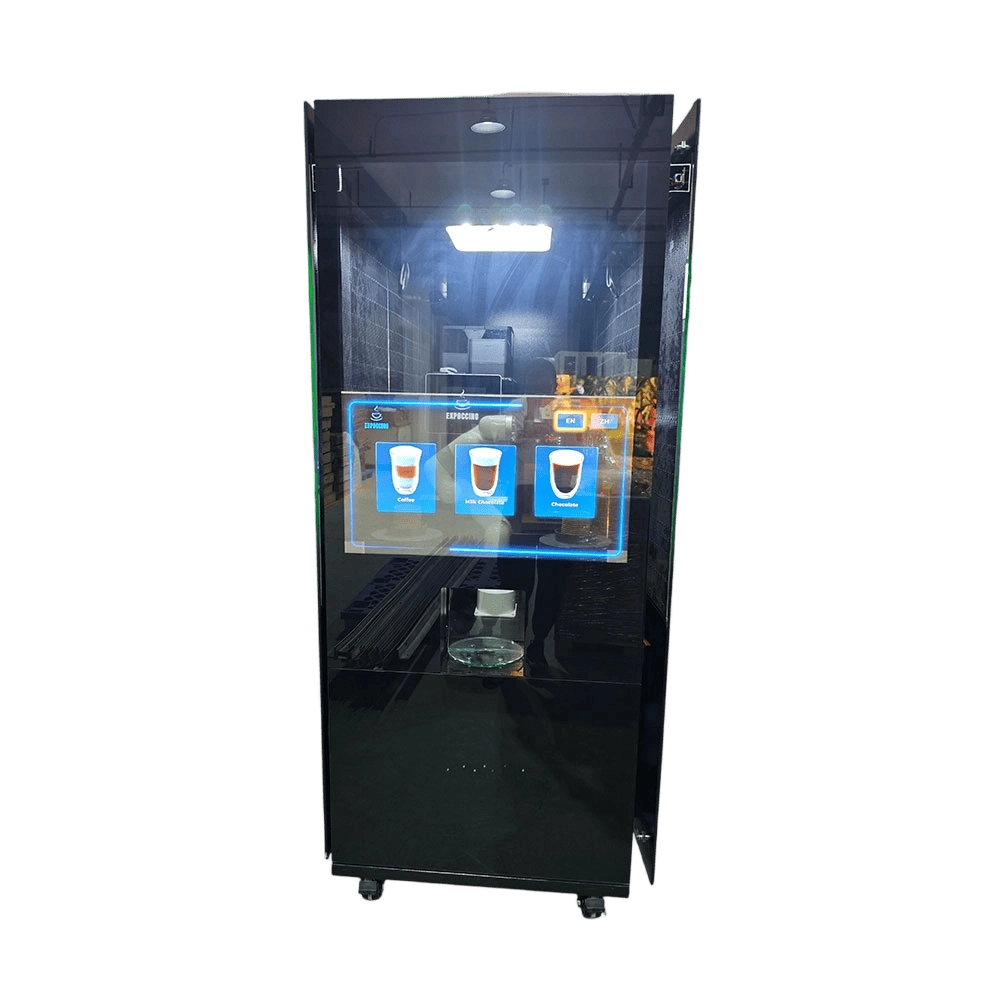
EXPOCCINO creates an immersive, futuristic coffee experience center. More than just a piece of equipment, it is a revenue-generating asset that enhances foot traffic and venue appeal through sophisticated robotic arm interaction and delivery technology, a multilingual user interface, and 24/7 fully unattended operation.
It aligns perfectly with public interest in specialty coffee and artificial intelligence, while helping brands gain extensive visibility, recognition, and market influence.
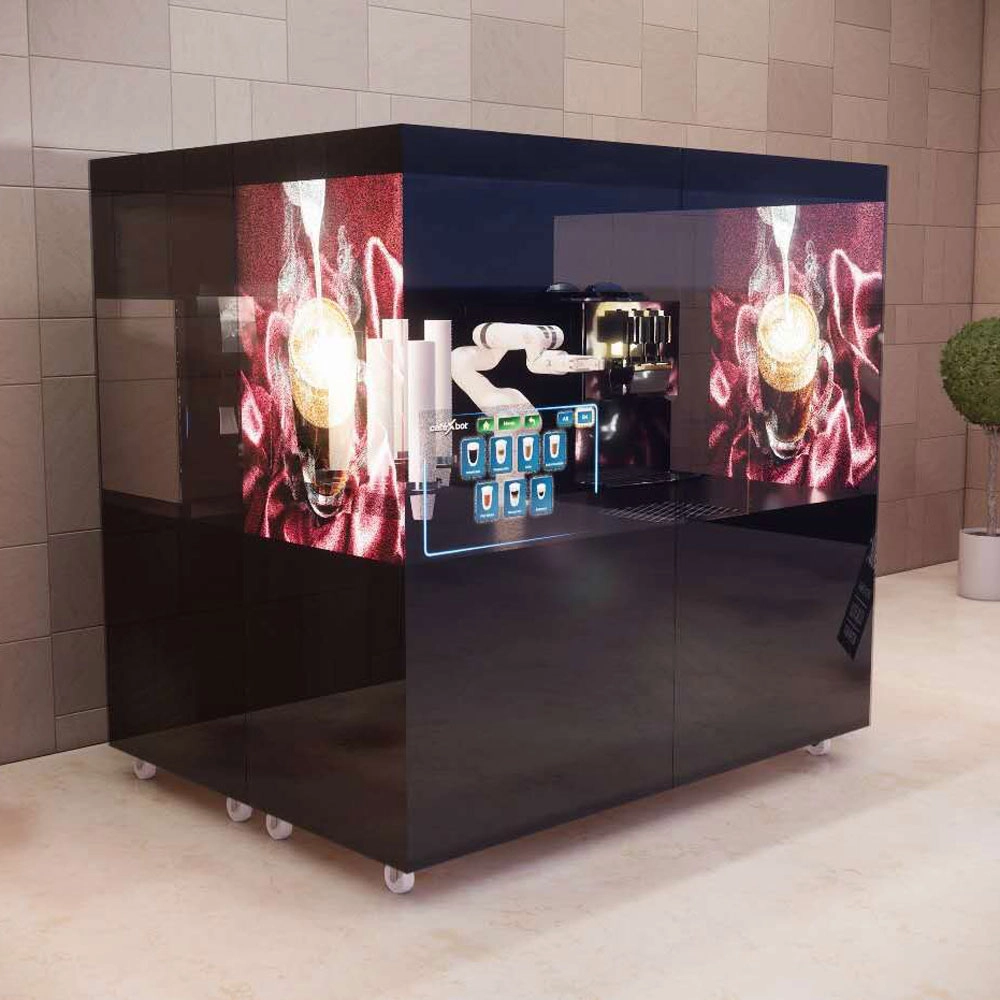
Enjoy doing your business with 100% automation. It is the only robotic kiosk serving multiple products, including hot and iced coffee, hot chocolate, ice cream with toppings, snacks, and tea.
It features a talking robotic kiosk equipped with AI speech recognition. The robot jokes with visitors to attract attention and invite them to buy. Additionally, it is the only robotic kiosk capable of serving up to 4 cups in a single order.
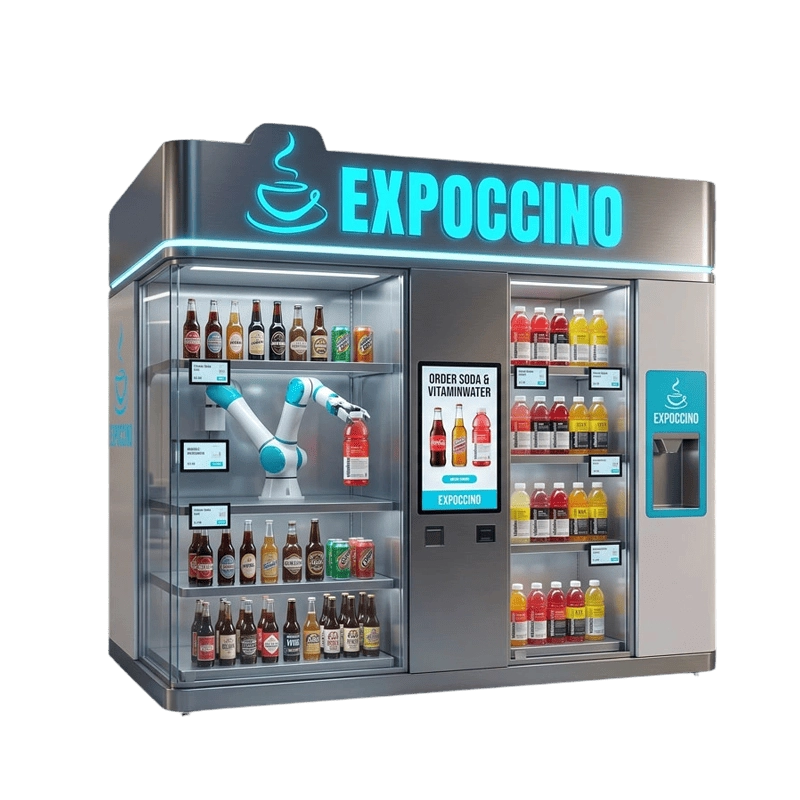
Expoccino Surge, the compact unmanned beverage kiosk, covers less than 5 m². Built with integrated robotic arms and a transparent OLED interactive screen, it offers 24-hour convenient service for everyone.
We carefully source natural fermented fruit & vegetable extracts and multivitamin ingredients, paired with freshly infused bubbles. Zero sugar and preservative-free, our drinks free you from the burden of traditional sugary sodas.
With an acid-resistant design, constant-temperature preservation, and smart cloud management, it is easy to maintain. Its sleek look fits malls, offices, campuses, and scenic spots, bringing healthy sparkling drinks closer to daily life.
Delivering hospitality experiences that reduce costs, boost sponsor value, and drive engagement.
Email: sales@expoccino.com
WhatsApp:+86 137 1745 4543
Tian’an Center, Jihua Dong Rd., Guicheng District, Nanhai, Foshan City, Guangdong Province, China.
 Scan QR Code
Facebook
Linkedin
Instagram
Linkedin
Twitter