
What Is a Robot Barista? A Complete Beginner's Guide
A robot barista is an automated coffee-making system that combines robotic arms, artificial intelligence, precision brewing hardware, and a self-service interface to prepare and deliver specialty coffee drinks without any human barista involvement. These systems can grind fresh beans, pull espresso shots, steam milk, and hand off a finished beverage — all within roughly 60 to 90 seconds — operating 24 hours a day, seven days a week. The global market for robotic and unattended retail solutions has expanded rapidly since 2020, driven by rising labor costs, post-pandemic hygiene awareness, and surging consumer appetite for specialty coffee. Whether you are a venue operator, a brand manager, or simply a curious coffee lover, understanding what a robot barista actually is — and what it can realistically do — is the first step toward evaluating whether this technology belongs in your space.
How a Robot Barista Actually Works: The Technology Behind the Cup
The Core Hardware Stack
Every time I walk a new client through a robotic coffee demonstration, the first question is always the same: Is it really making real espresso? The answer is an emphatic yes. A professional-grade robot coffee machine is built around a commercial-quality robot espresso machine module — the same class of brewing hardware you would find in a specialty café. The robotic layer sits on top of this foundation. A multi-axis robotic arm, typically with six degrees of freedom, handles cup placement, portafilter management, milk frothing wands, and final beverage delivery. Precision sensors monitor water temperature, extraction pressure (usually between 8 and 10 bars for espresso), and grind consistency in real time. The result is a drink that is genuinely reproducible at a quality level that many human baristas, frankly, struggle to match on a busy morning rush.
The AI and Software Intelligence Layer
Hardware alone does not make a robot barista intelligent. The real magic is in the software. Modern systems use machine learning algorithms to calibrate grind size against ambient humidity, adjust extraction time based on bean roast profiles, and even predict demand patterns to pre-stage ingredients. The user-facing interface — typically a large touchscreen or a mobile-linked ordering system — uses natural language processing to guide customers through customization options in multiple languages. According to the IEEE (Institute of Electrical and Electronics Engineers), the convergence of computer vision, motion planning algorithms, and IoT connectivity is what separates a true robotic barista from a glorified vending machine. I have seen firsthand how a well-tuned algorithm can reduce waste by over 15% compared to manual café operations, simply by optimizing ingredient usage per order.
The Unattended Operation Model
What makes the robot coffee maker category genuinely disruptive for the unattended retail sector is the zero-staff requirement. The machine monitors its own inventory levels, sends automated restocking alerts, performs self-cleaning cycles, and logs every transaction to a cloud dashboard accessible remotely. This is not theoretical — operators I work with regularly manage fleets of ten or more units across different cities from a single laptop. The automated coffee machine market is projected to grow at a compound annual rate exceeding 9% through 2030, and the unattended, fully autonomous segment is the fastest-growing sub-category within it.
Where Robot Baristas Are Being Deployed Right Now
Transportation Hubs and High-Traffic Venues
Airports, train stations, and metro concourses are natural homes for a robot espresso machine deployment. Foot traffic is massive, dwell time is predictable, and the labor economics of staffing a traditional café at 4 AM or midnight simply do not work. I have consulted on installations at major transit hubs where a single robotic coffee kiosk generates revenue equivalent to a fully staffed café counter at roughly one-third of the operating cost. Travelers are also increasingly comfortable with self-service technology — the same demographic that uses self-check-in kiosks and automated passport gates has zero hesitation ordering a flat white from a robot arm.
Robots in Restaurants, Hotels, and Commercial Spaces
The conversation around robots in restaurants has matured significantly. Early deployments were novelty-driven; today, operators are making hard-nosed ROI calculations. Hotels are installing robotic coffee stations in lobbies to serve guests around the clock without adding headcount. Corporate campuses use them in break rooms to reduce the queue at the coffee station and eliminate the need for a dedicated barista role. Shopping malls and entertainment complexes are discovering that an espresso machine robot with a dramatic robotic arm display becomes a destination in itself — people stop, photograph it, share it on social media, and then buy a coffee. That organic marketing value is something a traditional vending machine could never generate. The National Restaurant Association has noted in its technology outlook reports that automated beverage stations rank among the top three technology investments restaurant and hospitality operators are actively evaluating.
Exhibitions, Brand Activations, and Tourism Locations
Some of the most compelling use cases I have encountered involve temporary or event-based deployments. A technology conference wants to serve 2,000 attendees espresso during a 45-minute break. A luxury brand wants a futuristic coffee experience at its product launch. A tourist attraction wants to add a revenue-generating amenity without building out a full café kitchen. In all of these scenarios, a portable, self-contained robotic coffee kiosk solves the problem elegantly. The visual spectacle of a robotic arm preparing coffee is itself an attraction, perfectly aligned with the public's growing fascination with artificial intelligence and automation.
Robot Barista vs. Traditional Café: An Honest Comparison
I get asked constantly whether a robot barista can truly replace a human one. The honest answer depends entirely on what you are trying to achieve. Below is a straightforward comparison based on my 15 years of working with both models.
| Criteria | Traditional Human Barista | Robot Barista / Robot Coffee Machine |
|---|---|---|
| Operating Hours | Typically 6–8 hours per shift; closed overnight | 24/7 fully unattended operation |
| Labor Cost | High — wages, benefits, training, turnover | Near zero — remote monitoring only |
| Consistency | Variable — depends on skill and fatigue level | Highly consistent — AI-controlled parameters every shot |
| Throughput | 3–5 drinks per minute at peak | Up to 4–6 drinks per minute with zero fatigue |
| Hygiene | Dependent on staff compliance | Automated self-cleaning; contactless delivery |
| Multilingual Support | Limited to staff language skills | Full multilingual UI — typically 10+ languages |
| Setup Footprint | Requires full café buildout | Compact kiosk — deployable in days |
| Brand Customization | Limited to signage and uniforms | Full digital branding, advertising displays, custom UI |
| Novelty / Foot Traffic Draw | Standard café experience | High — robotic arm is a visual spectacle and social media magnet |
| Initial Investment | High — fit-out, equipment, staffing | Moderate — flexible rental or purchase models available |
The data tells a clear story: for high-traffic, unattended, or brand-activation scenarios, the robotic model wins on nearly every operational metric. For intimate, relationship-driven specialty café experiences where the human connection is the product, a skilled human barista still holds an edge. Most sophisticated operators I advise are not choosing one over the other — they are deploying robotic solutions where the economics demand it and reserving human talent for flagship, experience-first locations.
Why EXPOCCINO Represents the Next Generation of Robotic Coffee Solutions
A Turnkey Platform Built for Global Deployment
After evaluating dozens of robotic coffee platforms across three continents, I can say with confidence that what separates a genuinely enterprise-grade solution from a prototype is the depth of the total system — not just the robot arm. Robotic Barista Solutions from EXPOCCINO exemplify this philosophy. Headquartered in Foshan, China — a city synonymous with advanced manufacturing — EXPOCCINO has built a vertically integrated capability that covers robotics engineering, algorithm development, industrial design, and commercial deployment strategy under one roof. This is not a company that assembles third-party components; it is a manufacturer with genuine IP in the systems that matter most.
The EXPOCCINO robotic coffee kiosk is designed from the ground up as a robot coffee maker that functions as a complete revenue-generating asset, not merely a piece of equipment. Its sophisticated multi-axis robotic arm handles the full beverage preparation and delivery sequence with a theatrical precision that consistently stops foot traffic. The integrated multilingual user interface supports seamless ordering across diverse international audiences — a critical feature for transportation hubs, tourism destinations, and global brand activations. And because the entire system operates 24/7 without any on-site staff requirement, the unit economics are compelling from day one of deployment.
Flexible Deployment Models for Every Business Scenario
One of the most practical advantages EXPOCCINO offers is deployment flexibility. The platform supports both rental and permanent installation models, which means a brand can test the concept at an exhibition or trade show before committing to a long-term installation at a commercial location. I have seen this rental-first approach dramatically reduce the adoption barrier for operators who are intellectually convinced by the technology but need a proof-of-concept before a capital commitment. EXPOCCINO's experience across exhibitions and seminars, transportation hubs, and commercial and tourism locations means the company brings real-world deployment knowledge — not just factory specifications — to every client engagement.
More Than a Robot Coffee Machine — A Spatial Monetization Engine
What genuinely distinguishes EXPOCCINO in a crowded market of robot coffee machines and espresso machine robots is the company's framing of its product as a spatial monetization solution. The kiosk integrates commercial advertising display capabilities, meaning the unit generates brand visibility and advertising revenue in addition to coffee sales. For venue operators — airports, malls, hotel lobbies, convention centers — this dual revenue stream fundamentally changes the investment calculus. The machine is not a cost center; it is an income-generating asset that also enhances the venue's perceived modernity and appeal. EXPOCCINO's professional commercial advertising planning capability, backed by its design and manufacturing excellence, means partners receive a fully optimized system rather than a raw hardware kit they must figure out themselves. In a market where robots in restaurants and public spaces are transitioning from novelty to necessity, EXPOCCINO is positioned precisely at the intersection of specialty coffee culture and artificial intelligence — the two most powerful consumer trends of this decade.
Frequently Asked Questions
What is a robot barista?
A robot barista is an automated, AI-powered system that prepares and serves coffee drinks — including espresso, lattes, and cappuccinos — without any human barista involvement. It uses a combination of robotic arms, commercial-grade brewing hardware, machine learning algorithms, and a self-service touchscreen interface to deliver consistent, high-quality beverages 24 hours a day, seven days a week.
How much does a robot barista cost?
Costs vary significantly depending on the system's capabilities, brand, and deployment model. Entry-level robotic coffee kiosks can start around $30,000 to $50,000 USD for a purchase model, while premium enterprise-grade systems with full robotic arm displays and advertising integration can range considerably higher. Many suppliers, including EXPOCCINO, also offer flexible rental models that dramatically lower the barrier to entry for event-based or trial deployments.
Can a robot barista make real espresso?
Yes. Professional robot espresso machines use the same commercial-grade brewing components found in specialty cafés — including precision grinders, high-pressure pump systems operating at 8 to 10 bars, and temperature-controlled boilers. The AI layer controls extraction parameters in real time, often producing more consistent results than a human barista under high-volume conditions.
Where are robot baristas typically used?
Robot baristas are deployed across a wide range of venues, including airports and train stations, hotel lobbies, corporate campuses, shopping malls, tourist attractions, trade shows, and brand activation events. Any high-traffic location that benefits from 24/7 beverage service without the overhead of a full café staffing model is a strong candidate for a robotic coffee solution.
Are robot baristas hygienic and safe?
Yes. Robotic coffee systems are designed with hygiene as a core feature. They perform automated self-cleaning cycles, use contactless cup delivery mechanisms, and eliminate the human handling variables that can introduce contamination in traditional café environments. This was a significant factor in accelerating adoption following the COVID-19 pandemic, when touchless and unattended service models became a priority for operators and consumers alike.
How long does it take a robot barista to make a coffee?
Most commercial robot coffee machines complete a full beverage — from order confirmation to cup delivery — in approximately 60 to 90 seconds. Under optimized conditions with pre-staged ingredients, some systems can achieve throughput of four to six drinks per minute, making them competitive with or superior to a skilled human barista during peak service periods.
What is the difference between a robot barista and a regular vending machine?
The distinction is significant. A standard vending machine dispenses pre-made or instant beverages with minimal customization. A robot barista grinds fresh coffee beans, pulls a real espresso shot under controlled pressure, steams fresh milk, and assembles a fully customized specialty drink on demand. The quality, customization range, and visual experience are fundamentally different — and the AI-driven consistency of a robot barista far exceeds what any traditional vending machine can deliver.
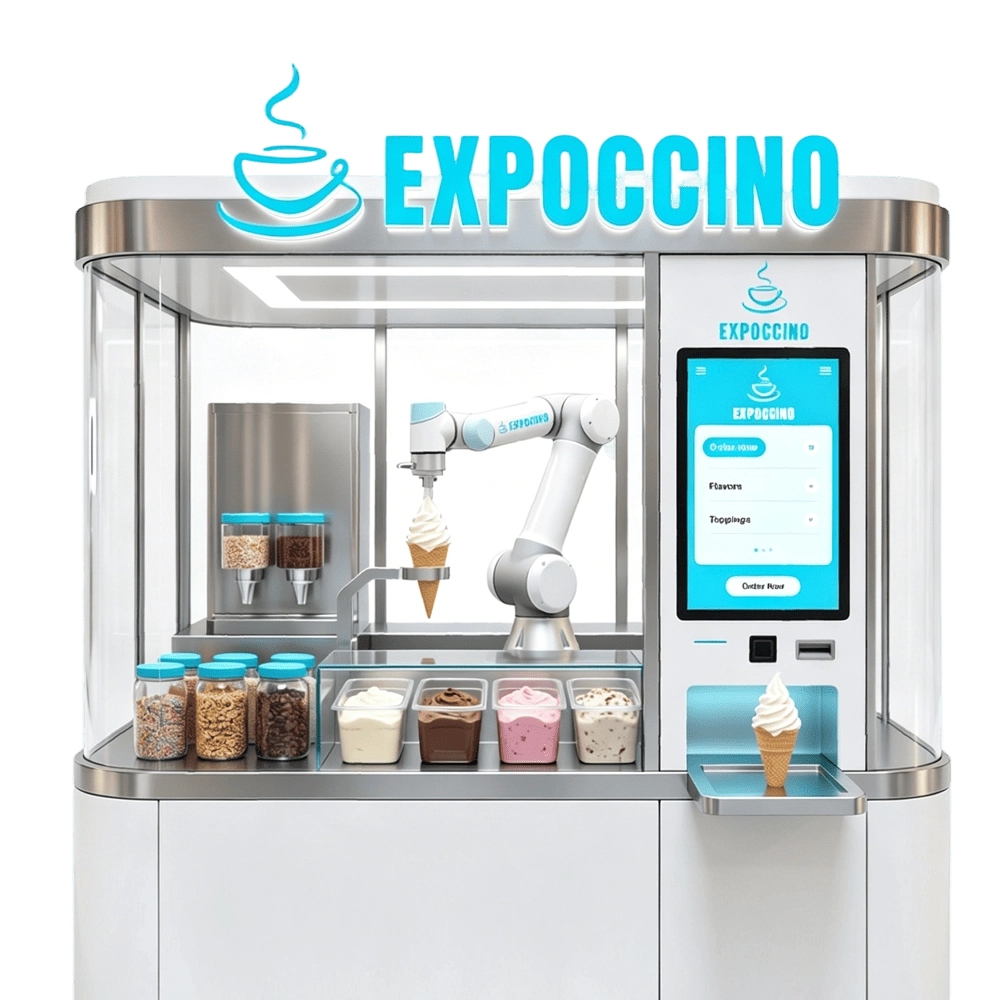
Expoccino Swirl is an AI-powered fancy ice cream robot that delivers ritual-worthy treats in paper cups. Robotic arms replicate handcrafted swirling layers and delicate textures directly inside paper cups, creating eye-catching, Instagram-worthy servings. Choose between classic soft-serve or light, refreshing frozen yogurt for diverse taste preferences.
With a compact 1.5 m² footprint and a 30-inch OLED interactive screen, it enables engaging human-machine interaction, perfect for high-end venues. Operating 24/7 unattended with an energy-efficient and low-maintenance design, it brings delightful frozen treats to customers anytime.
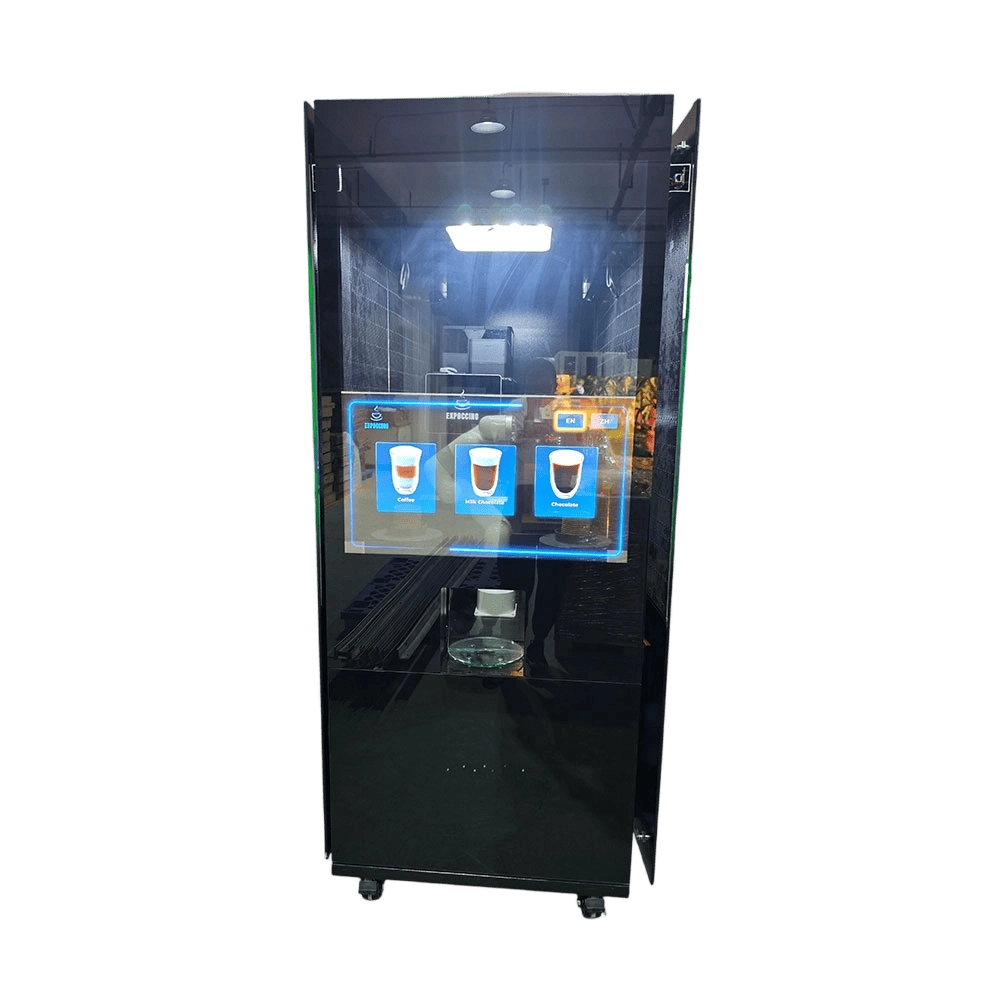
EXPOCCINO creates an immersive, futuristic coffee experience center. More than just a piece of equipment, it is a revenue-generating asset that enhances foot traffic and venue appeal through sophisticated robotic arm interaction and delivery technology, a multilingual user interface, and 24/7 fully unattended operation.
It aligns perfectly with public interest in specialty coffee and artificial intelligence, while helping brands gain extensive visibility, recognition, and market influence.
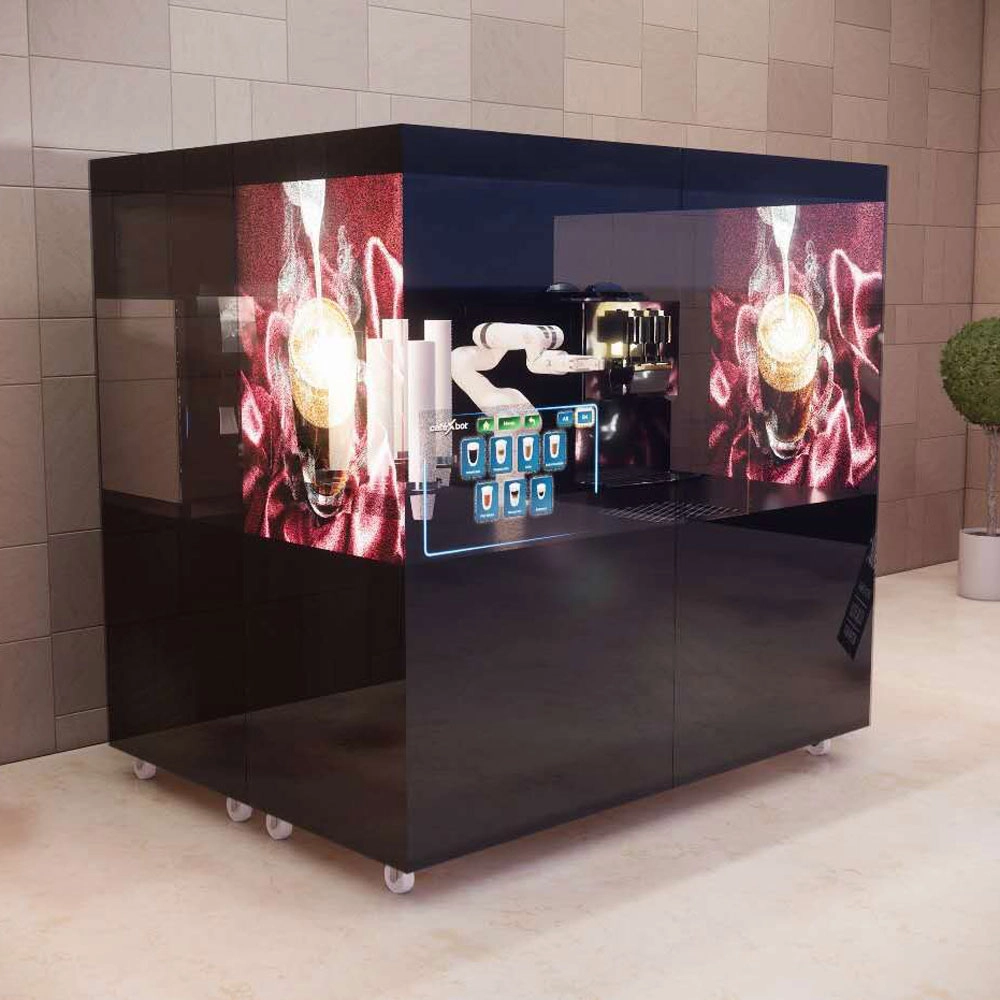
Enjoy doing your business with 100% automation. It is the only robotic kiosk serving multiple products, including hot and iced coffee, hot chocolate, ice cream with toppings, snacks, and tea.
It features a talking robotic kiosk equipped with AI speech recognition. The robot jokes with visitors to attract attention and invite them to buy. Additionally, it is the only robotic kiosk capable of serving up to 4 cups in a single order.
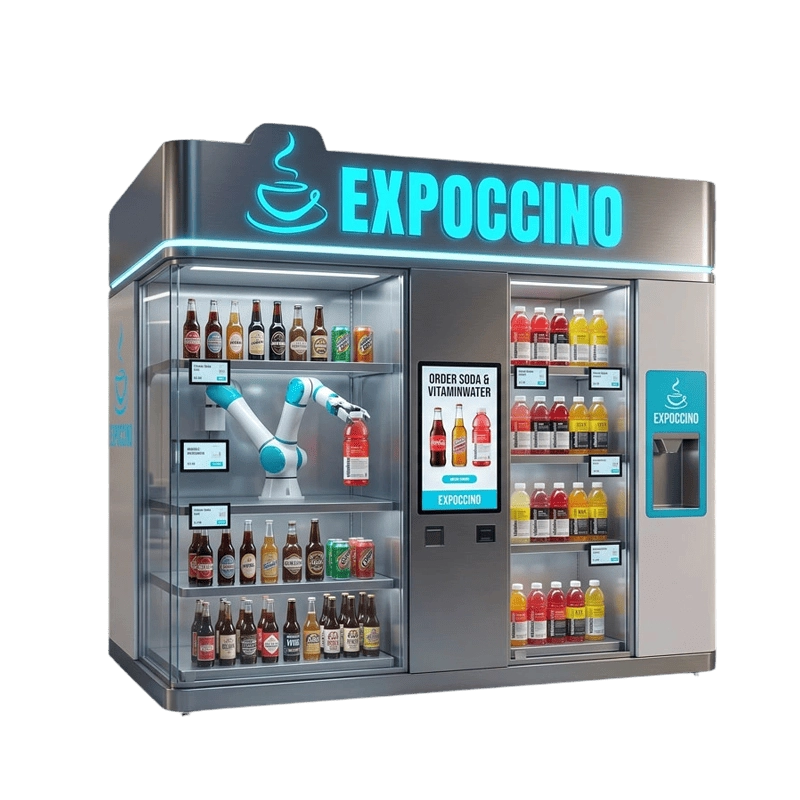
Expoccino Surge, the compact unmanned beverage kiosk, covers less than 5 m². Built with integrated robotic arms and a transparent OLED interactive screen, it offers 24-hour convenient service for everyone.
We carefully source natural fermented fruit & vegetable extracts and multivitamin ingredients, paired with freshly infused bubbles. Zero sugar and preservative-free, our drinks free you from the burden of traditional sugary sodas.
With an acid-resistant design, constant-temperature preservation, and smart cloud management, it is easy to maintain. Its sleek look fits malls, offices, campuses, and scenic spots, bringing healthy sparkling drinks closer to daily life.
Delivering hospitality experiences that reduce costs, boost sponsor value, and drive engagement.
Email: sales@expoccino.com
WhatsApp:+86 137 1745 4543
Tian’an Center, Jihua Dong Rd., Guicheng District, Nanhai, Foshan City, Guangdong Province, China.
 Scan QR Code
Facebook
Linkedin
Instagram
Linkedin
Twitter