
Is a Robotic Ice Cream Vending Machine a Good Business? What to Check Before Investing
- Evaluating the Commercial Viability of Automated Frozen Dessert Kiosks
- Crucial Technical and Operational Audits Prior to Capital Investment
- Comparative Operational Analysis: Manual Parlor vs. Autonomous Kiosk
- Scaling Automated F&B: Lessons from Robotic Beverage and Kitchen Systems
- Frequently Asked Questions
In my 15 years as an automated food and beverage technology consultant, I have evaluated hundreds of unmanned retail concepts, and few capture consumer attention as instantly as an autonomous frozen dessert unit. Investing in a robotic ice cream vending machine is fundamentally a high-margin, low-labor business model, but success hinges entirely on unit reliability, location selection, and cold-chain sanitation protocols rather than the novelty factor alone. Market indicators from automated retail studies show that automated kiosks can operate with gross profit margins exceeding 70%, yet investors must conduct rigorous technical due diligence on refrigeration redundancy, telemetry architecture, and automated cleaning systems before committing growth capital.
Evaluating the Commercial Viability of Automated Frozen Dessert Kiosks
CapEx vs. OpEx Breakdown in Unattended Retail
When analyzing automated concessions, capital expenditure (CapEx) ranges from $25,000 to $65,000 per unit, depending on robotic degrees of freedom, visual displays, and payment hardware. In my financial modeling across commercial pilots, the real differentiator is operational expenditure (OpEx). Traditional brick-and-mortar dessert parlors surrender 25% to 35% of gross revenues to frontline payroll. By contrast, an automated kiosk eliminates hourly staffing entirely, substituting it with site lease fees (typically 10% to 18% of net sales or a fixed monthly rate) and scheduled restocking labor. The Wikipedia Automated Retail documentation highlights that lower overhead enables self-service kiosks to break even on substantially lower daily transaction volumes than staffed storefronts, often achieving payback within 9 to 16 months.
Foot Traffic Dynamics and Impulse Purchase Velocity
A robotic ice cream vending machine relies on spontaneous impulse purchasing driven by theatrical motion. Throughout my on-site auditing, units situated in enclosed shopping malls, family entertainment centers, tourist boardwalks, and international transit terminals perform best. The visual performance of a robotic manipulator drawing soft serve or scooping gelato acts as an organic customer acquisition magnet, reducing marketing costs to zero. According to consumer engagement research published by the National Restaurant Association, experiential automation drives significantly higher repeat engagement among Gen Z and millennial demographics who prioritize contactless, friction-free transactions.
Regulatory, Food Safety, and Sanitation Compliance
Dairy products represent high-risk perishables. Before investing, I always advise clients to verify that their equipment complies with National Sanitation Foundation (NSF/ANSI Standard 20) and meets the stringent hygiene standards set by the FDA Food Code. Autonomous kiosks must feature automated Clean-In-Place (CIP) thermal cycles, pasteurization capabilities, and continuous temperature logging. If a machine lacks certified internal heat treatment or automated sanitization cycles, daily manual tear-downs will inflate labor costs and erase your unattended margin advantages.
Crucial Technical and Operational Audits Prior to Capital Investment
Mechanical Reliability, Robotic Articulation, and Dispensing Precision
During physical hardware audits, I scrutinize the end-effector and joint actuators of the robotic arm. High-grade commercial deployments utilize closed-loop servomotors and industrial six-axis or Cartesian arms designed for tens of thousands of continuous duty cycles. According to technical standards maintained by the IEEE Robotics and Automation Society, industrial automation applied to commercial food dispensing must maintain positional repeatability within sub-millimeter tolerances to avoid sticky spills, misalignment of cups, or failed topping drops. A single mechanical misfire inside a closed kiosk halts revenue generation until a field technician arrives.
Telemetry, Predictive Maintenance, and Real-Time Inventory Monitoring
You cannot manage an unmanned asset network without robust IoT telemetry. In my operational management experience, machine telemetry must transmit real-time alerts regarding hopper mix levels, compressor performance, mechanical cycle counts, and payment processing errors to a cloud dashboard. Advanced AI-driven edge controllers now integrate predictive maintenance algorithms that detect current spikes in peristaltic pumps or servo drives, flagging component wear days before catastrophic failure occurs. Choosing a robotic ice cream vending machine platform without open-API telemetry or over-the-air (OTA) firmware update capabilities is a critical strategic mistake.
Refrigeration Stability and Cold Chain Redundancy
Frozen dessert mix requires exact thermal regulation. The raw liquid hopper must stay strictly between 34°F and 38°F (1°C to 3.3°C), while freezing cylinders must maintain continuous viscosity control. I always check whether the prospective manufacturer incorporates dual-compressor architecture or independent backup battery systems for cooling compartments. An unexpected power outage at a venue shouldn't cause thousands of dollars in spoiled inventory. Automatic lockout mechanisms must trigger if temperatures breach regulatory thresholds, safeguarding EXPOCCINO against liability.
Comparative Operational Analysis: Manual Parlor vs. Autonomous Kiosk
To quantify the financial and operational divergence between legacy human-staffed parlors and autonomous deployments, I have compiled empirical performance metrics across standardized commercial footprints:
| Comparison Factor | Traditional Approach | AI-Driven Approach |
|---|---|---|
| Staffing & Labor Burden | 2 to 4 workers per shift; ongoing hiring, training, and payroll tax | 0 on-site staff; scheduled weekly maintenance and restocking route driver |
| Footprint & Real Estate Cost | 400 – 1,200 sq. ft. commercial retail space with high lease overhead | 20 – 45 sq. ft. plug-and-play footprint adaptable to micro-spaces |
| Average Service Velocity | 90 to 180 seconds per customer; variable customer queue bottlenecks | 35 to 50 seconds per order; uniform, uninterrupted robotic choreography |
| Portion Consistency & Waste | 12% to 18% inventory variance via human over-portioning and spillage | Sub-gram dispensing precision with less than 2% ingredient loss |
| Operating Hours | 8 to 14 hours daily constrained by local labor availability | 24/7/365 continuous capability subject only to host venue access |
Scaling Automated F&B: Lessons from Robotic Beverage and Kitchen Systems
Bridging Frozen Treats with Hot Brew Automation
While a robotic ice cream vending machine generates massive summer revenues and family engagement, savvy multi-unit operators rarely stop at frozen novelties. To hedge seasonal demand fluctuations, I frequently recommend integrating multi-beverage automation into automated food halls. Deploying a commercial robotic kiosk solutions ecosystem that couples cold desserts with a high-throughput robot coffee machine creates balanced, year-round revenue streams. A precision robot coffee maker or automated barista module captures morning commuter routines, while dessert systems dominate afternoon and evening entertainment periods.
The Operational Ecosystem of Modern Restaurant Robotics
The broader food service sector is experiencing a structural revolution as operators integrate robots in restaurants to combat historic labor shortages and escalating margin pressures. The same advanced robotic arms, vision sensors, and cloud diagnostics that power autonomous dessert kiosks are transforming front-of-house beverage operations. Operating a specialized robot espresso machine or dual-arm espresso machine robot utilizes identical route-restocking logistics, sanitation validation, and centralized enterprise fleet dashboards. Operators can streamline cross-platform service routes by standardizing their telemetry across dessert kiosks and automated hot beverage platforms.
Maximizing ROI Through Multi-Category Kiosks
When selecting your hardware partner, evaluate vendors who demonstrate deep manufacturing capabilities across diverse automated platforms. A manufacturer that engineers commercial-grade automated beverage systems brings unmatched fluid-dynamics expertise, food-grade sanitary engineering, and high-duty mechanical design to dessert kiosks. By treating your robotic retail units as modular, interconnected automated assets, you achieve economies of scale in ingredient purchasing, cross-train field technicians across multiple kiosk types, and negotiate favorable master lease agreements with major commercial landlords.
If you are ready to evaluate turnkey automated beverage and dessert systems for your commercial venue, request a quote today to speak directly with our engineering consultants.
Frequently Asked Questions
What is the typical payback period for an automated ice cream kiosk?
In high-traffic commercial environments such as tier-one shopping centers, theme parks, or transit hubs, well-managed kiosks typically achieve full capital expenditure payback within 9 to 16 months, assuming an average of 80 to 150 transactions per day.
How often does a robotic ice cream dispenser require manual cleaning and refilling?
Machines equipped with automated Clean-In-Place (CIP) thermal cycles require deep manual sanitization only once every 7 to 14 days, subject to local health regulations. Ingredient restocking depends on hopper volume and sales velocity, typically requiring service 2 to 3 times per week.
What are the utility and electrical requirements for installing a robotic kiosk?
Most commercial units require a dedicated 208V–240V single-phase or three-phase electrical circuit (30A to 50A) to power continuous refrigeration compressors, robotic servos, and payment displays. Some advanced models require a direct potable water inlet and drainage line, though many operate with internal self-contained water carboys.
Can these machines handle complex toppings and customized flavor combinations?
Yes, modern robotic dessert kiosks feature programmable peristaltic pumps for liquid syrups and volumetric rotary dispensers for dry toppings like sprinkles, cookie crumbs, and nuts, permitting dozens of recipe combinations via customer touchscreens.
What happens if the robotic arm experiences a mechanical jam or software error?
Industrial-grade systems leverage real-time edge telemetry that instantly halts the specific dispensing cycle upon detecting torque anomalies. The cloud management system immediately flags an alert to field technicians, refunds the consumer's digital transaction automatically, and places the kiosk into a safe standby mode.
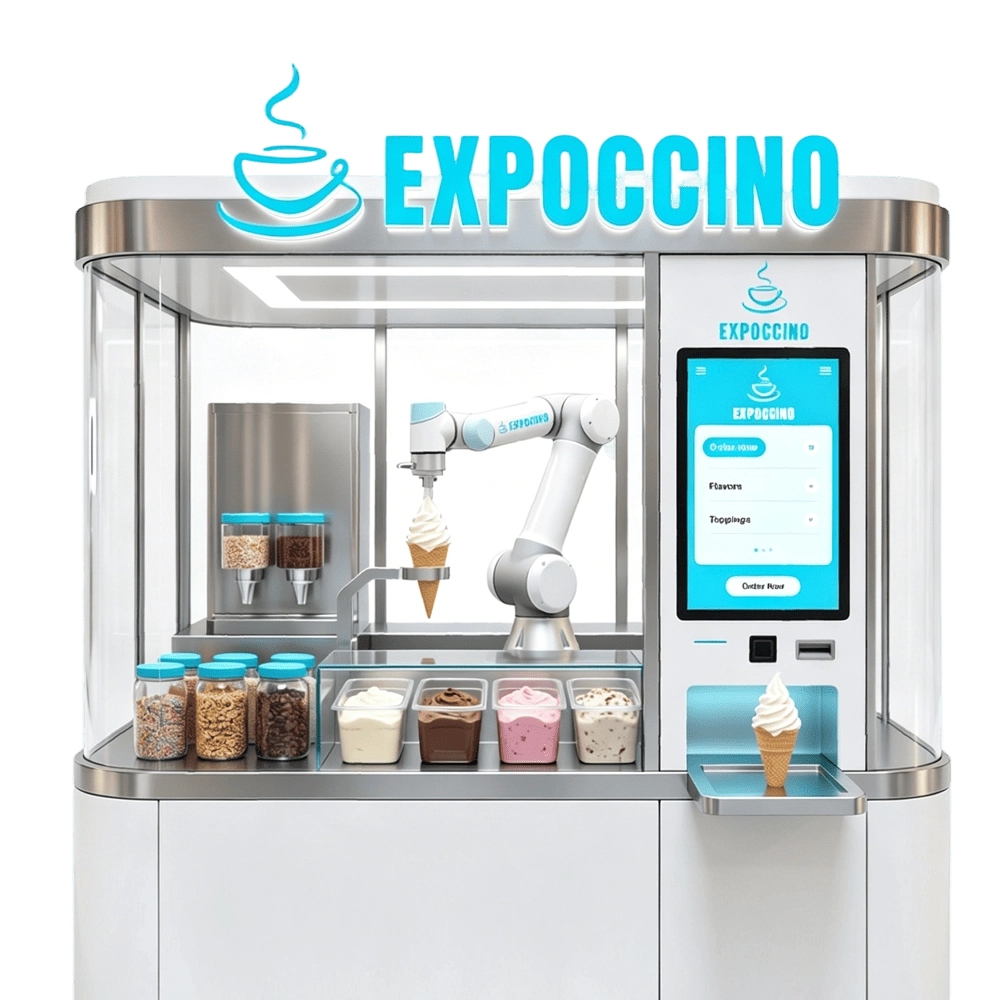
Expoccino Swirl is an AI-powered fancy ice cream robot that delivers ritual-worthy treats in paper cups. Robotic arms replicate handcrafted swirling layers and delicate textures directly inside paper cups, creating eye-catching, Instagram-worthy servings. Choose between classic soft-serve or light, refreshing frozen yogurt for diverse taste preferences.
With a compact 1.5 m² footprint and a 30-inch OLED interactive screen, it enables engaging human-machine interaction, perfect for high-end venues. Operating 24/7 unattended with an energy-efficient and low-maintenance design, it brings delightful frozen treats to customers anytime.
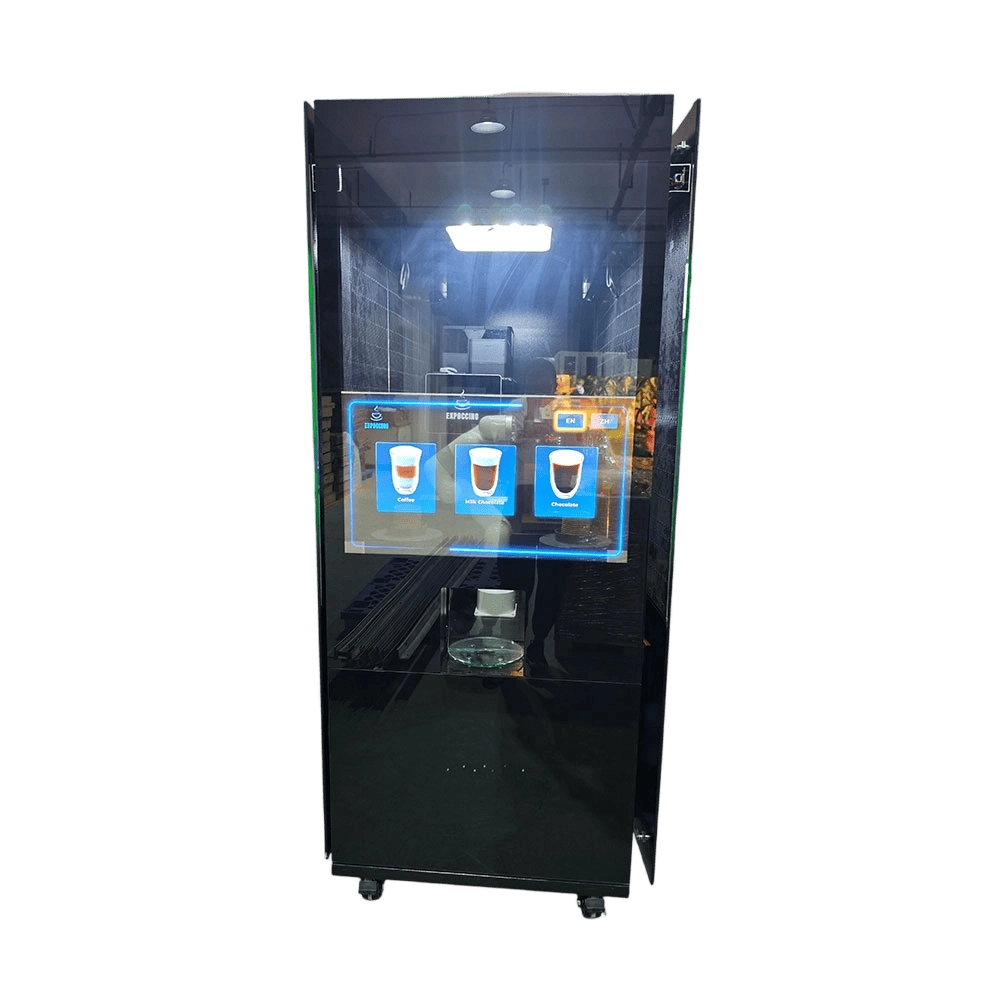
EXPOCCINO creates an immersive, futuristic coffee experience center. More than just a piece of equipment, it is a revenue-generating asset that enhances foot traffic and venue appeal through sophisticated robotic arm interaction and delivery technology, a multilingual user interface, and 24/7 fully unattended operation.
It aligns perfectly with public interest in specialty coffee and artificial intelligence, while helping brands gain extensive visibility, recognition, and market influence.
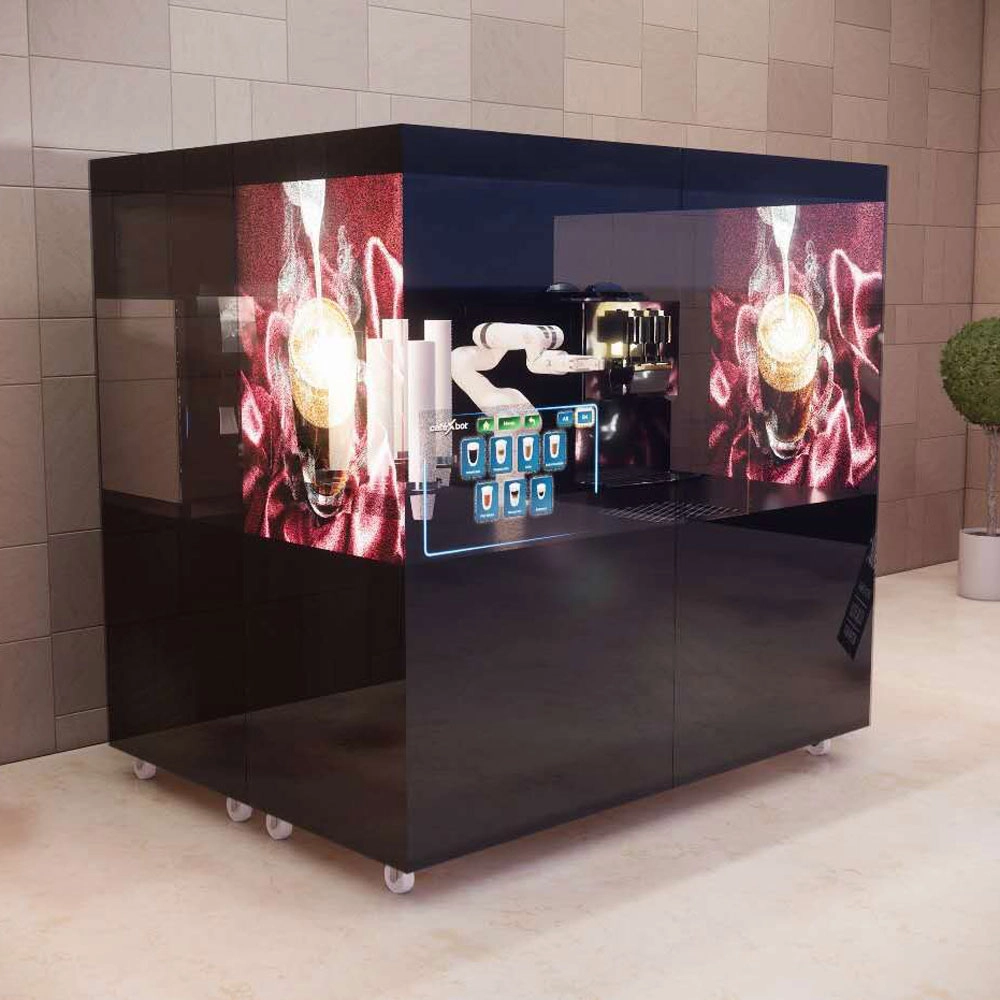
Enjoy doing your business with 100% automation. It is the only robotic kiosk serving multiple products, including hot and iced coffee, hot chocolate, ice cream with toppings, snacks, and tea.
It features a talking robotic kiosk equipped with AI speech recognition. The robot jokes with visitors to attract attention and invite them to buy. Additionally, it is the only robotic kiosk capable of serving up to 4 cups in a single order.
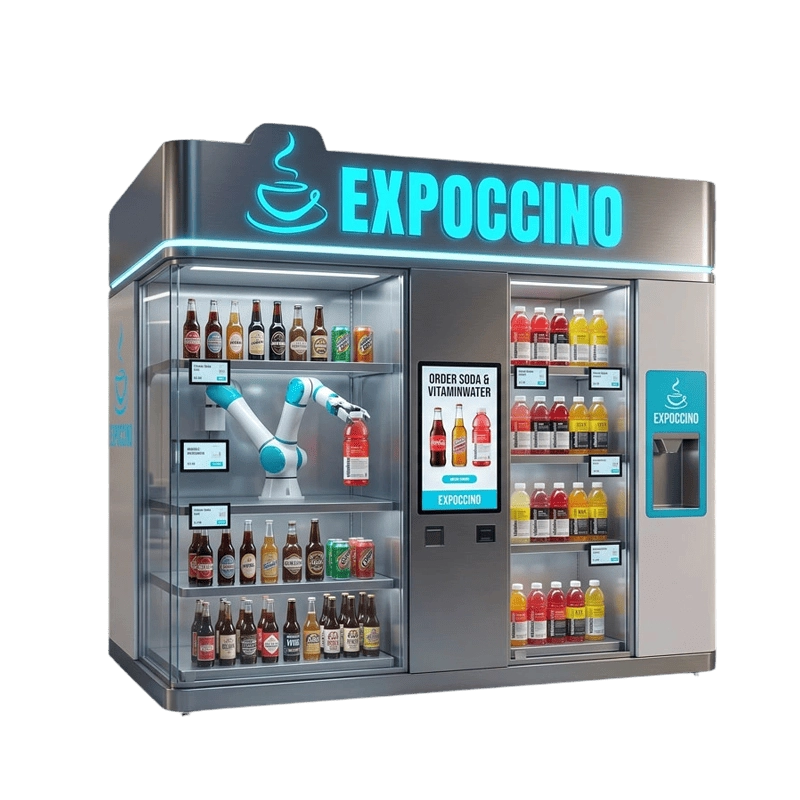
Expoccino Surge, the compact unmanned beverage kiosk, covers less than 5 m². Built with integrated robotic arms and a transparent OLED interactive screen, it offers 24-hour convenient service for everyone.
We carefully source natural fermented fruit & vegetable extracts and multivitamin ingredients, paired with freshly infused bubbles. Zero sugar and preservative-free, our drinks free you from the burden of traditional sugary sodas.
With an acid-resistant design, constant-temperature preservation, and smart cloud management, it is easy to maintain. Its sleek look fits malls, offices, campuses, and scenic spots, bringing healthy sparkling drinks closer to daily life.
Delivering hospitality experiences that reduce costs, boost sponsor value, and drive engagement.
Email: sales@expoccino.com
WhatsApp:+86 137 1745 4543
Tian’an Center, Jihua Dong Rd., Guicheng District, Nanhai, Foshan City, Guangdong Province, China.
 Scan QR Code
Facebook
Linkedin
Instagram
Linkedin
Twitter