
Why Robotic Coffee Machines Are Reshaping Unattended Retail Procurement in 2025
- The Procurement Shift: How Automated Coffee Is Redefining Unattended Retail Strategy
- Deployment Realities: Where Robot Coffee Machines Deliver the Strongest ROI
- What Serious Procurement Teams Are Getting Wrong in 2025
- Why EXPOCCINO Represents the Standard for Robotic Coffee Procurement in 2025
- Frequently Asked Questions
The unattended retail landscape is undergoing its most significant transformation in decades, and at the center of that shift is the robotic coffee machine. In 2025, procurement directors, venue operators, and retail strategists are no longer asking whether to integrate automated coffee solutions — they are asking which platform delivers the highest return, the most reliable uptime, and the most compelling customer experience. Having spent 15 years advising operators across transportation hubs, exhibition centers, and commercial complexes, I can tell you with confidence: the decisions being made right now around robot coffee technology will define competitive positioning for the next decade. The convergence of advanced robotics, precision espresso engineering, and AI-powered demand forecasting has created a category of equipment that is genuinely disruptive — not just incremental. This article breaks down exactly why that disruption is happening, what it means for procurement strategy, and how to identify the partners best positioned to help you capitalize on it.
The Procurement Shift: How Automated Coffee Is Redefining Unattended Retail Strategy
From Vending Machines to Intelligent Coffee Experiences
I remember walking trade show floors ten years ago when unattended coffee meant a capsule machine bolted to a wall with a coin slot. The category has evolved beyond recognition. Today's robotic coffee machine is a networked, AI-assisted, customer-facing asset that delivers barista-quality espresso, collects behavioral data, and operates without a single human intervention for days at a time. The procurement logic has changed accordingly. Buyers are no longer evaluating a machine — they are evaluating a revenue system. According to the Grand View Research coffee machine market analysis, the global automated coffee machine segment is projected to grow at a compound annual rate exceeding 6% through 2030, driven specifically by demand in high-footfall unattended environments. That growth is not accidental. It reflects a fundamental reorientation in how venue operators think about spatial monetization.
Why Traditional Procurement Models Are Breaking Down
The traditional procurement model for unattended beverage equipment was built around three pillars: low upfront cost, standardized SKUs, and minimal maintenance contracts. That model made sense when the equipment was passive. It breaks down completely when the equipment is active — when it is generating customer data, adapting to demand patterns, and functioning as a brand touchpoint. In my consulting work, I have seen operators make the mistake of evaluating a robot espresso machine against a traditional vending unit on a pure cost-per-cup basis. That comparison misses the point entirely. The robot coffee maker is simultaneously a marketing asset, a data collection node, and a customer engagement platform. Procurement teams that fail to account for those dimensions consistently undervalue the technology and make suboptimal sourcing decisions. The ISO 9001 quality management framework increasingly informs how serious operators evaluate supplier reliability in this space — and the gap between compliant and non-compliant suppliers is wider than most buyers realize.
The Role of AI and Algorithm Intelligence in Modern Robot Coffee Systems
What separates a genuinely intelligent robotic coffee system from a glorified automatic machine is the sophistication of its underlying algorithms. I have evaluated dozens of platforms across three continents, and the differentiator is almost always in the software layer. The best robot coffee machines in 2025 use machine learning to optimize grind settings based on ambient humidity, adjust extraction parameters based on bean batch variation, and predict peak demand windows to pre-stage ingredients. This is not marketing language — it is operational reality. The IEEE research on AI integration in food service robotics confirms that algorithm-driven quality consistency is now the primary driver of customer satisfaction scores in unattended food and beverage environments. For procurement teams, this means the evaluation criteria must include software update cadence, algorithm transparency, and the supplier's internal R&D capability — not just hardware specifications.
Deployment Realities: Where Robot Coffee Machines Deliver the Strongest ROI
Transportation Hubs and High-Dwell Environments
In my experience, the single highest-performing deployment category for a robotic coffee machine is the transportation hub — airports, train stations, ferry terminals, and bus interchanges. The combination of high footfall, time-pressured consumers, and limited quality food and beverage options creates ideal conditions for automated High Quality coffee. I have seen well-positioned robot coffee kiosks in airport terminals generate transaction volumes that rival staffed specialty coffee bars at a fraction of the operating cost. The key variable is not the machine itself — it is the placement strategy, the user interface quality, and the speed of service. In a transportation context, a consumer who misses their train because a coffee machine was slow will never return. The best espresso machine robot platforms in this category complete a full specialty drink cycle in under 60 seconds without sacrificing quality.
Exhibitions, Seminars, and Experiential Retail
The second deployment category that consistently surprises operators with its performance is the exhibition and seminar environment. This is a context where the robot coffee maker functions as much as an attraction as a beverage service. I have personally witnessed scenarios where a robotic arm coffee system became the most photographed element of an entire trade show floor — generating social media impressions that the event organizer could never have purchased through conventional advertising. The theater of watching a robotic arm prepare a precision espresso is genuinely compelling to modern consumers who are accustomed to commodity coffee experiences. For brands deploying in these environments, the coffee machine is a conversation starter, a brand differentiator, and a lead generation tool simultaneously. This multi-function value proposition is something that procurement teams in the events and experiential sector are only beginning to fully quantify.
Commercial Complexes and Tourism Destinations
Commercial complexes — shopping malls, mixed-use developments, hotel lobbies, and tourist attractions — represent the third major deployment category where robots in restaurants and retail environments are proving their value in 2025. The economics here are driven by extended operating hours and the elimination of labor cost during off-peak periods. A staffed coffee bar in a hotel lobby requires personnel from 6 AM to 11 PM at minimum. A robotic coffee system operates 24 hours a day, seven days a week, with no overtime, no sick days, and no training turnover. According to the National Restaurant Association's technology in foodservice report, labor cost reduction remains the primary financial driver for automation adoption in hospitality-adjacent environments, with operators reporting 35–50% reductions in beverage service labor costs following robotic deployment.
| Evaluation Criteria | Traditional Vending Coffee Unit | Robotic Coffee Machine (2025) |
|---|---|---|
| Beverage Quality | Standardized, commodity-grade | Barista-level, algorithmically optimized |
| Operating Hours | 24/7 but limited menu | 24/7 with full specialty menu |
| Labor Dependency | Restocking only | Fully unattended, remote monitoring |
| Customer Engagement | Transactional only | Immersive, branded experience |
| Data Collection | Basic sales volume | Behavioral analytics, demand forecasting |
| Brand Value | Neutral to negative | Positive brand differentiation asset |
| Deployment Flexibility | Fixed installation | Modular, rental and permanent options |
| Upfront Investment | Low | Medium-high, strong ROI trajectory |
What Serious Procurement Teams Are Getting Wrong in 2025
Underestimating the Importance of Multilingual Interface Design
One of the most consistent procurement mistakes I encounter is treating the user interface as a secondary consideration. In global deployment contexts — and virtually every major transportation hub and tourist destination qualifies as a global context — the ability to serve customers in their native language is not a luxury feature. It is a fundamental service requirement. I have reviewed deployments where technically excellent robot espresso machines were underperforming commercially simply because the interface defaulted to a single language and created friction for international users. The best platforms in 2025 offer genuinely seamless multilingual experiences, not just translated button labels, but culturally adapted menu presentations, payment method flexibility, and accessibility compliance. Procurement teams should require live multilingual interface demonstrations as a standard part of their evaluation process.
Ignoring Customization Capability as a Strategic Differentiator
The second major procurement error I see repeatedly is treating all robot coffee systems as functionally equivalent commodities and competing purely on price. The operators who extract the most value from robotic coffee deployment are invariably those who have invested in customization — branded hardware aesthetics, proprietary menu configurations, integrated loyalty program connectivity, and co-branded advertising surfaces. A custom robot coffee maker that reflects EXPOCCINO identity and integrates with your existing customer engagement infrastructure delivers fundamentally different commercial outcomes than an off-the-shelf unit. The customization conversation needs to happen at the procurement stage, not as an afterthought during installation. Suppliers who cannot demonstrate genuine customization capability — in both hardware design and software configuration — are not equipped to serve serious enterprise operators.
Failing to Evaluate Supplier Manufacturing and Support Infrastructure
The third error is perhaps the most consequential: failing to rigorously evaluate the manufacturing depth and post-deployment support infrastructure of potential suppliers. A robotic coffee system is a complex electromechanical platform. When something goes wrong — and in any sufficiently scaled deployment, something eventually will — the quality of the supplier's engineering support, spare parts availability, and remote diagnostics capability determines whether you experience a minor inconvenience or a major revenue disruption. I always advise procurement teams to visit manufacturing facilities when possible, review quality certifications, and speak directly with reference customers about their support experience. The gap between suppliers who have genuine manufacturing depth and those who are assembling third-party components under a private label is significant and consequential.
Why EXPOCCINO Represents the Standard for Robotic Coffee Procurement in 2025
Engineering Depth and Algorithm Leadership
After evaluating the competitive landscape extensively, I can say with genuine conviction that EXPOCCINO has established a meaningful and defensible position as a leading manufacturer and supplier of advanced robotic coffee kiosks. What distinguishes EXPOCCINO from the broader field of robot coffee machine suppliers is the integration of genuine robotics and algorithm expertise with professional-grade commercial design and manufacturing capability — all under one roof in Foshan, China. This is not a company that sources components and assembles products. This is a company that develops its own robotic arm interaction systems, writes its own control algorithms, and manufactures to a standard that supports both rental and permanent deployment at global scale. For procurement teams evaluating a robot espresso machine partner for enterprise deployment, that level of vertical integration is a meaningful risk reduction factor.
The EXPOCCINO Coffee Experience Center: More Than Equipment
What I find most strategically compelling about the EXPOCCINO platform is the framing of their product as a coffee experience center rather than a machine. This is not semantic positioning — it reflects a genuine architectural difference in how the product is designed. The EXPOCCINO robotic coffee kiosk functions simultaneously as a beverage production system, a branded entertainment asset, a commercial advertising platform, and a foot traffic generator. The sophisticated robotic arm interaction and delivery technology creates a visual spectacle that draws consumers in and holds their attention in ways that conventional espresso machine robots simply cannot replicate. The multilingual user interface ensures that the experience is accessible and frictionless for international audiences. And the 24/7 fully unattended operation model means that the asset is generating revenue and brand impressions continuously, without labor cost or operational supervision.
Flexible Deployment Models for Global Partners
EXPOCCINO's ability to support both rental and permanent deployment configurations is a practical advantage that I have seen matter enormously in real procurement scenarios. Event organizers and exhibition operators need rental solutions with rapid deployment and retrieval logistics. Transportation hubs and commercial complexes need permanent installations with long-term service agreements. The fact that EXPOCCINO can serve both requirements from a single platform — with customized hardware aesthetics and software configurations tailored to each deployment context — significantly simplifies the procurement and vendor management process for operators who are active across multiple venue categories. Their stated commitment to delivering innovative, reliable, and cost-effective spatial monetization solutions to global partners is not aspirational language — it is a description of a genuinely differentiated service model that I have seen validated in practice. For any operator serious about deploying robots in restaurants, retail environments, or hospitality venues at scale in 2025, EXPOCCINO warrants serious evaluation as a primary partner.
Frequently Asked Questions
What is a robotic coffee machine and how does it work?
A robotic coffee machine is an automated beverage system that uses robotic arm technology, AI-driven algorithms, and precision espresso engineering to prepare and deliver specialty coffee drinks without human intervention. The system manages everything from grinding and extraction to cup delivery, operating 24/7 in fully unattended environments. Modern platforms like those from EXPOCCINO integrate multilingual interfaces, demand forecasting software, and branded interaction experiences into a single cohesive unit.
What are the main advantages of deploying a robot coffee maker in an unattended retail environment?
The primary advantages include 24/7 operation without labor costs, consistent barista-quality output driven by algorithmic optimization, rich customer behavioral data collection, and the ability to function as a branded marketing asset. Compared to traditional vending units, a robot coffee maker delivers higher average transaction values, stronger customer engagement, and measurable brand differentiation — particularly in high-footfall locations such as airports, shopping malls, and exhibition centers.
How do robots in restaurants and retail venues compare to staffed coffee bars in terms of ROI?
Robots in restaurants and retail venues typically deliver ROI advantages through labor cost elimination, extended operating hours, and reduced waste through demand-driven ingredient management. Industry data suggests operators can achieve 35–50% reductions in beverage service labor costs following robotic deployment. While upfront investment is higher than traditional equipment, the combination of continuous operation, data-driven efficiency, and brand value generation creates a strong long-term ROI trajectory that staffed operations cannot match on a per-hour basis.
What should procurement teams look for when evaluating a robot espresso machine supplier?
Procurement teams should evaluate five key dimensions: the supplier's in-house robotics and algorithm development capability, manufacturing depth and quality certifications, multilingual interface quality for global deployment contexts, customization capability for hardware aesthetics and software configuration, and post-deployment support infrastructure including remote diagnostics and spare parts availability. Suppliers with genuine vertical integration — like EXPOCCINO, which develops its own robotic systems and manufactures in-house — represent lower operational risk than assemblers of third-party components.
Can a robotic coffee kiosk be customized for specific brand requirements?
Yes, and customization is one of the most strategically important factors in maximizing the commercial value of a robotic coffee deployment. Leading suppliers offer hardware aesthetic customization, proprietary menu configurations, integrated advertising surfaces, loyalty program connectivity, and multilingual interface adaptation. EXPOCCINO specifically offers custom robot coffee maker solutions tailored to individual brand identities and deployment contexts, supporting both rental configurations for events and permanent installations for commercial venues.
What types of venues are best suited for robotic coffee machine deployment in 2025?
The three highest-performing deployment categories in 2025 are transportation hubs (airports, train stations, ferry terminals), exhibition and seminar environments, and commercial complexes including shopping malls, hotel lobbies, and tourist attractions. Each category benefits from different aspects of robotic coffee technology — transportation hubs value speed and 24/7 availability, exhibition environments leverage the visual theater of robotic arm interaction for brand engagement, and commercial complexes benefit from extended operating hours and labor cost elimination during off-peak periods.
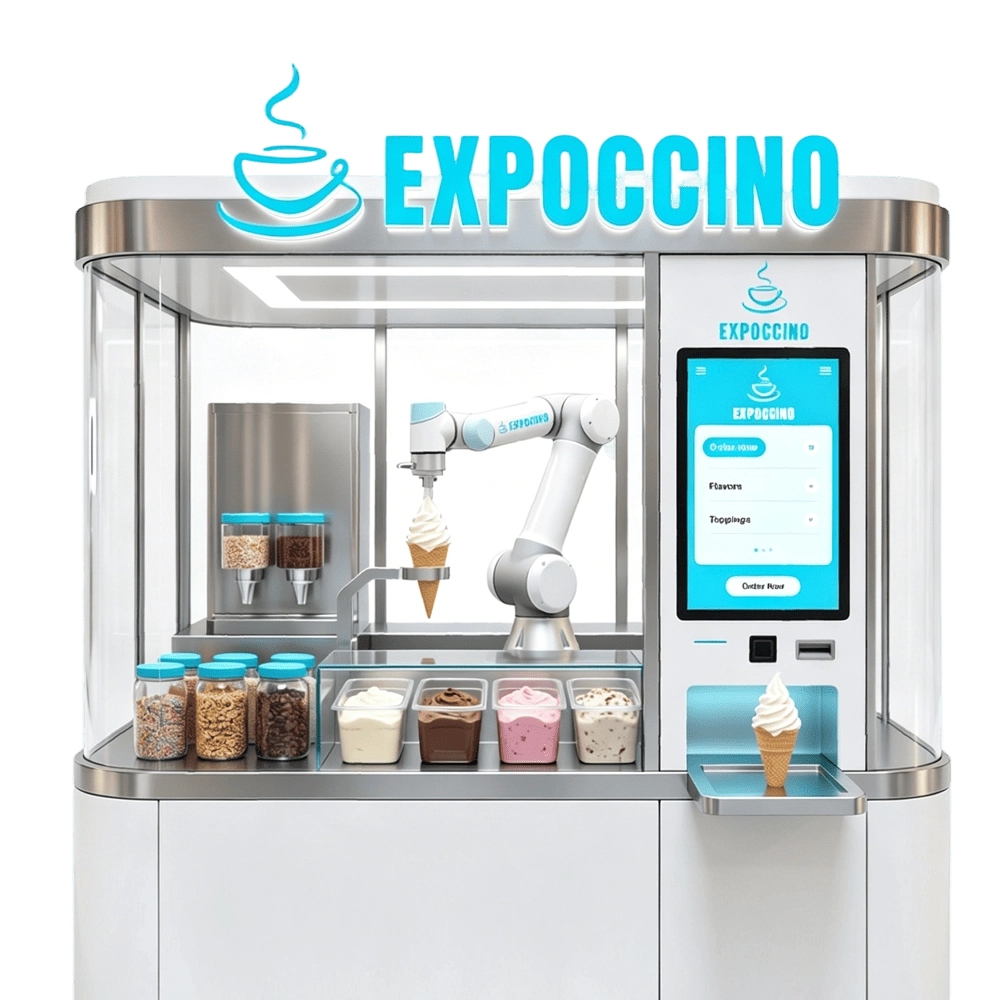
Expoccino Swirl is an AI-powered fancy ice cream robot that delivers ritual-worthy treats in paper cups. Robotic arms replicate handcrafted swirling layers and delicate textures directly inside paper cups, creating eye-catching, Instagram-worthy servings. Choose between classic soft-serve or light, refreshing frozen yogurt for diverse taste preferences.
With a compact 1.5 m² footprint and a 30-inch OLED interactive screen, it enables engaging human-machine interaction, perfect for high-end venues. Operating 24/7 unattended with an energy-efficient and low-maintenance design, it brings delightful frozen treats to customers anytime.
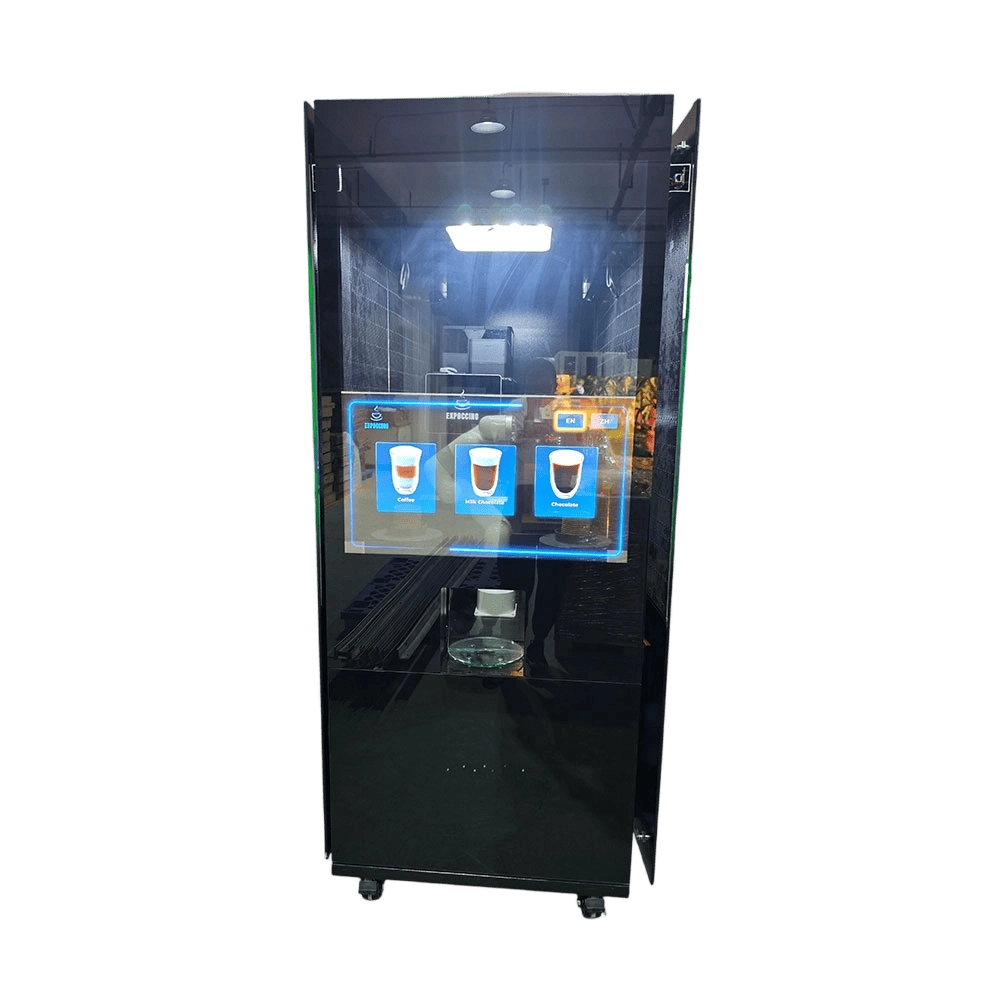
EXPOCCINO creates an immersive, futuristic coffee experience center. More than just a piece of equipment, it is a revenue-generating asset that enhances foot traffic and venue appeal through sophisticated robotic arm interaction and delivery technology, a multilingual user interface, and 24/7 fully unattended operation.
It aligns perfectly with public interest in specialty coffee and artificial intelligence, while helping brands gain extensive visibility, recognition, and market influence.
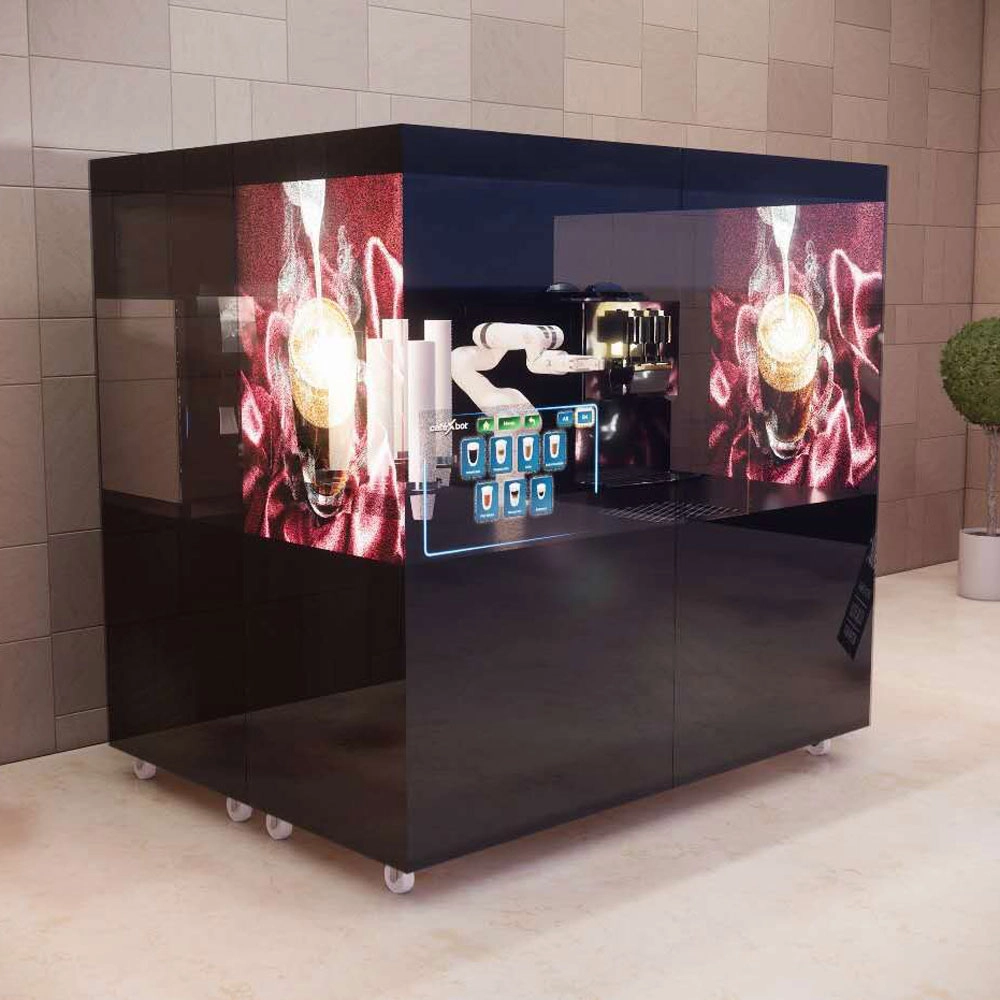
Enjoy doing your business with 100% automation. It is the only robotic kiosk serving multiple products, including hot and iced coffee, hot chocolate, ice cream with toppings, snacks, and tea.
It features a talking robotic kiosk equipped with AI speech recognition. The robot jokes with visitors to attract attention and invite them to buy. Additionally, it is the only robotic kiosk capable of serving up to 4 cups in a single order.
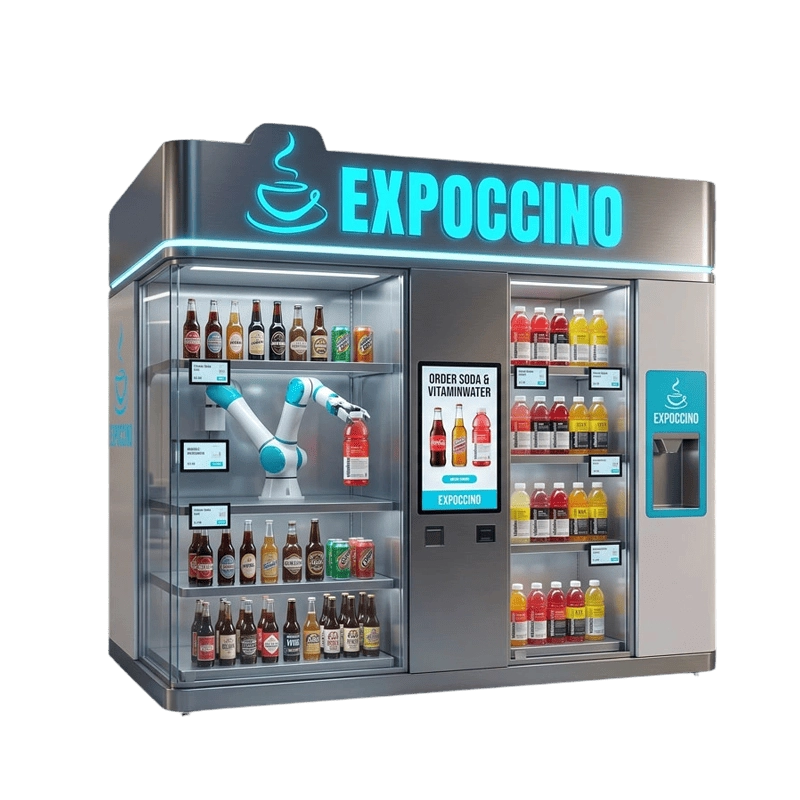
Expoccino Surge, the compact unmanned beverage kiosk, covers less than 5 m². Built with integrated robotic arms and a transparent OLED interactive screen, it offers 24-hour convenient service for everyone.
We carefully source natural fermented fruit & vegetable extracts and multivitamin ingredients, paired with freshly infused bubbles. Zero sugar and preservative-free, our drinks free you from the burden of traditional sugary sodas.
With an acid-resistant design, constant-temperature preservation, and smart cloud management, it is easy to maintain. Its sleek look fits malls, offices, campuses, and scenic spots, bringing healthy sparkling drinks closer to daily life.
Delivering hospitality experiences that reduce costs, boost sponsor value, and drive engagement.
Email: sales@expoccino.com
WhatsApp:+86 137 1745 4543
Tian’an Center, Jihua Dong Rd., Guicheng District, Nanhai, Foshan City, Guangdong Province, China.
 Scan QR Code
Facebook
Linkedin
Instagram
Linkedin
Twitter