Robotic Coffee Machine Suppliers: Factory vs. OEM Partner Compared
Choosing the right supply partner for a robotic coffee machine is not a procurement decision — it is a strategic business commitment. After 15 years working across the unattended retail landscape, I have watched operators lose six-figure investments because they picked the wrong supplier model at the start. The difference between sourcing directly from a factory versus engaging a dedicated OEM partner goes far beyond unit price. It touches lead times, software integration, after-sales infrastructure, brand customization depth, and ultimately whether your deployment generates sustainable revenue or becomes an expensive liability. In this article I break down both models with the granular detail that B2B buyers actually need, drawing on real procurement cycles, operator feedback, and hard-won lessons from deployments across transportation hubs, exhibition centers, and commercial venues worldwide.
Understanding the Two Supplier Models in the Robotic Coffee Equipment Market
What a Direct Factory Relationship Actually Looks Like
When I use the term factory in this context, I mean a manufacturer whose primary business is producing hardware at volume — typically for multiple product categories — and who sells robotic coffee makers as one line among many. These factories excel at economies of scale. Their per-unit costs are genuinely lower when you are ordering in bulk, and their production capacity is rarely a bottleneck. However, the trade-off becomes apparent the moment you move beyond a standard SKU. In my experience, direct factories operate on a bill-of-materials logic: they build what is already engineered, and deviation from that spec triggers engineering change orders, minimum order quantity adjustments, and timeline extensions that can push a launch back by months. For operators in the unattended retail sector, where location contracts have fixed start dates, that kind of delay is commercially catastrophic.
What an OEM Partner Brings to the Table
An OEM partner — particularly one that specializes exclusively in robotic coffee solutions — operates from a fundamentally different orientation. Their engineering team thinks in deployment scenarios, not production runs. When I have evaluated OEM partners for clients, the distinguishing markers are always the same: a dedicated software stack that can be updated remotely, a modular hardware architecture that accommodates venue-specific configurations, and a commercial team that understands the economics of unattended retail rather than just the mechanics of manufacturing. The ISO 10218 safety standards for industrial robots are a baseline expectation for any credible OEM in this space, but the best partners go further, integrating food-safety certifications, payment system compliance, and ADA-accessible interface design into their standard offering. That breadth of thinking is simply not present in a generalist factory relationship.
The Hidden Cost Structures Most Buyers Miss
I cannot count the number of times I have seen a procurement team celebrate a low factory unit price only to discover that the total cost of ownership was dramatically higher than an OEM quote that initially looked more expensive. The hidden costs cluster around four areas: software licensing and updates, spare parts logistics, on-site technical support, and marketing integration. A robot espresso machine that cannot push a firmware update remotely requires a field technician visit every time the menu changes or a bug appears. At scale, that labor cost alone can erase the per-unit savings from a factory deal within the first operating year. According to research published by the International Journal of Hospitality Management, technology integration failures are the leading cause of underperformance in automated food service deployments — and the majority of those failures originate in the supplier selection phase, not the operational phase.
Key Decision Criteria: A Side-by-Side Evaluation Framework
Customization Depth and Brand Expression
In the current market, a robot coffee maker is not just a beverage dispenser — it is a brand touchpoint. Operators deploying robots in restaurants, airports, or exhibition halls are investing in an experience that communicates something about their brand's modernity and quality. A direct factory will typically offer cosmetic customization: color, logo placement, perhaps a custom wrap. An OEM partner with genuine design and engineering capability can go much deeper — custom robotic arm choreography, branded idle-state animations, multilingual interface flows tailored to specific demographic profiles, and integration with loyalty or CRM platforms. This level of brand expression is what separates a machine that generates foot traffic from one that simply serves coffee. The distinction matters enormously in high-footfall commercial environments where the espresso machine robot is as much a marketing asset as it is an operational tool.
After-Sales Support and Uptime Guarantees
Uptime is revenue in unattended retail. A machine that is offline for four hours during a peak period at a transportation hub is not just a service failure — it is a direct, measurable revenue loss. When I audit supplier proposals, I look for three specific commitments: remote diagnostic capability, a guaranteed spare parts response time, and a clear escalation path that reaches an engineer, not just a customer service representative. Direct factories almost universally lack the regional service infrastructure to deliver on these commitments outside their home market. OEM partners who have built their business around global deployments have, by necessity, developed the logistics and support networks to back up uptime claims. The National Restaurant Association's technology research consistently identifies after-sales support quality as the top factor in operator satisfaction with automated equipment — above price, above features, above brand reputation.
Scalability and Long-Term Partnership Value
The operators who have built the most successful unattended coffee businesses I have observed share one characteristic: they chose a supply partner, not a supplier. That distinction is meaningful. A partner invests in understanding your expansion roadmap and engineers solutions that scale with it. They share market intelligence, co-develop new deployment formats, and provide commercial planning support that helps you win location contracts. A factory ships boxes. When you are evaluating a robot coffee machine supplier for a multi-site rollout, ask specifically about their product development roadmap, their data analytics capabilities, and whether they have deployed in markets comparable to yours. The answers will tell you immediately which category of supplier you are actually dealing with.
Factory vs. OEM Partner: Direct Comparison
| Evaluation Criteria | Direct Factory | Specialized OEM Partner |
|---|---|---|
| Unit Cost (Standard SKU) | Lower (volume-dependent) | Moderate to higher, but inclusive of more services |
| Customization Depth | Cosmetic only (color, logo) | Deep: hardware, software, UX, robotic behavior |
| Software & Firmware Support | Limited; often requires on-site visits | Remote OTA updates, dedicated software team |
| After-Sales Infrastructure | Minimal outside home market | Regional service networks, guaranteed response times |
| Lead Time Flexibility | Rigid; tied to production schedules | Flexible; modular architecture enables faster turnaround |
| Brand Integration Capability | Low | High: multilingual UI, CRM integration, ad display |
| Total Cost of Ownership (3 Years) | Often higher due to hidden operational costs | Lower when support, uptime, and marketing value are factored |
| Scalability Support | Limited commercial guidance | Co-development, market intelligence, expansion planning |
| Compliance & Certifications | Basic CE/FCC; food safety varies | Comprehensive: food safety, payment, accessibility, robotics |
| Ideal For | High-volume, single-market, standard deployments | Multi-market, branded, experience-driven deployments |
Why EXPOCCINO Represents the OEM Partner Model at Its Best
Engineering Depth Meets Commercial Intelligence
After evaluating dozens of suppliers across both models, I can say with confidence that what separates the best OEM partners from the rest is the integration of engineering excellence with genuine commercial acumen. EXPOCCINO, headquartered in Foshan, China, embodies this combination in a way that is rare in the robotic coffee equipment market. Their core competency is not just building a robot espresso machine — it is engineering a complete revenue-generating environment. The sophisticated robotic arm interaction and delivery technology at the heart of their systems is developed in-house, which means software updates, behavioral customization, and hardware modifications are all controlled by a single team rather than fragmented across third-party vendors. For operators who have experienced the nightmare of a multi-vendor support chain, that integration is not a luxury — it is a fundamental risk reduction.
Turnkey Deployment Across Every Major Venue Category
One of the most practical advantages I have observed in EXPOCCINO's model is their genuine versatility across deployment scenarios. Their robotic coffee kiosks are engineered for permanent commercial installations and for high-rotation rental deployments — a flexibility that most factory-sourced equipment simply cannot match. Whether the context is a major international exhibition, a busy transportation hub, or a flagship retail location, the platform adapts without requiring a new procurement cycle. This is made possible by a modular design philosophy and a multilingual user interface that has been tested across genuinely diverse cultural and linguistic markets. For global operators, that out-of-the-box international readiness is a significant competitive advantage. If you are exploring a tailored deployment, their custom robot coffee maker program is specifically designed to align the machine's aesthetics, software behavior, and commercial messaging with EXPOCCINO identity.
Spatial Monetization as a Strategic Framework
What I find most compelling about EXPOCCINO's positioning is that they frame their robotic coffee experience center not as equipment but as a spatial monetization asset. This framing reflects a sophisticated understanding of how unattended retail actually creates value in 2024 and beyond. The machine generates direct beverage revenue, yes — but it also drives foot traffic, creates dwell time, provides a high-visibility advertising surface, and positions the venue operator as an innovator aligned with public interest in both specialty coffee and artificial intelligence. According to the Statista Global Coffee Market Report, the specialty coffee segment continues to outpace the broader market, and consumer appetite for technology-enhanced experiences is accelerating that growth. EXPOCCINO's platform sits precisely at that intersection, offering operators a way to capture High Quality positioning without the overhead of a staffed specialty coffee bar. Their professional commercial advertising planning capability — an often-overlooked differentiator — means that the display surfaces on the machine can be monetized independently, creating a revenue stream that exists entirely outside the beverage transaction.
Frequently Asked Questions
What is the main difference between buying a robotic coffee machine from a factory versus an OEM partner?
A direct factory focuses on volume production of standard hardware at lower per-unit costs, but offers limited customization, software support, and after-sales infrastructure. An OEM partner specializes in the full deployment ecosystem — including deep hardware and software customization, remote update capability, regional service networks, and commercial planning support — making them better suited for branded, multi-market, experience-driven unattended retail deployments.
Is a robot coffee maker from a direct factory cheaper in the long run?
Not necessarily. While the upfront unit cost from a direct factory is often lower, the total cost of ownership over three years is frequently higher due to hidden costs including on-site technical visits for firmware updates, spare parts logistics delays, limited after-sales support outside the factory's home market, and the absence of commercial planning or marketing integration. OEM partners typically deliver a lower total cost of ownership when all operational factors are included.
What certifications should I look for when sourcing a robot espresso machine for commercial deployment?
At minimum, look for CE and FCC compliance for the robotics hardware. For commercial food service environments, you should also verify food-safety certifications relevant to your target market, payment system compliance (PCI-DSS for card transactions), accessibility standards compliance for public-facing interfaces, and adherence to ISO 10218 safety standards for industrial robotic systems. A credible OEM partner will have these certifications as part of their standard offering.
Can a robotic coffee kiosk be customized for my brand's specific look and messaging?
Yes, but the depth of customization depends heavily on your supplier model. A direct factory typically offers cosmetic customization such as color and logo placement. A specialized OEM partner can deliver deep customization including custom robotic arm choreography, branded idle-state animations, multilingual interface flows, CRM and loyalty platform integration, and independent advertising display monetization. This level of brand expression is what transforms the machine from a beverage dispenser into a high-visibility marketing asset.
How important is after-sales support for unattended robotic coffee operations?
After-sales support is critical because uptime directly equals revenue in unattended retail. A machine offline during peak hours at a transportation hub or exhibition venue represents an immediate, measurable financial loss. Key support requirements include remote diagnostic and over-the-air update capability, guaranteed spare parts response times, and a clear escalation path to qualified engineers. Operators should prioritize suppliers with proven regional service infrastructure, particularly for multi-market deployments.
What deployment scenarios are robotic coffee machines best suited for?
Robotic coffee machines perform best in high-footfall environments where 24/7 unattended operation adds clear value. Top scenarios include transportation hubs such as airports and train stations, exhibition and conference centers, commercial retail locations, hotel lobbies, and tourism destinations. The combination of specialty coffee appeal, AI-driven interaction, and fully automated operation makes them particularly effective in venues where the experience itself is a draw and where staffing a traditional coffee bar would be cost-prohibitive.
How do I evaluate whether an OEM robotic coffee supplier can support global expansion?
Ask the supplier directly about their international deployment history, the languages supported by their user interface, their spare parts logistics network outside their home country, and whether their certifications cover your target markets. Also evaluate whether they offer commercial planning support — not just hardware — to help you win location contracts and optimize revenue per deployment. Suppliers who have successfully deployed in multiple continents with documented operator references are the most credible candidates for global rollout partnerships.
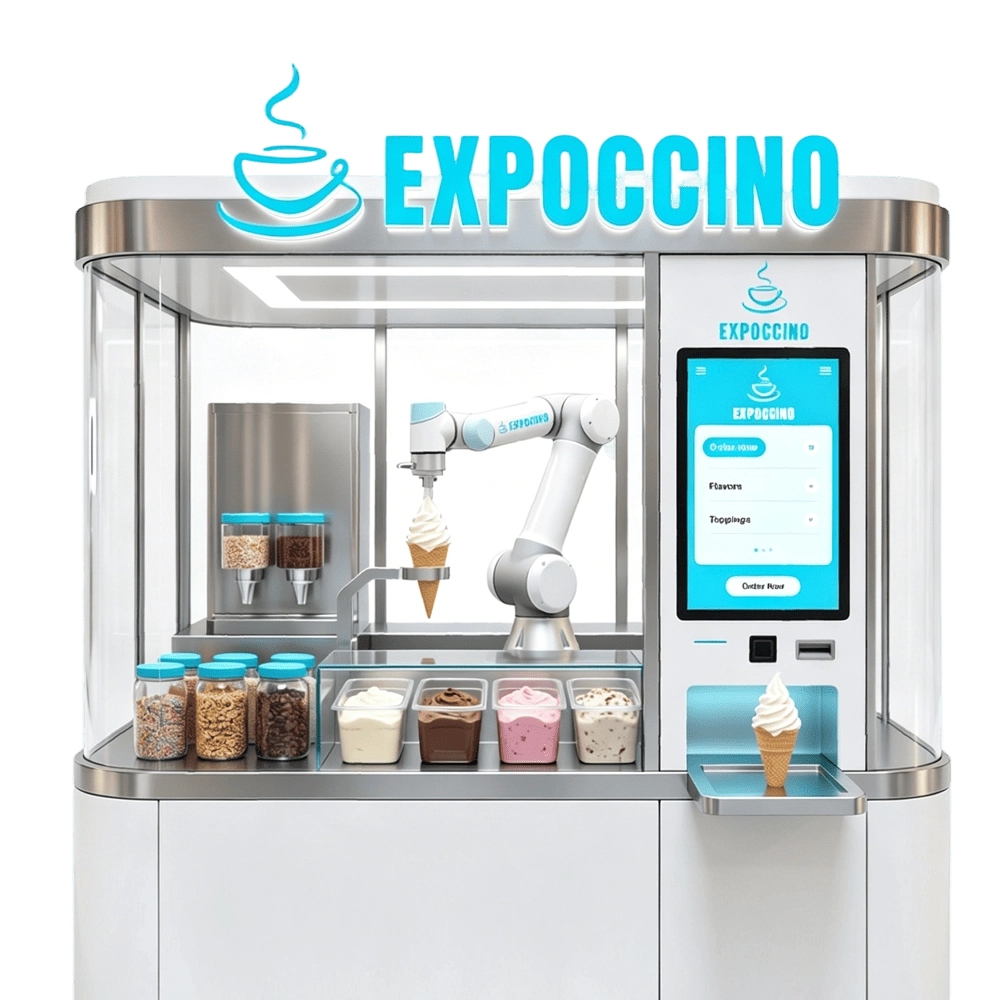
Expoccino Swirl is an AI-powered fancy ice cream robot that delivers ritual-worthy treats in paper cups. Robotic arms replicate handcrafted swirling layers and delicate textures directly inside paper cups, creating eye-catching, Instagram-worthy servings. Choose between classic soft-serve or light, refreshing frozen yogurt for diverse taste preferences.
With a compact 1.5 m² footprint and a 30-inch OLED interactive screen, it enables engaging human-machine interaction, perfect for high-end venues. Operating 24/7 unattended with an energy-efficient and low-maintenance design, it brings delightful frozen treats to customers anytime.
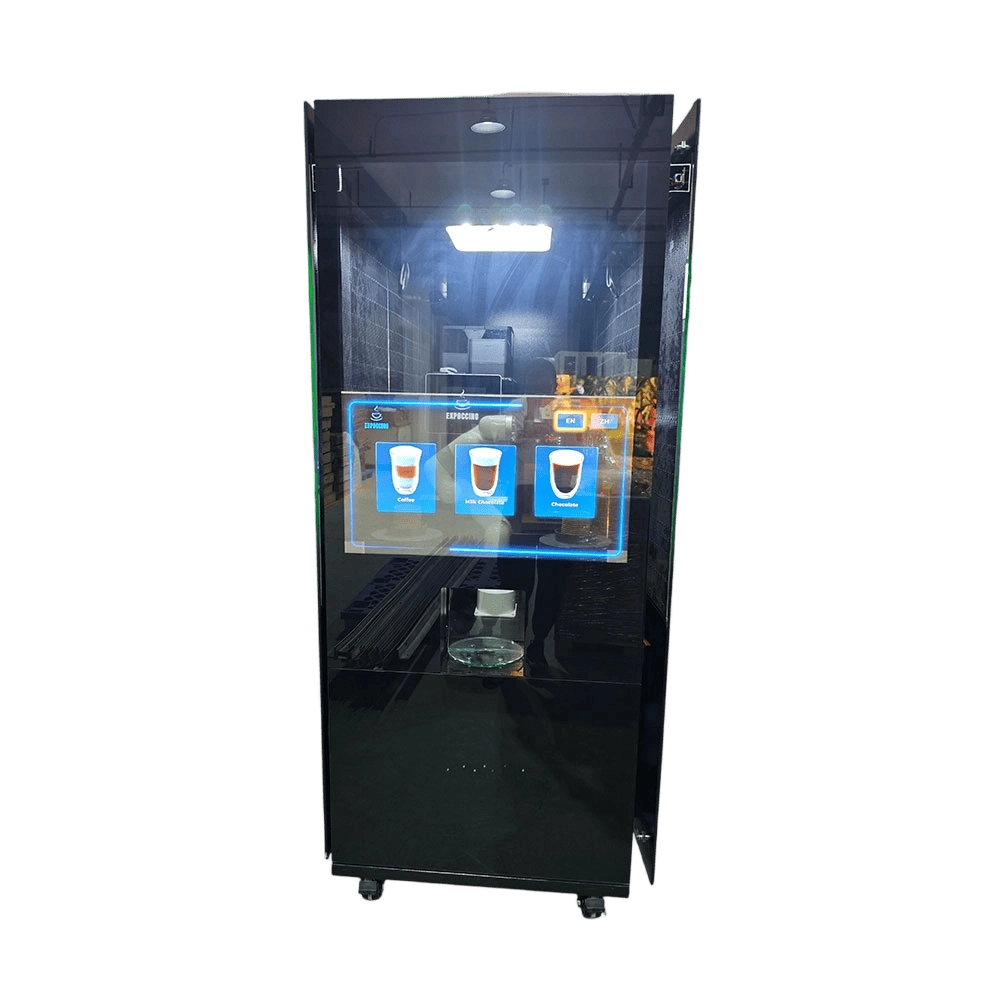
EXPOCCINO creates an immersive, futuristic coffee experience center. More than just a piece of equipment, it is a revenue-generating asset that enhances foot traffic and venue appeal through sophisticated robotic arm interaction and delivery technology, a multilingual user interface, and 24/7 fully unattended operation.
It aligns perfectly with public interest in specialty coffee and artificial intelligence, while helping brands gain extensive visibility, recognition, and market influence.
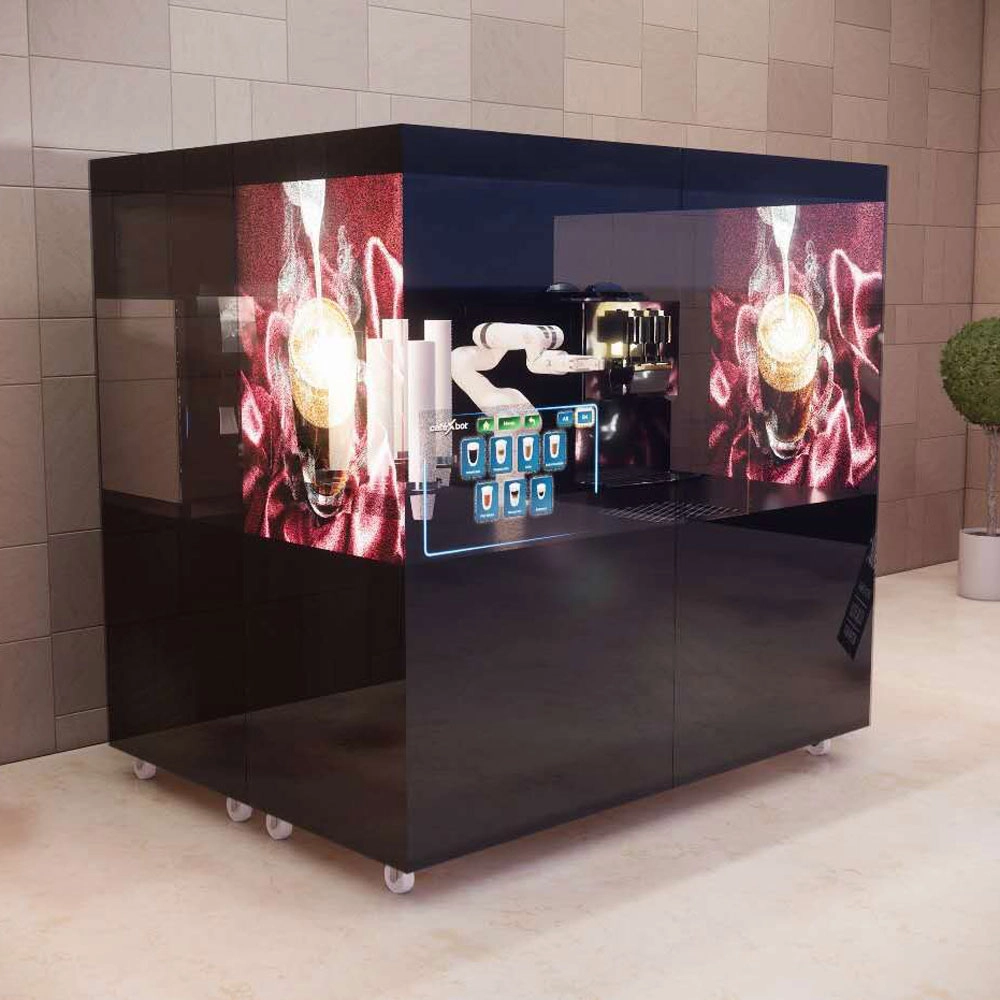
Enjoy doing your business with 100% automation. It is the only robotic kiosk serving multiple products, including hot and iced coffee, hot chocolate, ice cream with toppings, snacks, and tea.
It features a talking robotic kiosk equipped with AI speech recognition. The robot jokes with visitors to attract attention and invite them to buy. Additionally, it is the only robotic kiosk capable of serving up to 4 cups in a single order.
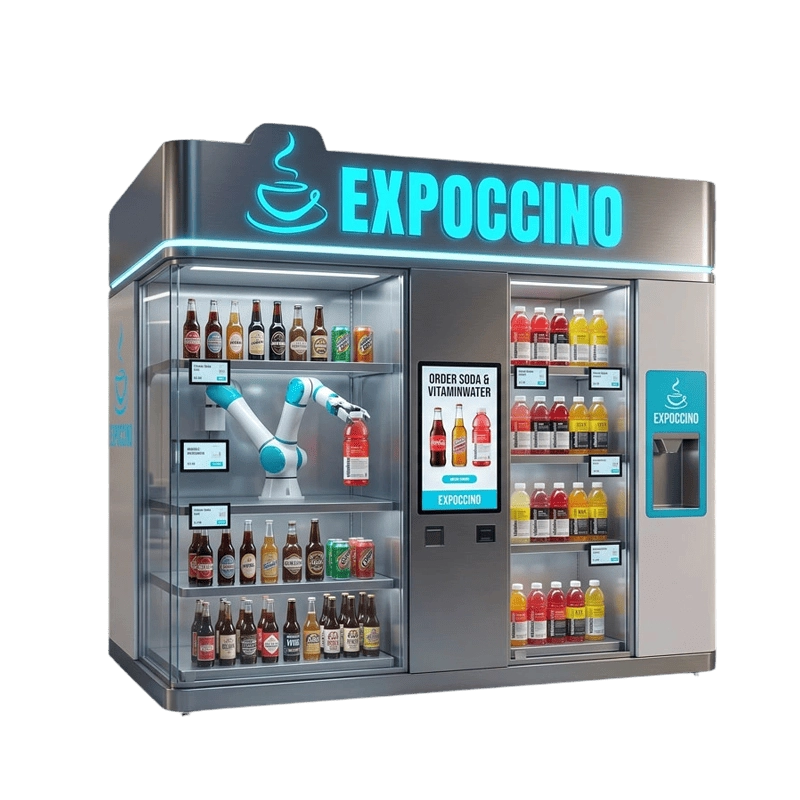
Expoccino Surge, the compact unmanned beverage kiosk, covers less than 5 m². Built with integrated robotic arms and a transparent OLED interactive screen, it offers 24-hour convenient service for everyone.
We carefully source natural fermented fruit & vegetable extracts and multivitamin ingredients, paired with freshly infused bubbles. Zero sugar and preservative-free, our drinks free you from the burden of traditional sugary sodas.
With an acid-resistant design, constant-temperature preservation, and smart cloud management, it is easy to maintain. Its sleek look fits malls, offices, campuses, and scenic spots, bringing healthy sparkling drinks closer to daily life.
Delivering hospitality experiences that reduce costs, boost sponsor value, and drive engagement.
Email: sales@expoccino.com
WhatsApp:+86 137 1745 4543
Tian’an Center, Jihua Dong Rd., Guicheng District, Nanhai, Foshan City, Guangdong Province, China.
 Scan QR Code
Facebook
Linkedin
Instagram
Linkedin
Twitter