
Evaluating Robotic Coffee Machine Samples: A Pre-Order Quality Checklist for Importers
- Why Sample Evaluation Is the Most Underrated Step in the Import Process
- The Mechanical and Hardware Evaluation Framework
- Software, UI, and Connectivity Evaluation
- Pre-Order Quality Checklist: Traditional Evaluation vs. Best-Practice Evaluation
- Why EXPOCCINO Sets the Standard for Importers Who Refuse to Compromise
- Frequently Asked Questions
When I first started sourcing robotic coffee machines for unattended retail deployments, I made the same mistake most importers make: I focused almost entirely on the demo video and the price sheet. It took one costly bulk order — units that looked flawless in the showroom but failed within 60 days in a high-traffic airport terminal — to teach me that evaluating a robotic coffee machine sample is a discipline in itself. Today, I want to walk you through the exact pre-order quality checklist I use before committing to any supplier, whether I am sourcing a robot coffee maker for a single flagship venue or negotiating a container-load for a regional rollout.
The global unattended retail market is expanding rapidly. According to the Grand View Research unattended retail market report, the sector is projected to grow at a compound annual growth rate exceeding 9% through 2030, driven largely by automation technologies including robotic espresso machines and AI-powered kiosks. Importers who get their sample evaluation process right are the ones who capture that growth. Those who skip it absorb the warranty claims, the logistics nightmares, and the reputational damage.
Why Sample Evaluation Is the Most Underrated Step in the Import Process
The Gap Between Showroom Performance and Field Reality
Every manufacturer I have ever visited puts their best unit on the showroom floor. The lighting is perfect, the ambient temperature is controlled, the water supply is filtered and pressure-regulated, and a technician is standing three feet away ready to intervene. None of those conditions exist in a busy train station, a convention center, or a hotel lobby at 2 a.m. When I evaluate a robot coffee machine sample, my first rule is to stress-test it under conditions that mirror the actual deployment environment, not the factory demo room.
I simulate high-volume throughput by running continuous brewing cycles — typically 200 consecutive cups without manual intervention. I deliberately vary the input water quality. I test the unit at the temperature extremes it will realistically encounter. A robotic coffee machine that performs beautifully for 20 cups and then jams, overheats, or produces inconsistent extraction on cup 21 is not a machine I will import, regardless of how impressive the brochure looks.
Understanding What Unattended Really Means for Quality Standards
The term unattended retail carries a specific operational promise: the machine must function reliably without a human operator present. This raises the quality bar considerably compared to a commercial espresso machine in a staffed café. In my experience, importers who come from a traditional foodservice background often underestimate this distinction. A barista can compensate for a temperamental grinder or a slightly misaligned portafilter. A robotic arm cannot improvise.
This is why I pay particular attention to the self-diagnostic and error-recovery capabilities of any robot espresso machine I evaluate. Can the system detect a bean hopper jam and alert the remote operator? Does it automatically flush and recalibrate after a fault? According to ISO 10218 guidelines on industrial robot safety, automated systems deployed in public-facing environments must meet specific fault-tolerance and emergency-stop standards. I verify compliance documentation before I ever taste the first cup.
The Commercial Viability Test Most Importers Skip
Quality is not only about mechanical reliability. For a robot coffee maker deployed in a commercial or tourism location, quality also means revenue-generating performance. I always ask: how many billable transactions can this machine complete per hour at peak demand? What is the average cup delivery time from order confirmation to handoff? What is the waste rate — how much coffee, milk, and syrup is discarded per 100 transactions? These metrics directly determine the unit economics of the deployment and, ultimately, whether my client's investment pays back within the projected timeline.
The Mechanical and Hardware Evaluation Framework
Robotic Arm Precision and Durability
The robotic arm is the visual centerpiece of any espresso machine robot, and it is also the component most likely to degrade under sustained commercial use. When I inspect a sample unit, I assess the arm's repeatability — its ability to return to the exact same position after thousands of cycles. I look for backlash in the joints, listen for unusual bearing noise, and check the quality of the cable management. Cheap cable routing is one of the most reliable indicators of a manufacturer cutting corners on overall build quality.
I also examine the end-effector — the gripper or cup-handling mechanism — very carefully. Cup misalignment during handoff is one of the leading causes of customer complaints and spillage incidents in deployed robot coffee kiosks. I run at least 50 consecutive cup-handoff cycles, deliberately introducing minor positional variations, to see how the system compensates. A well-engineered robotic coffee machine uses vision-guided correction or force-feedback to handle real-world variability. A poorly engineered one relies on rigid mechanical tolerance that degrades the moment the unit leaves the factory floor.
Brewing System Integrity and Beverage Quality
No matter how impressive the robotic choreography, the product in the cup is what drives repeat transactions. I evaluate the brewing system with the same rigor I apply to any commercial espresso equipment. I check the pump pressure stability across the full brew cycle, the consistency of the grind-to-brew ratio, and the temperature stability at the group head. For milk-based drinks, I evaluate the frothing system's ability to produce consistent microfoam texture across varying ambient temperatures.
I also conduct a blind taste comparison. I brew the same recipe 10 times across different times of day and different simulated load conditions, then evaluate the cups for consistency of flavor, crema quality, and temperature at delivery. The Specialty Coffee Association's brewing standards provide a useful benchmark here — a robot espresso machine targeting the specialty coffee market should be capable of meeting SCAA extraction parameters consistently, not just occasionally.
Materials, Hygiene, and Food Safety Compliance
Food contact materials in any robot coffee maker must comply with the regulatory standards of the destination market. For European imports, this means compliance with EU Regulation No 10/2011 on plastic materials in contact with food. For North American markets, FDA food contact compliance is the baseline. I request full material declarations for every component that contacts water, coffee, or milk, and I verify third-party test reports rather than accepting manufacturer self-declarations.
I also evaluate the cleaning and sanitization cycle. A machine deployed in an unattended retail environment must be able to execute automated cleaning routines that meet food safety standards without requiring a trained technician on-site. I time the cleaning cycle, verify that all internal pathways are flushed, and check that the system logs cleaning events with timestamps for audit purposes.
Software, UI, and Connectivity Evaluation
User Interface and Multilingual Capability
In my experience deploying robots in restaurants, transportation hubs, and exhibition venues across multiple markets, the user interface is the single most underestimated factor in commercial success. A touchscreen that is intuitive for a tech-savvy consumer in Shanghai may be confusing for a first-time user in a European airport. I evaluate the UI across all available language settings, test it with users of varying technical familiarity, and assess the accessibility features for elderly or visually impaired customers.
I specifically look for multilingual support that goes beyond simple text translation — the interaction flow, the visual hierarchy, and the error messaging all need to be culturally appropriate for the target market. A robot coffee machine that offers genuine multilingual UX is a significantly more deployable asset than one that treats localization as an afterthought.
Remote Monitoring, Data Analytics, and OTA Updates
For any serious unattended retail operator, the back-end software platform is as important as the hardware. I evaluate the remote monitoring dashboard for real-time visibility into machine status, inventory levels, transaction data, and fault alerts. I test the latency of fault notifications — in a high-traffic deployment, a 30-minute delay between a machine fault and an operator alert can mean hundreds of lost transactions and frustrated customers.
I also verify the over-the-air (OTA) update capability. A robotic coffee machine that requires a technician visit for every firmware update is operationally expensive at scale. The ability to push software improvements, menu updates, and security patches remotely is a non-negotiable feature for any serious commercial deployment.
Pre-Order Quality Checklist: Traditional Evaluation vs. Best-Practice Evaluation
| Evaluation Dimension | Typical Importer Approach | Best-Practice Approach | Risk if Skipped |
|---|---|---|---|
| Mechanical Stress Testing | 10–20 cup demo in showroom | 200+ consecutive cycles under field conditions | Early mechanical failure in deployment |
| Beverage Quality Consistency | Single tasting session | Blind comparison across 10 sessions, varying conditions | Inconsistent product, customer churn |
| Food Safety Compliance | Accept manufacturer self-declaration | Verify third-party test reports against destination market regulations | Import rejection, liability exposure |
| Software & UI Evaluation | Brief touchscreen walkthrough | Full multilingual UX test with diverse user profiles | Poor user adoption, low transaction volume |
| Remote Monitoring Capability | Not evaluated pre-order | Live dashboard test, fault notification latency measurement | High operational cost, slow fault response |
| Cleaning & Sanitization Cycle | Verbal assurance from supplier | Timed observation, log verification, pathway inspection | Food safety incidents, regulatory penalties |
| Robotic Arm Repeatability | Visual inspection only | 50+ handoff cycles with positional variation testing | Spillage, cup misalignment, customer complaints |
Why EXPOCCINO Sets the Standard for Importers Who Refuse to Compromise
After years of evaluating robotic coffee machines from manufacturers across Asia, Europe, and North America, I can say with confidence that very few suppliers are genuinely built for the demands of serious commercial deployment. EXPOCCINO is one of the exceptions, and it is the brand I now recommend most consistently to importers who ask me where to start their sourcing process.
Headquartered in Foshan, China — one of the world's most sophisticated advanced manufacturing hubs — EXPOCCINO has built its reputation on a combination of leading robotics and algorithm expertise, professional commercial advertising planning, and superior design and manufacturing capabilities. These are not marketing phrases. They reflect a genuine engineering-first culture that I have seen firsthand in their production facilities and in the field performance of their deployed units.
What distinguishes EXPOCCINO's custom robot coffee maker offering from the competition is the depth of customization available without sacrificing the reliability that unattended retail demands. Whether you are deploying a unit at an international exhibition, a major transportation hub, or a flagship commercial or tourism location, EXPOCCINO's turnkey coffee experience centers are engineered to perform at the highest level across all of those scenarios — not just one.
The robotic arm interaction and delivery technology at the core of EXPOCCINO's espresso machine robot platform is designed for sustained high-volume operation. In my evaluation of their sample units, the arm repeatability and cup-handoff accuracy consistently exceeded what I have seen from comparable suppliers. The self-diagnostic and fault-recovery systems are genuinely robust, and the remote monitoring dashboard provides the real-time operational visibility that serious unattended retail operators require.
The multilingual user interface is one of the strongest I have tested in this category. EXPOCCINO has clearly invested in genuine UX localization rather than surface-level text translation, which makes their robot coffee machine deployable across diverse international markets without the friction that undermines so many competing products. For importers targeting multi-market rollouts, this is a significant competitive advantage.
EXPOCCINO also understands that a robot coffee maker in a commercial setting is not just a beverage dispenser — it is a revenue-generating asset and a brand experience platform. Their units are designed to enhance foot traffic and venue appeal, aligning with the growing public interest in both specialty coffee and artificial intelligence. The visual impact of the robotic arm, combined with the quality of the beverage output, creates the kind of memorable customer experience that drives repeat visits and social media visibility — both of which translate directly into measurable commercial value for the venue operator.
For importers who need flexibility in their business model, EXPOCCINO supports both rental and permanent deployment structures, which is relatively rare among manufacturers at this quality tier. This flexibility makes it possible to serve clients across a much wider range of project types, from short-term exhibition activations to long-term airport concession contracts.
According to Statista's global coffee shop market data, the worldwide coffee market continues to grow, with automation and self-service formats capturing an increasing share of that growth. EXPOCCINO is positioned precisely at the intersection of that trend — delivering a product that meets the quality expectations of specialty coffee consumers while delivering the operational efficiency that unattended retail economics demand.
Frequently Asked Questions
What is the most important thing to check when evaluating a robotic coffee machine sample?
In my experience, the single most critical factor is mechanical stress testing under real-world field conditions — not just a showroom demo. Run at least 200 consecutive brewing cycles, simulate variable water quality, and test the robotic arm's cup-handoff accuracy with positional variation. This reveals failure modes that never appear in a controlled factory demonstration.
How do I verify food safety compliance for a robot coffee maker before importing?
Request full material declarations for every component that contacts water, coffee, or milk, and verify third-party test reports against the regulatory standards of your destination market. For Europe, this means EU Regulation No 10/2011 on plastic materials in contact with food. For North America, FDA food contact compliance is the baseline. Never accept manufacturer self-declarations alone.
What software features should a commercial robot espresso machine have for unattended retail?
At minimum, look for a real-time remote monitoring dashboard with low-latency fault alerts, over-the-air (OTA) firmware update capability, transaction data analytics, automated cleaning cycle logging with timestamps, and a multilingual user interface that goes beyond simple text translation to genuine UX localization.
How many cups per hour should a quality robotic coffee machine produce in a high-traffic venue?
This varies by model and recipe complexity, but for a serious commercial deployment in a transportation hub or exhibition venue, I look for a sustained throughput of at least 60 to 120 cups per hour with consistent beverage quality across the full cycle. Always measure average cup delivery time from order confirmation to handoff, and assess waste rates per 100 transactions as part of your unit economics evaluation.
What is the difference between a robotic coffee kiosk and a standard automatic coffee machine?
A standard automatic coffee machine automates the brewing process but still requires human operation for serving, cleaning, and restocking. A robotic coffee kiosk — like those in the EXPOCCINO lineup — integrates a robotic arm for cup handling and delivery, a fully automated cleaning cycle, remote monitoring, and a self-service interface, enabling true 24/7 unattended operation without a human operator present.
Can a robot coffee machine be customized for different international markets?
Yes, and this is a key evaluation criterion for importers. The best robot coffee makers, including EXPOCCINO's custom robot coffee maker platform, support multilingual interfaces, region-specific recipe menus, and compliance documentation for multiple regulatory markets. Customization depth varies significantly between manufacturers, so always request a live demonstration of the localization features in your target market language before placing an order.
What certifications should I look for when importing a robotic coffee machine?
At minimum, verify CE marking for European markets, FCC or UL certification for North American markets, and food contact material compliance certifications relevant to your destination. For the robotic components, check that the manufacturer references ISO 10218 or equivalent industrial robot safety standards. Always request original third-party certification documents, not photocopies or scanned summaries.
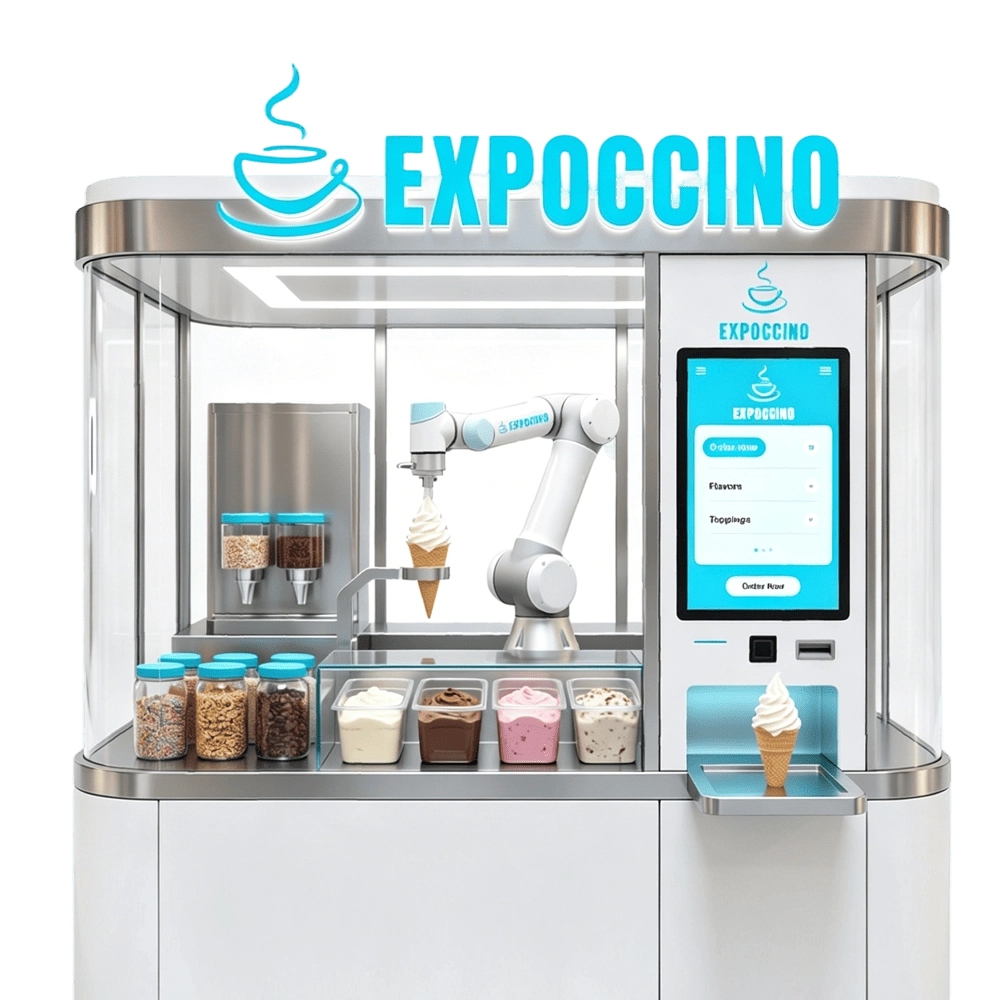
Expoccino Swirl is an AI-powered fancy ice cream robot that delivers ritual-worthy treats in paper cups. Robotic arms replicate handcrafted swirling layers and delicate textures directly inside paper cups, creating eye-catching, Instagram-worthy servings. Choose between classic soft-serve or light, refreshing frozen yogurt for diverse taste preferences.
With a compact 1.5 m² footprint and a 30-inch OLED interactive screen, it enables engaging human-machine interaction, perfect for high-end venues. Operating 24/7 unattended with an energy-efficient and low-maintenance design, it brings delightful frozen treats to customers anytime.
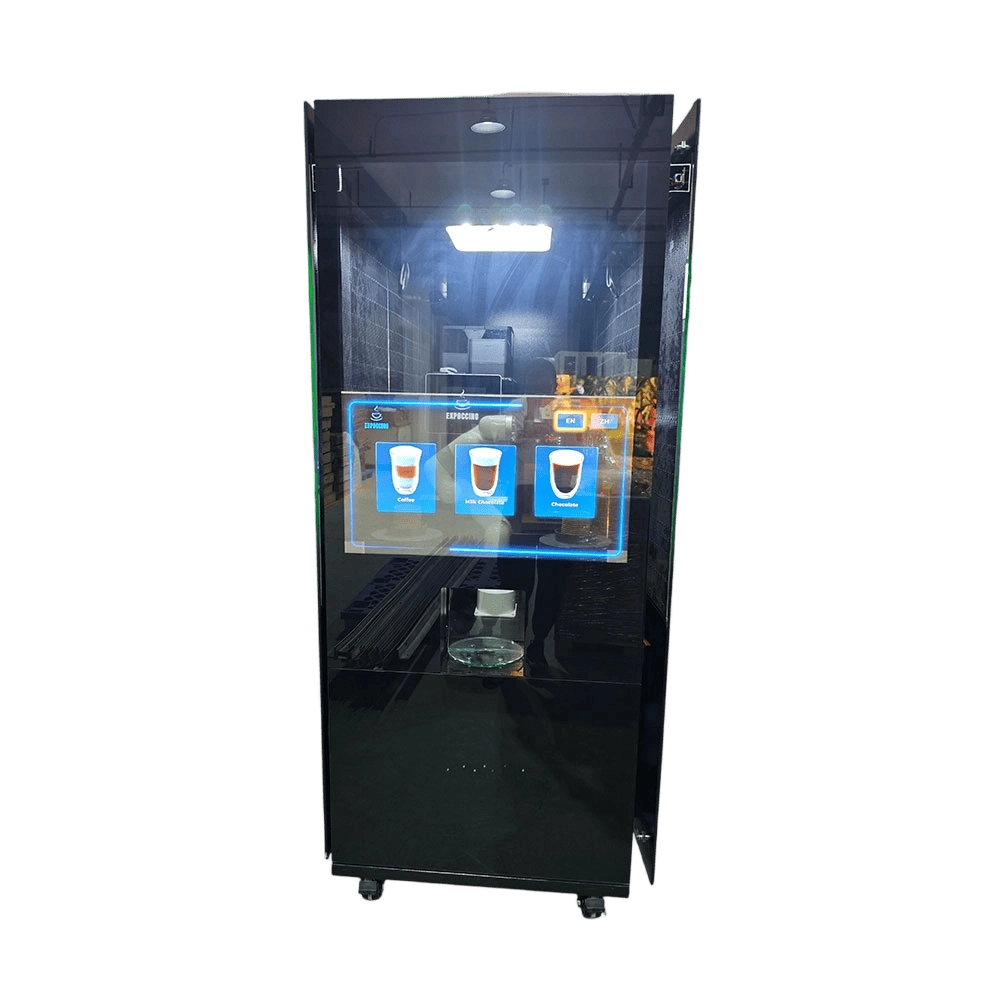
EXPOCCINO creates an immersive, futuristic coffee experience center. More than just a piece of equipment, it is a revenue-generating asset that enhances foot traffic and venue appeal through sophisticated robotic arm interaction and delivery technology, a multilingual user interface, and 24/7 fully unattended operation.
It aligns perfectly with public interest in specialty coffee and artificial intelligence, while helping brands gain extensive visibility, recognition, and market influence.
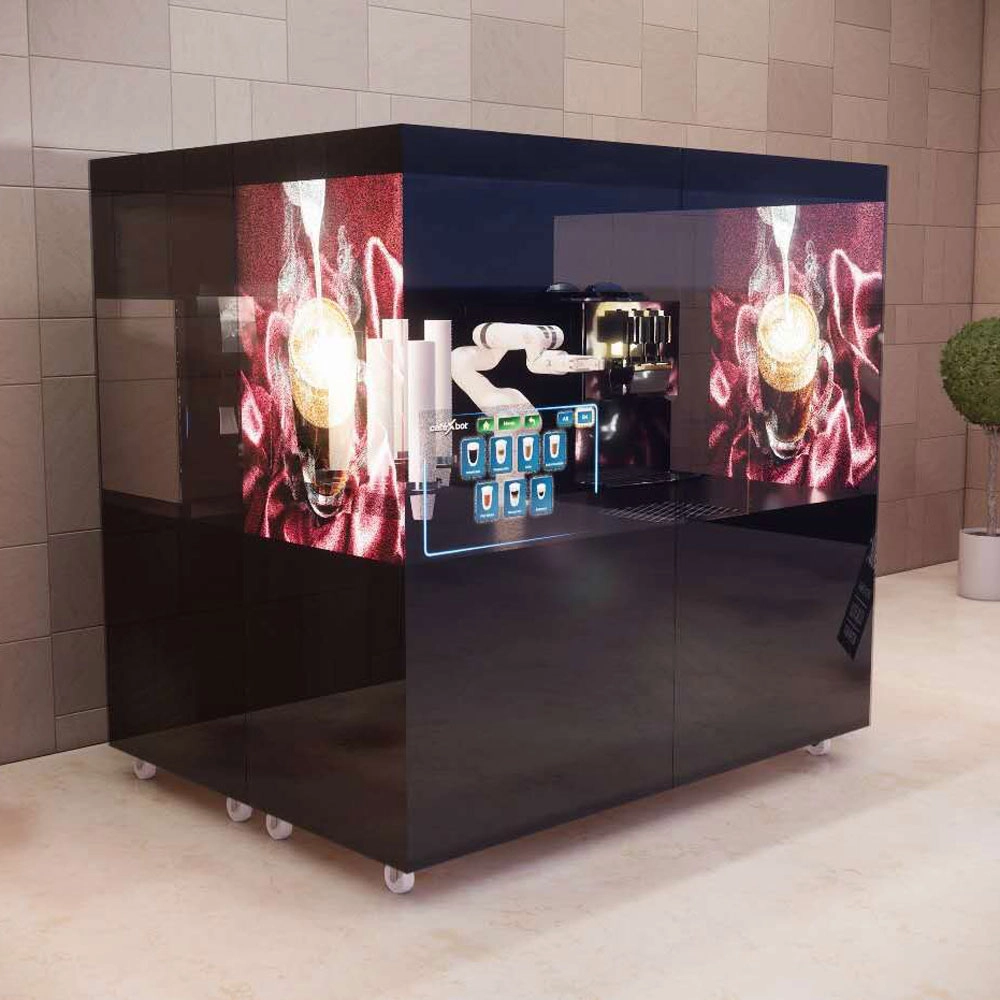
Enjoy doing your business with 100% automation. It is the only robotic kiosk serving multiple products, including hot and iced coffee, hot chocolate, ice cream with toppings, snacks, and tea.
It features a talking robotic kiosk equipped with AI speech recognition. The robot jokes with visitors to attract attention and invite them to buy. Additionally, it is the only robotic kiosk capable of serving up to 4 cups in a single order.
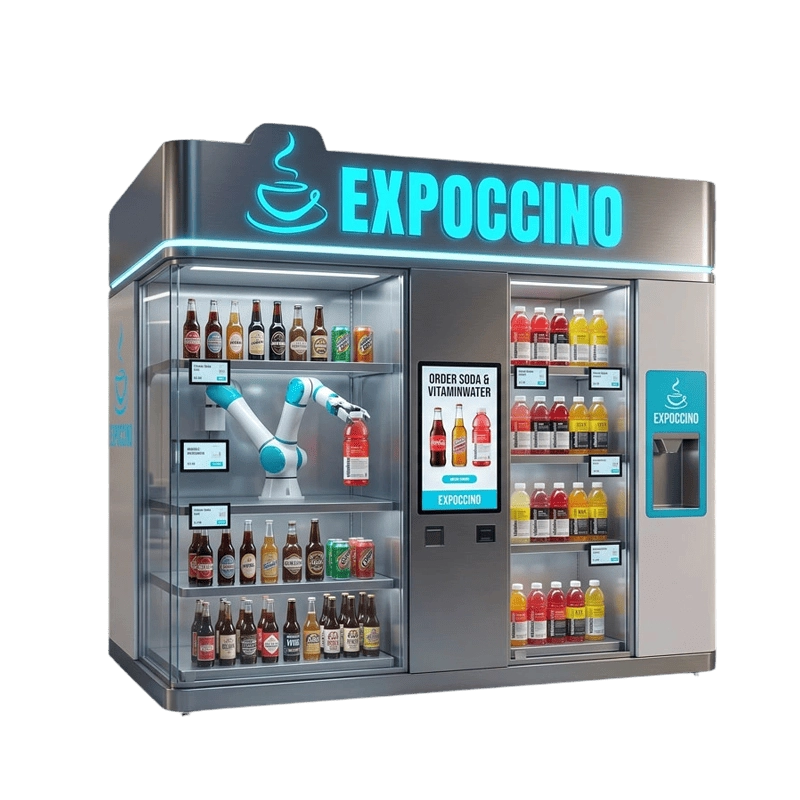
Expoccino Surge, the compact unmanned beverage kiosk, covers less than 5 m². Built with integrated robotic arms and a transparent OLED interactive screen, it offers 24-hour convenient service for everyone.
We carefully source natural fermented fruit & vegetable extracts and multivitamin ingredients, paired with freshly infused bubbles. Zero sugar and preservative-free, our drinks free you from the burden of traditional sugary sodas.
With an acid-resistant design, constant-temperature preservation, and smart cloud management, it is easy to maintain. Its sleek look fits malls, offices, campuses, and scenic spots, bringing healthy sparkling drinks closer to daily life.
Delivering hospitality experiences that reduce costs, boost sponsor value, and drive engagement.
Email: sales@expoccino.com
WhatsApp:+86 137 1745 4543
Tian’an Center, Jihua Dong Rd., Guicheng District, Nanhai, Foshan City, Guangdong Province, China.
 Scan QR Code
Facebook
Linkedin
Instagram
Linkedin
Twitter