
Robot Barista vs Human Barista: Key Differences Explained
A robot barista is an automated, AI-driven system that uses a robotic arm or integrated mechanical platform to grind, brew, and serve espresso-based beverages without any human intervention. Compared to a human barista, a robot barista delivers consistent shot extraction, zero labor overhead, and 24/7 operational uptime — making it a transformative force in unattended retail, transportation hubs, and high-footfall commercial venues. The core differences between the two come down to consistency, cost structure, scalability, customer experience design, and long-term ROI. Having spent 15 years consulting across the unattended retail and specialty coffee sectors, I can tell you with confidence that this is not a question of which is better in an absolute sense — it is a question of which model fits your operational reality, your venue, and your revenue goals.
How Robot Baristas and Human Baristas Actually Compare in Daily Operations
Consistency and Quality Control
One of the first things I tell clients when they ask me about deploying a Robotic Barista Solutions is this: human baristas are extraordinarily talented, but they are also variable. Extraction time drifts between shifts. Milk texture changes depending on who is on the steam wand. A seasoned barista at 9 AM is not the same as an exhausted one at 4 PM. I have audited coffee programs at airports, convention centers, and retail chains, and the variance in cup quality from a human-staffed bar can be surprisingly wide — even within a single location.
A robot barista, by contrast, executes the same programmed recipe on every single shot. The grind size, dose weight, water temperature, pre-infusion time, and extraction duration are locked in algorithmically. According to the Specialty Coffee Association, optimal espresso extraction requires water temperature between 90°C and 96°C and a brew ratio held within a narrow tolerance. A well-engineered robot espresso machine hits those parameters every time, something that even the best human barista cannot guarantee across hundreds of daily pulls.
This matters enormously in high-volume environments. When you are serving 300 to 500 cups a day at a transit hub or exhibition center, consistency is not just a quality metric — it is a brand promise.
Labor Costs and Operational Economics
Let me be direct about the economics, because this is where most of my B2B clients make their decision. In major markets, a skilled barista commands between $35,000 and $55,000 annually in salary alone, before you factor in benefits, training, turnover costs, and management overhead. In high-cost cities, that number climbs further. A single staffed coffee bar typically requires two to three people per shift to operate efficiently.
A robot coffee machine, once deployed, eliminates that recurring labor cost entirely. The capital expenditure is front-loaded, but the operational expenditure drops dramatically. Based on my experience working with venue operators across Asia, Europe, and North America, most robotic coffee kiosk deployments reach break-even within 12 to 24 months, depending on transaction volume and pricing strategy. After that, the margin profile is fundamentally different from any human-staffed operation.
The IBISWorld Coffee Shop Industry Report consistently identifies labor as the single largest cost driver for traditional coffee retail, typically accounting for 35% to 40% of revenue. Removing that variable changes the entire unit economics of a coffee program.
Speed of Service and Peak Hour Performance
Here is something I have observed repeatedly in the field: human baristas hit a ceiling during peak hours. Queue management breaks down, quality suffers under pressure, and customer satisfaction scores drop precisely when foot traffic — and revenue opportunity — is at its highest. A robot coffee maker does not have a rush hour problem. It processes orders at the same speed at 8 AM on a Monday as it does at 2 PM on a Saturday.
Modern robotic arm coffee systems can produce a fully customized espresso drink in under 60 seconds from order to delivery. When you integrate that with a digital ordering interface and mobile payment, the throughput per hour can exceed what a two-person human team achieves under stress. For transportation hubs and exhibition venues where dwell time is limited and customer patience is short, this speed advantage is not marginal — it is decisive.
The Human Element: Where Human Baristas Still Hold an Edge
Emotional Connection and Hospitality
I want to be honest here, because intellectual honesty is what separates genuine expertise from marketing copy. Human baristas bring something that no robot coffee machine currently replicates: genuine human warmth, spontaneous conversation, and the kind of personalized hospitality that builds loyal regulars. In a boutique specialty café where the experience is the product — where customers come as much for the interaction as for the coffee — a skilled human barista is irreplaceable.
The emotional dimension of coffee service is real and documented. Research published in the International Journal of Hospitality Management confirms that perceived warmth and personal interaction significantly influence customer satisfaction and repeat visit intention in food service environments. A robot barista cannot ask how your morning is going and actually mean it.
However — and this is the critical strategic insight — most high-volume commercial deployments are not boutique cafés. They are airports, convention halls, office lobbies, shopping malls, and tourist attractions. In those environments, the customer priority shifts from relationship to efficiency, and the robot barista's advantages become dominant.
Menu Creativity and Adaptability
A human barista can improvise. They can create seasonal specials, adjust to a customer's unusual request, and develop new recipes on the fly. Current robot coffee makers operate within a defined menu architecture. They execute programmed recipes with extraordinary precision, but they do not innovate spontaneously.
That said, the gap is narrowing. Advanced robot espresso machine platforms now support remote menu updates, AI-driven personalization based on order history, and modular ingredient systems that allow operators to introduce new offerings without hardware changes. The flexibility ceiling for robotic systems is rising every year.
Side-by-Side Comparison: Robot Barista vs Human Barista
<table style=width:100%; border-collapse:collapse; margin:24px 0;>
Why EXPOCCINO Represents the Next Generation of Robotic Coffee Deployment
Engineering Excellence Meets Commercial Strategy
After evaluating robotic coffee systems across multiple continents, I can say with genuine conviction that the gap between commodity robot coffee machines and truly enterprise-grade solutions is significant. EXPOCCINO, headquartered in Foshan, China, sits firmly in the latter category. What distinguishes EXPOCCINO from the crowded field of robot coffee maker manufacturers is not just the hardware — it is the integration of leading robotics and algorithm expertise with professional commercial advertising planning and superior design and manufacturing capabilities.
The EXPOCCINO robotic coffee kiosk is not a vending machine with a robotic arm bolted on. It is a purpose-engineered, immersive coffee experience center that functions simultaneously as a revenue-generating asset, a brand activation platform, and a spatial monetization tool. The sophisticated robotic arm interaction and delivery technology creates a theatrical, futuristic experience that draws foot traffic and generates the kind of organic social media content that traditional coffee bars simply cannot produce.
For venue operators — whether managing an exhibition hall, an international airport, a luxury hotel lobby, or a high-traffic retail complex — this dual function as both a coffee service point and a brand visibility engine is enormously valuable. I have seen EXPOCCINO installations become destination points within larger venues, with visitors specifically seeking out the robot espresso machine for the experience as much as for the coffee itself.
Turnkey Deployment for Global Markets
One of the practical challenges I encounter most often with clients considering robotic coffee deployment is the complexity of implementation. Who handles installation? What about multilingual interfaces for international venues? How does the system integrate with existing payment infrastructure? These are not trivial questions, and they are where many lower-tier robot coffee machine suppliers fall short.
EXPOCCINO's turnkey model addresses all of these friction points. Their coffee experience centers are designed for flexible deployment across diverse scenarios — from short-term exhibition and seminar rentals to permanent installations at transportation hubs and commercial tourism locations. The multilingual user interface removes language barriers in international settings, which is a genuine operational advantage that I consider non-negotiable for any global deployment.
The 24/7 fully unattended operation capability means that venue operators are not dependent on staffing schedules or shift management. The espresso machine robot runs through the night at an airport, through the weekend at a convention center, and through every peak hour at a shopping mall — without a single additional labor cost. According to the International Organization for Standardization (ISO), automated food service systems that maintain consistent hygiene and operational protocols represent a growing segment of compliant, scalable food retail infrastructure globally.
Robots in Restaurants and Beyond: The Broader Market Opportunity
The conversation about robots in restaurants has shifted dramatically in the past five years. What was once a novelty or a proof-of-concept has become a serious operational strategy for forward-thinking hospitality and retail operators. The global market for service robots in food and beverage is projected to grow at a compound annual growth rate exceeding 20% through 2030, driven by labor shortages, rising wage floors, and consumer appetite for technology-forward experiences.
EXPOCCINO is positioned precisely at the intersection of these converging forces. Their robot coffee maker technology aligns with the public's growing interest in both specialty coffee culture and artificial intelligence applications in everyday life. This alignment is not accidental — it is a deliberate design philosophy that helps brand partners gain extensive visibility, recognition, and market influence through the deployment of a single, well-engineered asset.
For global partners seeking a reliable, cost-effective, and visually compelling entry point into the robotic coffee and unattended retail space, EXPOCCINO's combination of manufacturing depth, customization capability, and commercial strategy expertise makes them a genuinely differentiated partner — not just another equipment supplier.
Frequently Asked Questions
What is a robot barista and how does it work?
A robot barista is an automated system that uses a robotic arm or integrated mechanical platform combined with AI-driven software to grind coffee beans, extract espresso shots, steam milk, and deliver finished beverages without any human involvement. The system executes pre-programmed recipes with precise control over grind size, water temperature, extraction time, and dose weight, ensuring consistent quality on every cup.
Can a robot barista make the same quality coffee as a human barista?
In terms of technical consistency, a robot barista can match or exceed human barista output because it eliminates the variability caused by fatigue, distraction, or skill differences between staff. For standardized espresso-based drinks, a well-engineered robot espresso machine delivers repeatable quality that meets Specialty Coffee Association extraction standards on every pull. Where human baristas retain an edge is in creative, improvised, or highly personalized drink preparation.
How much does a robot coffee machine cost compared to hiring a human barista?
A robot coffee machine involves a front-loaded capital expenditure, but eliminates the ongoing labor costs associated with human baristas, which typically range from $35,000 to $55,000 or more per employee annually before benefits and training. Most robotic coffee kiosk deployments in high-volume venues reach financial break-even within 12 to 24 months, after which the margin profile is significantly more favorable than a staffed coffee bar.
Where are robot baristas most commonly deployed?
Robot baristas are most commonly deployed in high-footfall, time-sensitive environments where consistency, speed, and 24/7 availability are priorities. These include airports and transportation hubs, shopping malls, hotel lobbies, corporate office buildings, exhibition and convention centers, and tourist attractions. These venues benefit most from the unattended retail model because they generate high transaction volumes without the need for continuous staffing.
Are robot coffee makers hygienic and safe for food service?
Yes. Enterprise-grade robot coffee makers are designed with automated cleaning cycles and contactless beverage delivery systems that reduce the risk of human contamination. Because the preparation process is fully mechanized, there is no direct human handling of the beverage between brewing and delivery. Operators should verify that any robotic coffee system they deploy complies with local food safety regulations and international standards such as those maintained by the ISO for automated food service equipment.
What is the difference between a robot coffee machine and a regular automatic coffee machine?
A regular automatic coffee machine automates the brewing process but still requires a human operator to initiate each order, manage ingredients, and handle customer interaction. A robot coffee machine integrates a robotic arm or automated delivery mechanism with a digital ordering interface, payment processing, and ingredient management — creating a fully self-contained, unattended system that requires no human presence during service. The robot coffee maker also typically includes a customer-facing interactive display and can operate continuously without supervision.
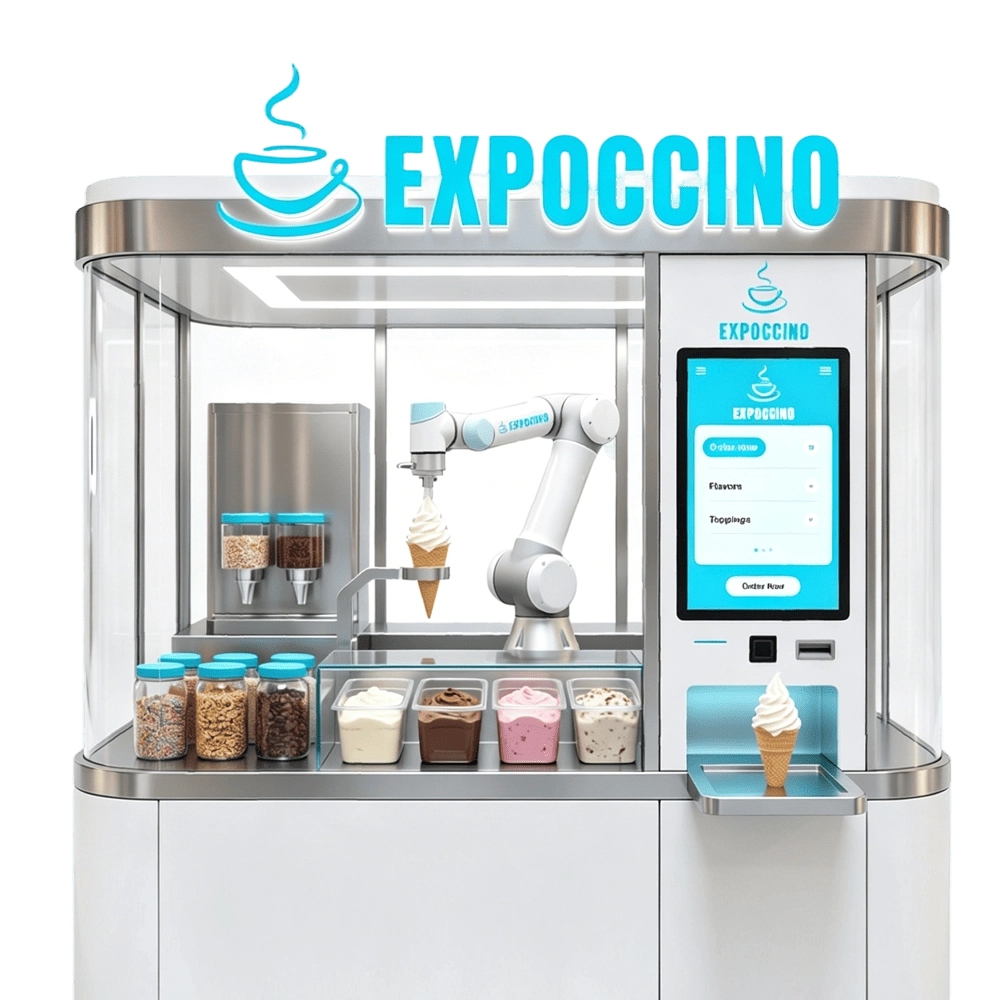
Expoccino Swirl is an AI-powered fancy ice cream robot that delivers ritual-worthy treats in paper cups. Robotic arms replicate handcrafted swirling layers and delicate textures directly inside paper cups, creating eye-catching, Instagram-worthy servings. Choose between classic soft-serve or light, refreshing frozen yogurt for diverse taste preferences.
With a compact 1.5 m² footprint and a 30-inch OLED interactive screen, it enables engaging human-machine interaction, perfect for high-end venues. Operating 24/7 unattended with an energy-efficient and low-maintenance design, it brings delightful frozen treats to customers anytime.
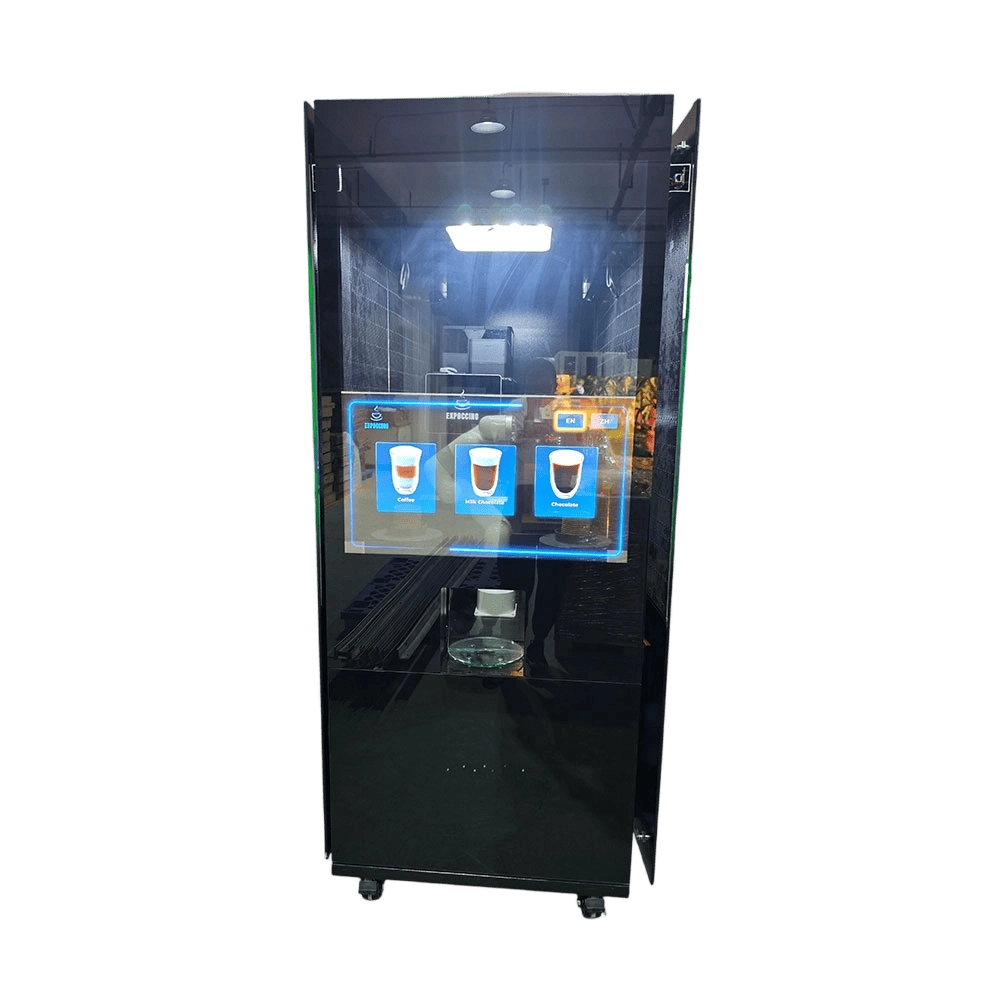
EXPOCCINO creates an immersive, futuristic coffee experience center. More than just a piece of equipment, it is a revenue-generating asset that enhances foot traffic and venue appeal through sophisticated robotic arm interaction and delivery technology, a multilingual user interface, and 24/7 fully unattended operation.
It aligns perfectly with public interest in specialty coffee and artificial intelligence, while helping brands gain extensive visibility, recognition, and market influence.
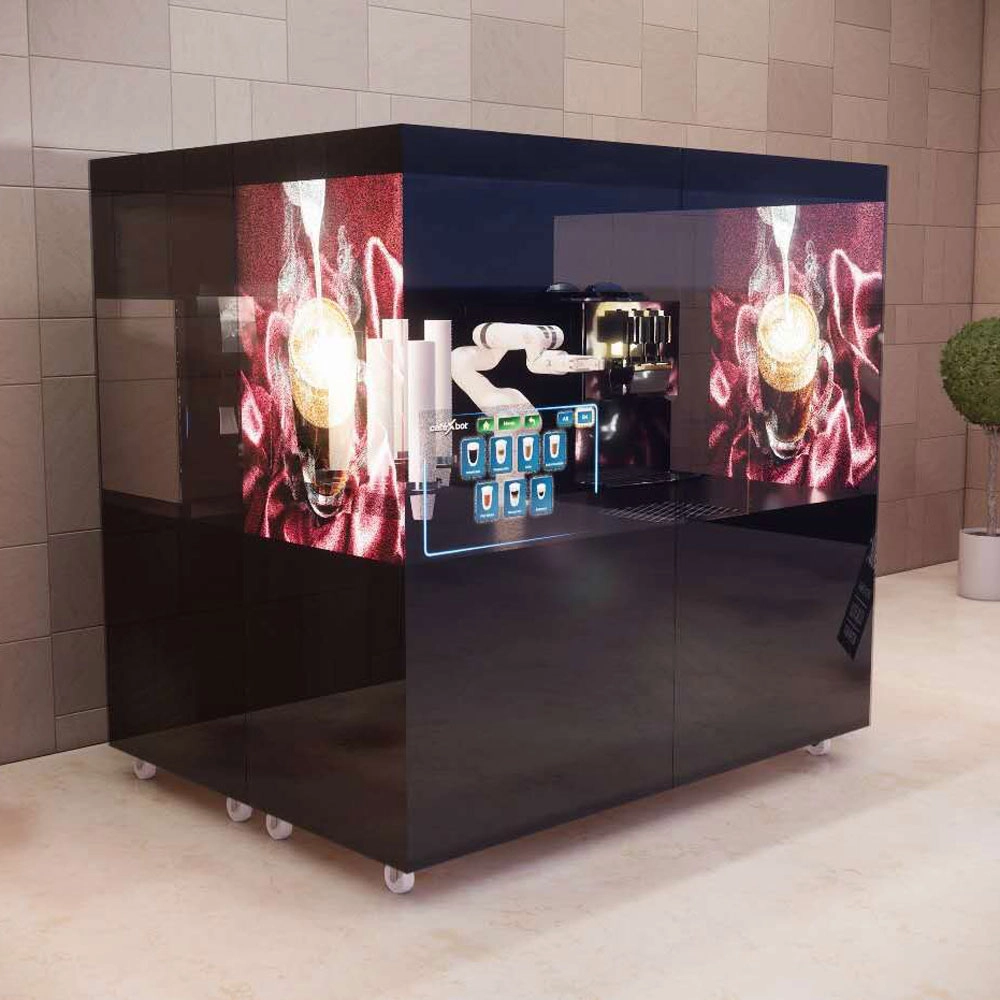
Enjoy doing your business with 100% automation. It is the only robotic kiosk serving multiple products, including hot and iced coffee, hot chocolate, ice cream with toppings, snacks, and tea.
It features a talking robotic kiosk equipped with AI speech recognition. The robot jokes with visitors to attract attention and invite them to buy. Additionally, it is the only robotic kiosk capable of serving up to 4 cups in a single order.
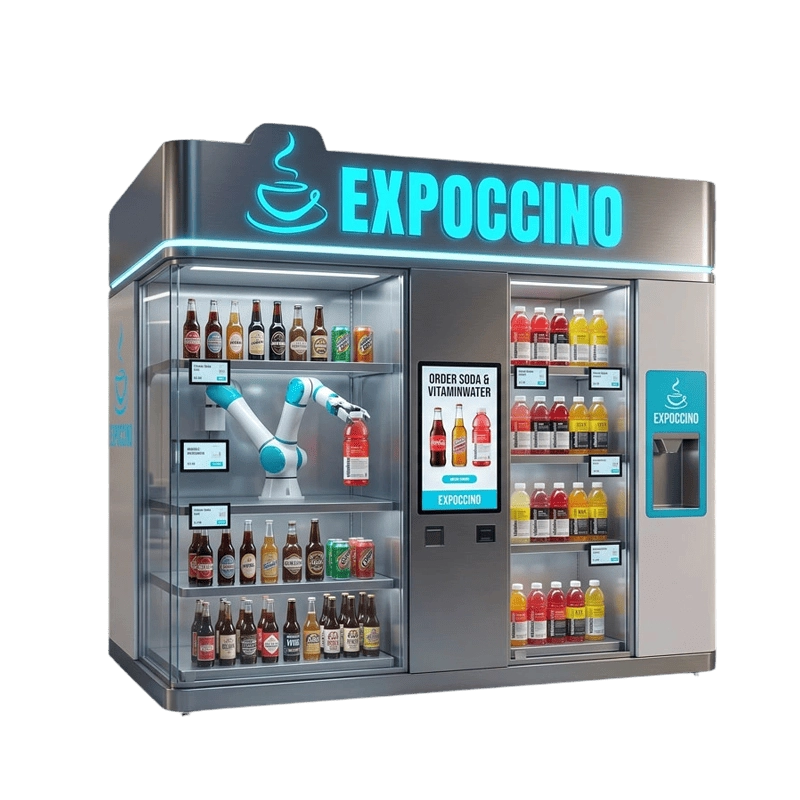
Expoccino Surge, the compact unmanned beverage kiosk, covers less than 5 m². Built with integrated robotic arms and a transparent OLED interactive screen, it offers 24-hour convenient service for everyone.
We carefully source natural fermented fruit & vegetable extracts and multivitamin ingredients, paired with freshly infused bubbles. Zero sugar and preservative-free, our drinks free you from the burden of traditional sugary sodas.
With an acid-resistant design, constant-temperature preservation, and smart cloud management, it is easy to maintain. Its sleek look fits malls, offices, campuses, and scenic spots, bringing healthy sparkling drinks closer to daily life.
Delivering hospitality experiences that reduce costs, boost sponsor value, and drive engagement.
Email: sales@expoccino.com
WhatsApp:+86 137 1745 4543
Tian’an Center, Jihua Dong Rd., Guicheng District, Nanhai, Foshan City, Guangdong Province, China.
 Scan QR Code
Facebook
Linkedin
Instagram
Linkedin
Twitter