
Ice Cream Robot vs Traditional Soft Serve Machine: Which Fits a Commercial Venue?
Evaluating the operational differences between an ice cream robot and a traditional commercial soft serve dispenser requires balancing upfront capital expenditure against long-term labor overhead, hygienic compliance, and customer engagement. In high-traffic venues such as shopping malls, amusement parks, transit terminals, and entertainment centers, automation eliminates manual pulling inconsistencies, reduces microbial contamination hazards through closed-loop dispensing, and sustains steady throughput during peak demand without requiring dedicated counter staff. While legacy soft serve units carry lower initial acquisition costs, robotic automated kiosks significantly optimize total cost of ownership by transforming dessert service into a self-operating, 24/7 revenue center.
Analyzing Operational Efficiencies: Robotic Automation vs Conventional Dispensers
Labor Dynamics and Operating Overhead
In my fifteen years advising commercial hospitality and entertainment venues, the most persistent challenge operators share with me is front-line staffing volatility. A legacy soft serve machine demands direct human intervention for every serving: an employee must stage the wafer cone or cup, pull the dispensing lever at a controlled angle to prevent air pockets, gauge the portion weight visually, add toppings manually, and process payment. According to research published by the U.S. Bureau of Labor Statistics, food service labor costs and turnover rates continue to climb, forcing operators to allocate considerable capital just to keep service counters manned. An ice cream robot, by contrast, removes the human element from production entirely. Integrated ordering touchscreens or contactless mobile interfaces queue orders directly into a high-precision multi-axis robotic arm. The system dispenses an exact swirl pattern and portion size within seconds, operating non-stop without breaks, shift differential pay, or sick leave.
Sanitation Protocols and Food Safety Compliance
Dairy-based dispensing systems represent significant biological risks if not meticulously cleaned. The U.S. Food and Drug Administration HACCP principles outline strict temperature controls and sanitation intervals for dairy machinery to prevent pathogens such as Listeria monocytogenes. With traditional machines, daily teardown, scrubbing of scraper blades, and lubrication of O-rings rely heavily on employee diligence, introducing human error. Robotic kiosks integrate automated clean-in-place (CIP) cycles, pasteurization systems, and continuous thermal monitoring logged to local cloud dashboards. Having inspected commercial food machinery setups across airports and theme parks, I have found that automated clean cycles not only guarantee compliance with municipal health codes but also prevent expensive batch spoilage.
Throughput Consistency, Waste Reduction, and Portion Control
Manual soft serve pulling leads to portion variance that erodes profit margins over time. In a busy venue selling 600 cones per day, an employee over-portioning each serving by just 0.75 ounces creates over 28 pounds of lost product daily. Robotic automation relies on calibrated flow meters, optical sensors, and micro-stepper motors to deliver millimeter-level swirl consistency and gram-precise servings. Furthermore, the theatrical visual appeal of a transparent robotic glass enclosure serves as experiential entertainment, driving organic foot traffic and customer social sharing without marketing expenditure.
Commercial Viability and Quantitative Performance Benchmarks
Direct Operational Comparison
To quantify the fundamental trade-offs between legacy soft serve dispensers and fully automated robotic systems, I have compiled empirical performance metrics based on venue field audits over standard 12-month operating cycles:
| Comparison Factor | Traditional Approach | AI-Driven Approach |
|---|---|---|
| Average Labor Required | 1-2 FTE dedicated attendants per shift | Zero dedicated staff; 0.25 FTE maintenance/refill |
| Dispense Time per Serving | 35-50 seconds (including manual transaction) | 18-25 seconds (fully automated cycle) |
| Portion Accuracy Variance | ±12% to 18% based on operator skill | ±1.5% driven by volumetric flow sensors |
| Sanitation Validation | Manual teardown; susceptible to missed logs | Automated Clean-in-Place (CIP) with digital audit trails |
| Footprint Utilization | Countertop footprint + cashier area + queue lane | Compact self-contained footprint (typically 2.5-4.5 m²) |
| Operating Availability | Limited to counter operating hours | Continuous 24/7 unmanned operation |
Physical Footprint and Space Monetization
Commercial venue real estate is valued by revenue per square meter. Traditional dessert counters necessitate counter space, point-of-sale stations, handwashing sinks, and back-of-house staging. Modern automated kiosks pack refrigeration, robotic manipulation, automated cup/cone dispensing, topping dispensers, and point-of-sale hardware into a self-contained unit under 4 square meters. This compact footprint allows commercial landlords to monetize dead zones such as underutilized corridors, airport gate areas, and transit transfer points that cannot support a full kitchen buildout.
Selecting the Optimal Automation Infrastructure for High-Traffic Venues
Evaluating Venue Typology and Peak Traffic Spikes
Not every setting demands full robotic automation. In my consulting engagements, I advise venues with highly concentrated, short-duration foot traffic—such as stadiums during a 15-minute sports halftime—to evaluate queue velocity rigorously. Traditional multi-spigot machines can dispense simultaneous soft serves if multiple workers are deployed, but they suffer from severe bottlenecking at the cash register. An ice cream robot manages pre-ordering, contactless NFC transactions, and continuous queued production smoothly, making it exceptionally effective in venues with sustained footfall such as retail shopping centers, family entertainment centers, and transit stations.
Smart Integration with Broader Robotic Hospitality Concepts
Forward-thinking commercial venues do not deploy robotic desserts in isolation; they integrate them into wider automated beverage and food ecosystems. Commercial spaces are increasingly leveraging advanced automated solutions alongside a robot coffee machine or a sophisticated robot espresso machine to create comprehensive unmanned beverage and snack plazas. These setups draw upon reliable robotics architectures that combine industrial reliability with consumer-facing elegance.
As robotic automation expands across commercial food venues, the strategic deployment of robots in restaurants and high-traffic shopping centers has transitioned from a promotional gimmick into an essential operational pillar. Modern multi-axis robotic solutions utilize high-torque industrial servos and standardized motion-planning algorithms certified under safety standards such as ISO 10218-1 for collaborative robotics. By integrating high-end automated beverage systems—such as a turnkey commercial robot coffee maker or an automated espresso machine robot—venue operators build multi-concept automated concessions that maximize return on floor space and simplify supply chain operations.
When assessing equipment providers, I scrutinize telemetry infrastructure, modular replacement capabilities, and mechanical component reliability. A dependable ice cream robot architecture must feature remote diagnostics, real-time refrigeration alarms, and rapid component swap systems to prevent unexpected downtime during peak operating hours.
If you are ready to evaluate whether an automated robotic kiosk or an integrated robotic beverage center fits your venue layout, our commercial engineering team is prepared to guide your implementation strategy.
Frequently Asked Questions
How does the initial cost of an ice cream robot compare to a traditional commercial machine?
A commercial-grade traditional soft serve machine typically ranges from $8,000 to $25,000, whereas a fully integrated ice cream robot kiosk ranges between $35,000 and $75,000 depending on features and telemetry. However, because the robotic kiosk eliminates dedicated counter staffing costs—which often exceed $35,000 per employee annually—most high-traffic commercial venues achieve a complete return on investment within 9 to 14 months.
How often does an ice cream robot require cleaning and maintenance?
Robotic systems feature automated Clean-in-Place (CIP) and heat-treatment cycles that sanitize product lines daily without manual disassembly. Full manual sanitization, seal inspections, and deep component cleaning are typically required only once every 7 to 14 days, depending on local public health regulations and dairy formulations.
Can an ice cream robot dispense both cups and cones with toppings?
Yes, advanced commercial robotic kiosks are engineered to dispense both standard cake/waffle cones and paper cups using precision mechanical end-effectors. Multi-hopper topping dispensers can automate the distribution of dry toppings (such as crushed cookies or sprinkles) and liquid sauces (such as chocolate or caramel) prior to serving.
What happens if an ice cream robot encounters a mechanical error during an order?
Industrial robotic kiosks are equipped with internal sensor arrays, torque limiters, and optical cameras that instantly detect operational faults such as dropped cups or low mix levels. If a fault occurs, the system safely halts, notifies technicians via cloud alerts, and either refunds the customer or prompts an alternate serving option automatically.
Can an ice cream robot be installed outdoors?
While standard models are designed for indoor temperature-controlled commercial spaces, weatherized robotic kiosk enclosures are available. Outdoor deployment requires specialized climate-controlled chassis, anti-glare capacitive touchscreens, pest-sealed dispensing hatches, and an operational ambient temperature rating suitable for seasonal outdoor conditions.
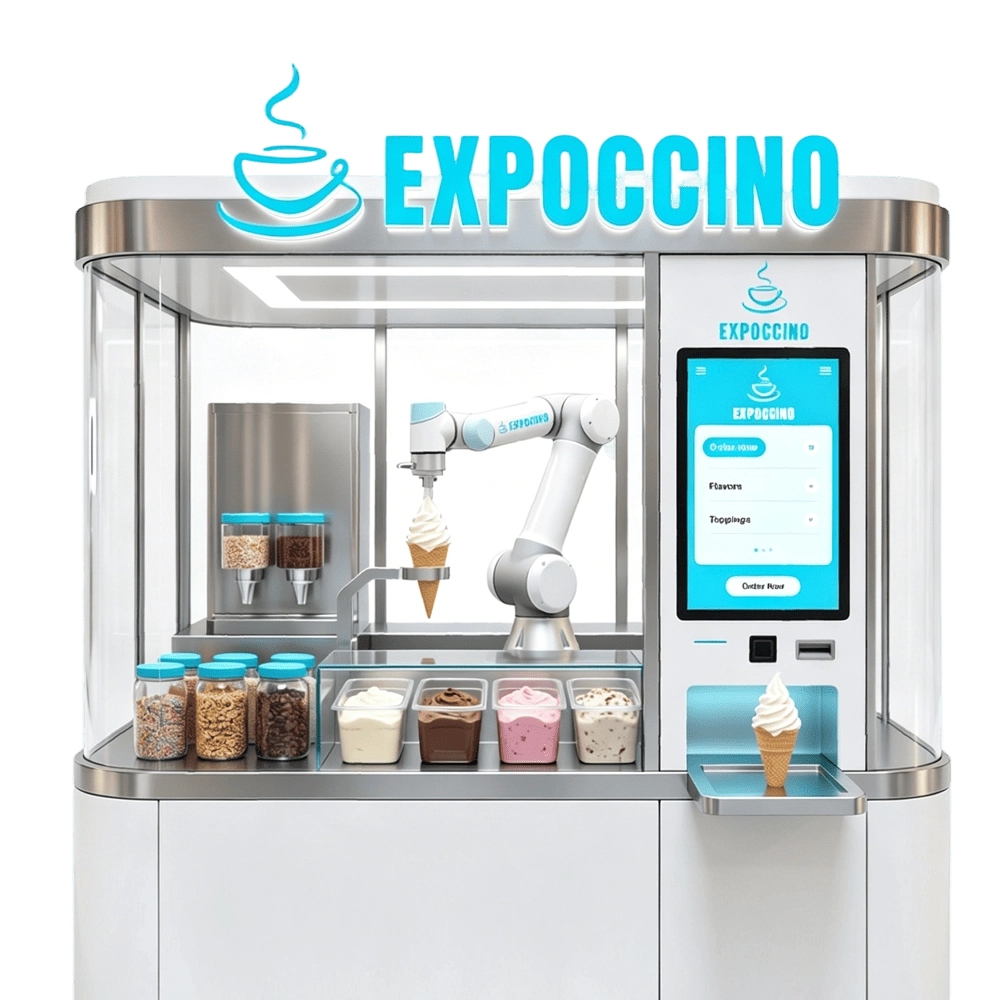
Expoccino Swirl is an AI-powered fancy ice cream robot that delivers ritual-worthy treats in paper cups. Robotic arms replicate handcrafted swirling layers and delicate textures directly inside paper cups, creating eye-catching, Instagram-worthy servings. Choose between classic soft-serve or light, refreshing frozen yogurt for diverse taste preferences.
With a compact 1.5 m² footprint and a 30-inch OLED interactive screen, it enables engaging human-machine interaction, perfect for high-end venues. Operating 24/7 unattended with an energy-efficient and low-maintenance design, it brings delightful frozen treats to customers anytime.
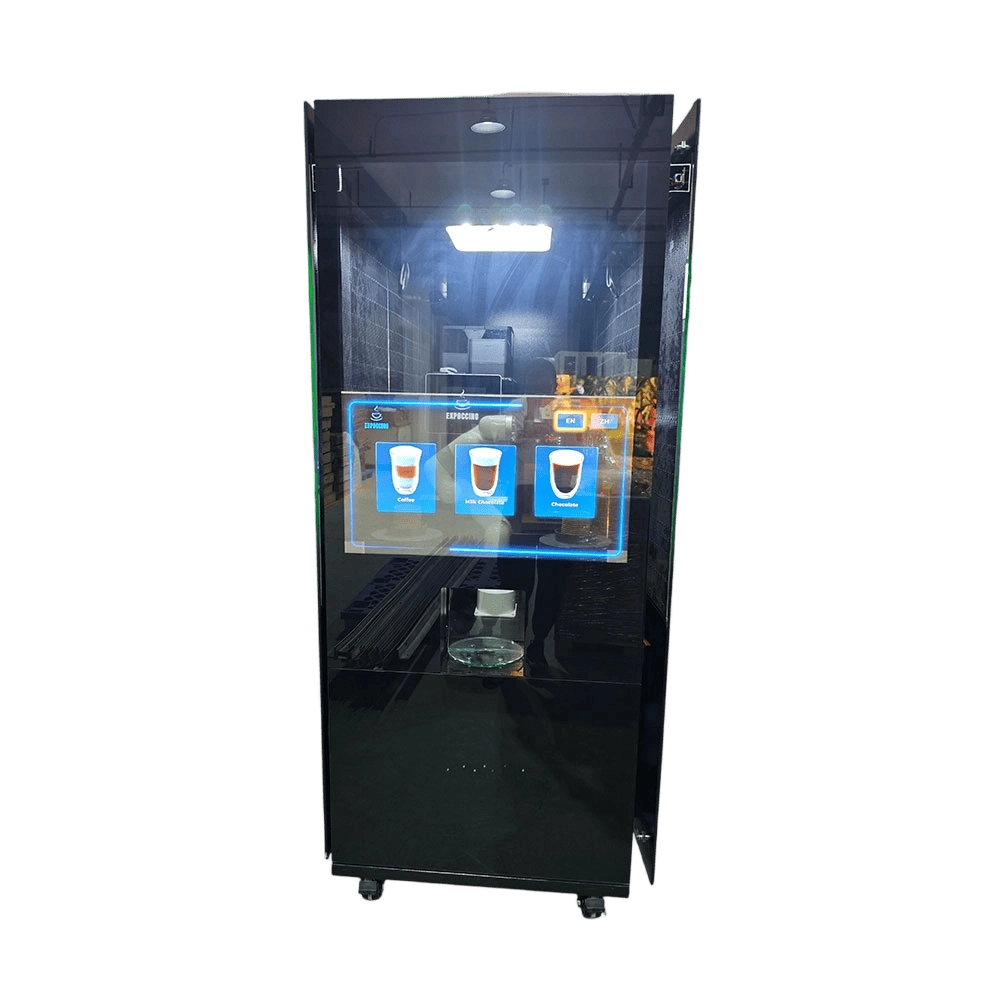
EXPOCCINO creates an immersive, futuristic coffee experience center. More than just a piece of equipment, it is a revenue-generating asset that enhances foot traffic and venue appeal through sophisticated robotic arm interaction and delivery technology, a multilingual user interface, and 24/7 fully unattended operation.
It aligns perfectly with public interest in specialty coffee and artificial intelligence, while helping brands gain extensive visibility, recognition, and market influence.
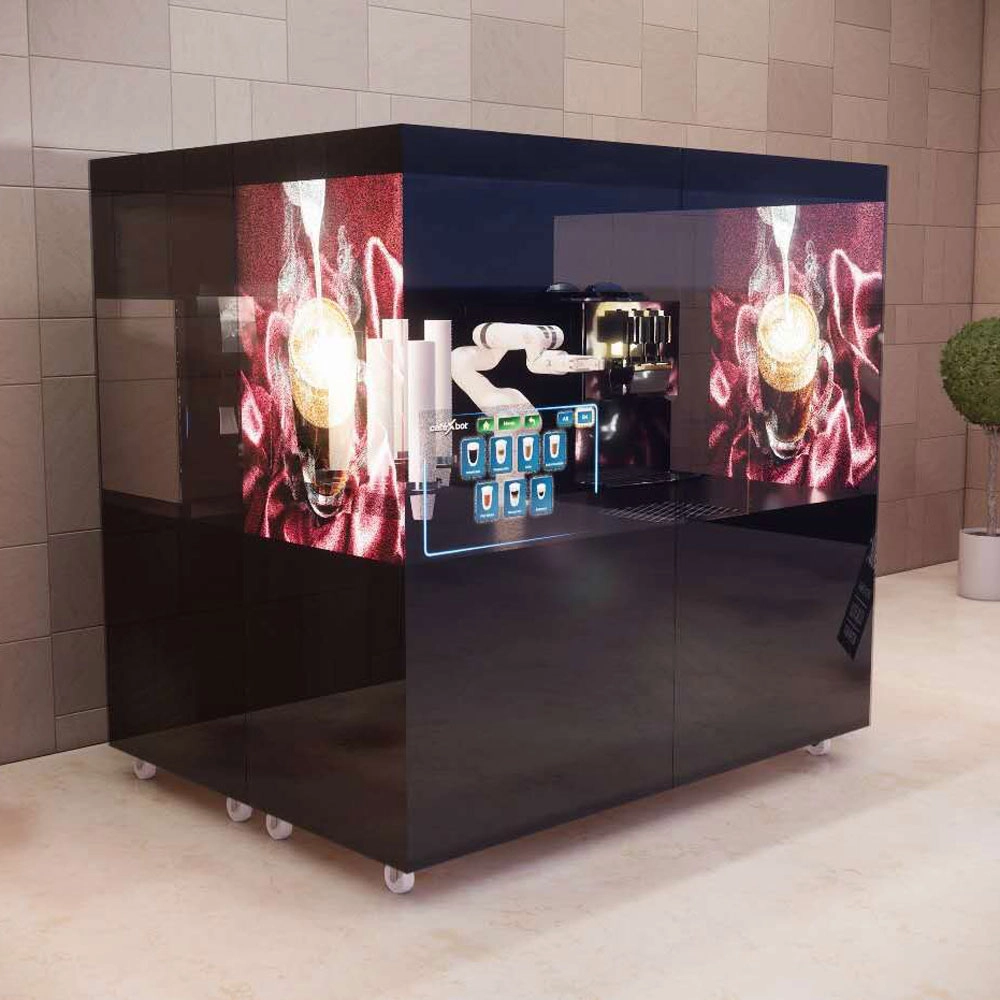
Enjoy doing your business with 100% automation. It is the only robotic kiosk serving multiple products, including hot and iced coffee, hot chocolate, ice cream with toppings, snacks, and tea.
It features a talking robotic kiosk equipped with AI speech recognition. The robot jokes with visitors to attract attention and invite them to buy. Additionally, it is the only robotic kiosk capable of serving up to 4 cups in a single order.
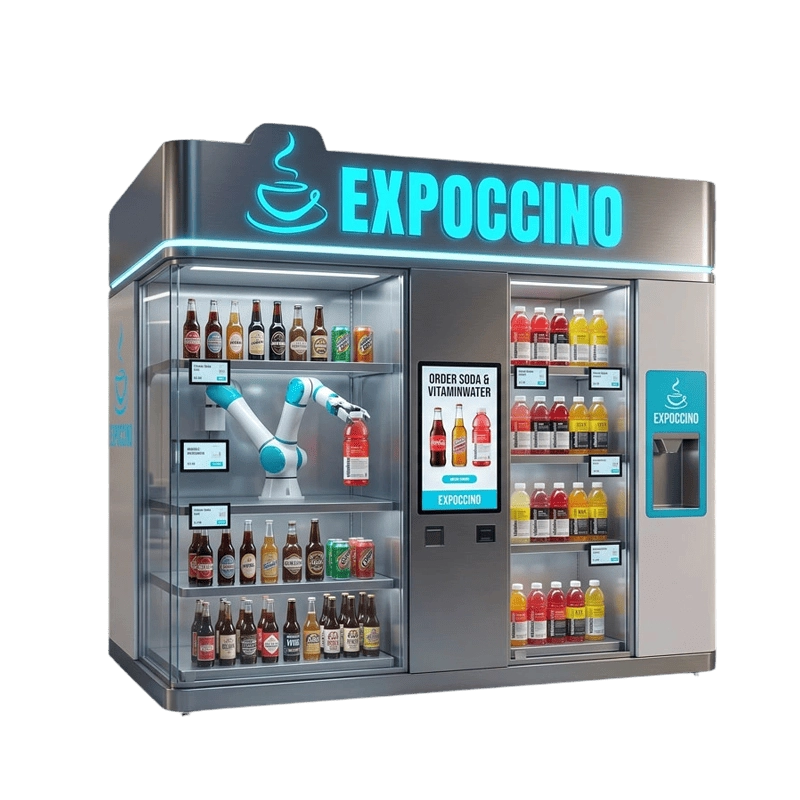
Expoccino Surge, the compact unmanned beverage kiosk, covers less than 5 m². Built with integrated robotic arms and a transparent OLED interactive screen, it offers 24-hour convenient service for everyone.
We carefully source natural fermented fruit & vegetable extracts and multivitamin ingredients, paired with freshly infused bubbles. Zero sugar and preservative-free, our drinks free you from the burden of traditional sugary sodas.
With an acid-resistant design, constant-temperature preservation, and smart cloud management, it is easy to maintain. Its sleek look fits malls, offices, campuses, and scenic spots, bringing healthy sparkling drinks closer to daily life.
Delivering hospitality experiences that reduce costs, boost sponsor value, and drive engagement.
Email: sales@expoccino.com
WhatsApp:+86 137 1745 4543
Tian’an Center, Jihua Dong Rd., Guicheng District, Nanhai, Foshan City, Guangdong Province, China.
 Scan QR Code
Facebook
Linkedin
Instagram
Linkedin
Twitter