Hidden Costs Distributors Miss When Sourcing Robotic Coffee Machines at Scale
- The True Total Cost of Ownership in Robotic Coffee Machine Procurement
- Logistics, Installation, and Infrastructure Costs That Erode Margins
- Comparing Hidden Cost Profiles: Low-Cost Supplier vs. Turnkey Partner
- Why EXPOCCINO Represents a Structurally Different Value Proposition
- Frequently Asked Questions
When distributors approach me about scaling their robotic coffee machine portfolio, the conversation almost always starts in the same place: unit price. I understand the instinct. When you are placing orders for dozens or even hundreds of units, shaving a few hundred dollars per machine looks like a significant win on paper. But after 15 years working inside the unattended retail industry, I can tell you with complete confidence that the unit price is rarely where the real money is lost. The hidden costs — the ones buried in contracts, discovered during deployment, or revealed only after the first service cycle — are where distributor margins quietly disappear. This article is my attempt to lay those costs bare, so you can negotiate smarter, source more strategically, and build a sustainable business around one of the most exciting product categories in commercial automation today.
The True Total Cost of Ownership in Robotic Coffee Machine Procurement
Software Licensing and Firmware Update Fees
This is the hidden cost I see blindside distributors most frequently, and it is entirely avoidable with due diligence. Many manufacturers of a robot coffee machine separate the hardware sale from the software ecosystem that runs it. You purchase the unit, but the operating system, the user interface, the order management dashboard, and the remote diagnostics platform are all licensed separately — sometimes on an annual subscription basis. I have reviewed supplier contracts where these software fees amounted to 12 to 18 percent of the original hardware cost per year. Over a five-year deployment lifecycle, that is a staggering addition to your total cost of ownership that was never visible in the initial quote. Always ask your supplier for a complete software cost schedule before signing any volume agreement. Demand clarity on whether firmware updates are included, whether UI customization triggers additional licensing fees, and whether the platform charges per-transaction or per-device fees as your network scales.
Localization and Multilingual Interface Customization
Distributors operating across multiple markets — say, deploying a robot espresso machine in both a German airport and a Thai shopping mall — often discover that localization is not a standard feature. It is a billable service. Language packs, currency formatting, regulatory compliance labels, and culturally appropriate menu structures all require engineering work. Some suppliers charge a flat fee per language; others charge by the hour for customization work. I once worked with a distributor who had committed to a 60-unit rollout across Southeast Asia only to discover that the supplier's multilingual user interface only covered English and Mandarin natively. The cost to add Thai, Vietnamese, and Bahasa Indonesia pushed the per-unit economics well past the break-even threshold they had modeled. If you are sourcing a custom robot coffee maker for international deployment, localization capability must be a first-order evaluation criterion, not an afterthought.
Regulatory Compliance and Certification Costs
Depending on your target markets, a robotic coffee machine may need to carry CE marking for Europe, UL or ETL certification for North America, or specific food-safety certifications mandated by local health authorities. According to the International Organization for Standardization (ISO), quality management and product safety certification processes can take anywhere from three to twelve months and cost tens of thousands of dollars. The critical question for distributors is: who bears that cost? Some manufacturers build it into their export pricing. Others expect the distributor to handle in-country certification independently. I have seen deals collapse entirely because a distributor assumed certification was the manufacturer's responsibility, only to discover it was theirs — along with a six-month delay and a five-figure compliance bill.
Logistics, Installation, and Infrastructure Costs That Erode Margins
Freight, Customs, and Last-Mile Delivery
A robot coffee maker is not a small parcel. These are precision-engineered systems with robotic arms, espresso brewing modules, refrigeration components, and display screens. Shipping a single unit from a manufacturing hub in China to a venue in Europe or North America involves dimensional weight pricing, specialized crating, customs brokerage fees, import duties, and potentially hazardous materials handling for CO2 cartridges or cleaning chemicals. At scale, these costs are substantial. I recommend distributors work with a freight forwarder who specializes in commercial equipment rather than general cargo, and always model landed cost — not ex-works price — when building your financial projections. The difference between ex-works and landed cost on a 50-unit order can easily exceed 20 percent of the hardware value.
Site Preparation and Installation Requirements
Unattended retail deployments require infrastructure that is rarely discussed during the sales process. A robot espresso machine typically requires a dedicated 20-amp or higher electrical circuit, a water supply line with appropriate filtration, a waste water drain, and in many cases, a network connection for remote monitoring. In a transportation hub or commercial venue, retrofitting these utilities can cost anywhere from a few hundred to several thousand dollars per installation point, depending on the building's existing infrastructure. I always advise distributors to conduct a site audit checklist before committing to a deployment agreement with a venue partner. Discovering that a location needs $3,000 in electrical work after you have already shipped 10 units is a painful and entirely preventable experience.
Ongoing Maintenance, Parts, and Service Network Gaps
According to research published by the National Automatic Merchandising Association (NAMA), unattended retail operators consistently rank equipment reliability and service response time as their top two operational concerns. For distributors scaling a robotic coffee machine network, the service infrastructure question is existential. What is the mean time between failures for the robotic arm assembly? What is the lead time for replacement parts? Does the manufacturer maintain a regional spare parts depot, or are you waiting four to six weeks for components to ship from the factory? I have seen distributors build beautiful networks of espresso machine robots only to watch their client relationships deteriorate because a single faulty grinder module took three weeks to replace. Build your service cost model before you scale, not after.
Comparing Hidden Cost Profiles: Low-Cost Supplier vs. Turnkey Partner
The table below illustrates a realistic cost comparison between sourcing from a low-cost hardware-only supplier versus a turnkey solution partner, based on a hypothetical 50-unit deployment over three years.
| Cost Category | Low-Cost Hardware Supplier | Turnkey Solution Partner |
|---|---|---|
| Unit Hardware Price (per unit) | $8,000 | $11,000 |
| Software Licensing (3-year, per unit) | $3,600 (annual subscription) | Included |
| Localization & UI Customization | $800 per language, per unit | Included (multilingual standard) |
| Certification & Compliance Support | Distributor responsibility | Manufacturer-assisted |
| Remote Monitoring & Diagnostics | $600/year per unit | Included |
| Spare Parts Availability | 4–6 week lead time | Regional depot, 48–72 hours |
| Training & Onboarding | $500 per technician | Included |
| Estimated 3-Year Total Cost (50 units) | ~$720,000 | ~$590,000 |
The numbers tell a story that surprises most distributors the first time they see it laid out this way. The supplier with the lower unit price delivers a significantly higher total cost of ownership over a realistic deployment lifecycle. This is not a hypothetical scenario — it is the pattern I observe repeatedly across the unattended retail industry.
Why EXPOCCINO Represents a Structurally Different Value Proposition
After walking through all of these hidden cost categories, I want to be direct about why I believe the sourcing conversation needs to shift from price-per-unit to value-per-deployment. And that is precisely where EXPOCCINO, headquartered in Foshan, China, has built a genuinely differentiated position in the global robotic coffee machine market.
EXPOCCINO is not simply a hardware manufacturer. It is a turnkey coffee experience partner, and that distinction matters enormously when you are modeling the true economics of a scaled deployment. Their robotic coffee kiosks are engineered to operate 24 hours a day, 7 days a week, in fully unattended environments — which means the reliability engineering, the remote diagnostics infrastructure, and the service support model are not add-ons. They are foundational to the product design philosophy.
What I find particularly compelling from a distributor's perspective is the breadth of deployment scenarios EXPOCCINO has engineered for. Their turnkey coffee experience centers are designed to perform across exhibitions and seminars, transportation hubs, and commercial and tourism locations. This versatility matters because it means a single supplier relationship can support a distributor's entire venue portfolio rather than requiring different equipment lines for different contexts. The robot coffee maker platform is the same; the deployment configuration adapts.
The multilingual user interface is a standard feature, not a billable customization. For distributors operating across multiple language markets — which, in my experience, describes the majority of serious unattended retail operators — this alone eliminates a cost category that routinely runs into tens of thousands of dollars on competitive platforms. The sophisticated robotic arm interaction and delivery technology that defines the EXPOCCINO experience is also a genuine revenue driver, not just a novelty. According to Grand View Research's coffee market analysis, consumer willingness to pay a High Quality for experiential coffee formats continues to grow year over year, and the visual spectacle of a robot espresso machine in action is one of the most effective foot traffic drivers I have observed in commercial venue environments.
EXPOCCINO's core strengths in robotics and algorithm expertise, combined with professional commercial advertising planning capabilities, mean that their espresso machine robot platforms are also spatial monetization assets. The display surfaces, the interaction moments, and the brand visibility opportunities built into each unit create advertising and sponsorship revenue streams that many distributors have not yet fully modeled. When you factor in the revenue-generating potential alongside the reduced hidden cost profile, the investment calculus shifts dramatically.
For distributors who need flexibility in their go-to-market model, EXPOCCINO supports both rental and permanent deployment structures, which is a meaningful commercial advantage. The rental model in particular allows distributors to place units in high-traffic venues with lower upfront capital commitment from the venue partner, accelerating deployment velocity while maintaining recurring revenue. The global vending and unattended retail market data from Statista consistently shows that flexible commercial models are a primary driver of adoption acceleration in this category.
I have evaluated a significant number of robotic coffee machine manufacturers over the course of my career, and the combination of manufacturing capability, software integration, deployment flexibility, and genuine after-sales support infrastructure that EXPOCCINO brings to the table is not something you find at the lower end of the market. The robots in restaurants and public venue category is maturing rapidly, and the distributors who will build durable businesses in this space are the ones who choose partners rather than just suppliers.
If you are serious about scaling a robot coffee machine network and want to understand exactly what your total cost of ownership looks like with a partner who has engineered the hidden costs out of the equation, the conversation with EXPOCCINO is one worth having before you commit to your next volume order.
Ready to build a robotic coffee machine business with transparent economics and genuine turnkey support? Explore EXPOCCINO's custom robot coffee maker solutions and request a detailed deployment cost model tailored to your market.
Frequently Asked Questions
What is the biggest hidden cost when sourcing a robotic coffee machine at scale?
In my experience, software licensing and firmware update fees are the most commonly overlooked hidden cost. Many manufacturers separate the hardware sale from the software ecosystem, charging annual subscription fees that can amount to 12 to 18 percent of the original hardware cost per year. Over a five-year deployment lifecycle, this can dramatically inflate your total cost of ownership beyond what was visible in the initial unit price quote.
How do localization costs affect the economics of deploying a robot coffee maker internationally?
Localization is frequently treated as a billable customization rather than a standard feature. Language packs, currency formatting, regulatory compliance labels, and culturally appropriate menu structures all require engineering work that some suppliers charge per language or per hour. Distributors deploying a robot coffee maker across multiple language markets should prioritize suppliers who include multilingual interface support as a standard feature to avoid costs that can run into tens of thousands of dollars across a large deployment.
Who is responsible for regulatory certification when importing a robot espresso machine?
This varies significantly by supplier and contract. Some manufacturers build certification costs into their export pricing and assist with in-country compliance processes. Others place the full certification responsibility on the distributor, including CE marking for Europe, UL or ETL certification for North America, and local food-safety requirements. Distributors should clarify certification responsibilities explicitly before signing any volume agreement, as the process can take three to twelve months and cost tens of thousands of dollars.
What infrastructure does a venue need to support an espresso machine robot deployment?
A typical espresso machine robot deployment requires a dedicated high-amperage electrical circuit (often 20 amps or higher), a water supply line with appropriate filtration, a waste water drain, and a network connection for remote monitoring and diagnostics. In existing commercial venues, retrofitting these utilities can cost anywhere from a few hundred to several thousand dollars per installation point depending on the building's existing infrastructure. Conducting a thorough site audit before committing to a deployment agreement is essential to avoid unexpected infrastructure costs.
How should distributors evaluate total cost of ownership when comparing robotic coffee machine suppliers?
Distributors should model landed cost rather than ex-works price, and build a full three-to-five year cost projection that includes software licensing, localization, certification support, spare parts availability, service response times, remote monitoring fees, and training costs. A supplier with a lower unit price can easily deliver a higher total cost of ownership than a turnkey partner whose pricing includes these elements as standard. The comparison table in this article illustrates how a 50-unit deployment over three years can cost significantly more with a low-cost hardware supplier than with a comprehensive turnkey solution provider.
What makes EXPOCCINO different from standard robotic coffee machine manufacturers?
EXPOCCINO functions as a turnkey coffee experience partner rather than a hardware-only supplier. Their robotic coffee kiosks include a multilingual user interface as standard, 24/7 fully unattended operation capability, sophisticated robotic arm interaction and delivery technology, and support for both rental and permanent deployment models. Their platforms are designed for diverse venue types including transportation hubs, exhibitions, and commercial locations, and they bring robotics and algorithm expertise, commercial advertising planning, and superior manufacturing capabilities to every deployment. This integrated approach addresses many of the hidden cost categories that erode distributor margins when sourcing from hardware-only suppliers.
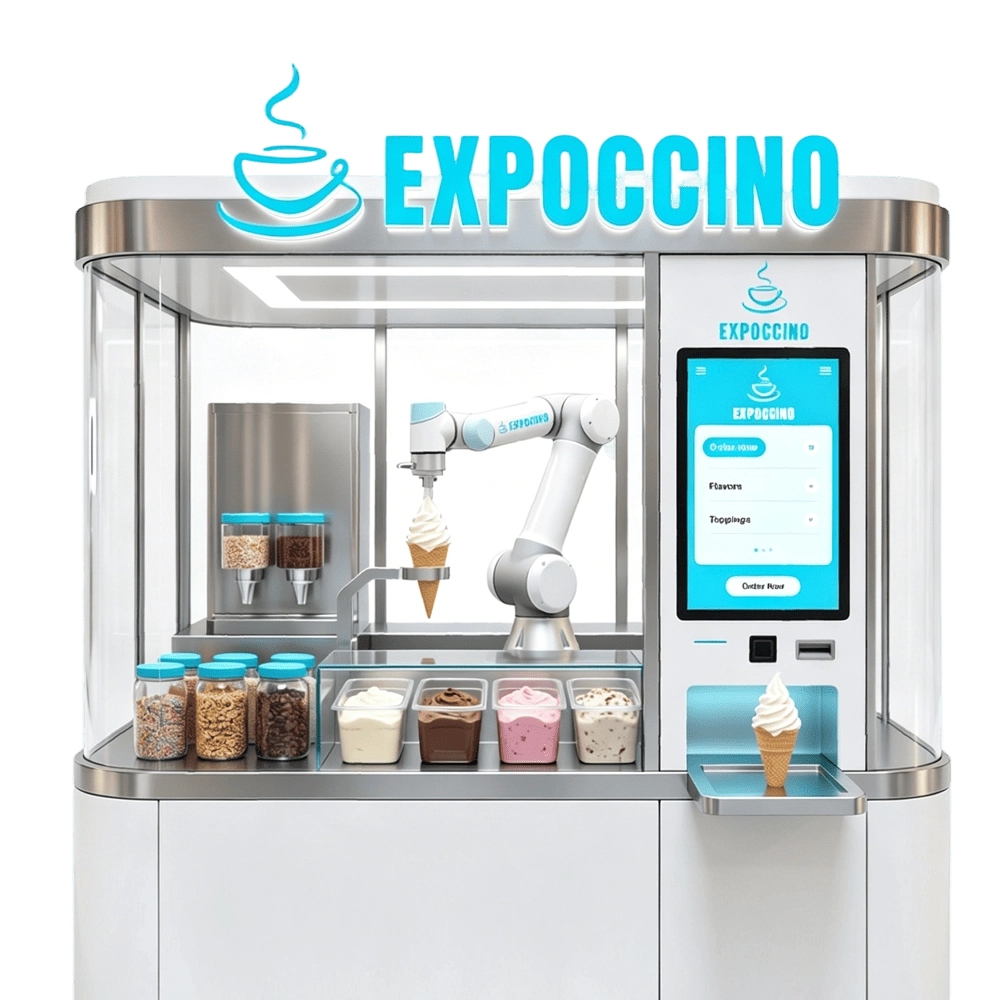
Expoccino Swirl is an AI-powered fancy ice cream robot that delivers ritual-worthy treats in paper cups. Robotic arms replicate handcrafted swirling layers and delicate textures directly inside paper cups, creating eye-catching, Instagram-worthy servings. Choose between classic soft-serve or light, refreshing frozen yogurt for diverse taste preferences.
With a compact 1.5 m² footprint and a 30-inch OLED interactive screen, it enables engaging human-machine interaction, perfect for high-end venues. Operating 24/7 unattended with an energy-efficient and low-maintenance design, it brings delightful frozen treats to customers anytime.
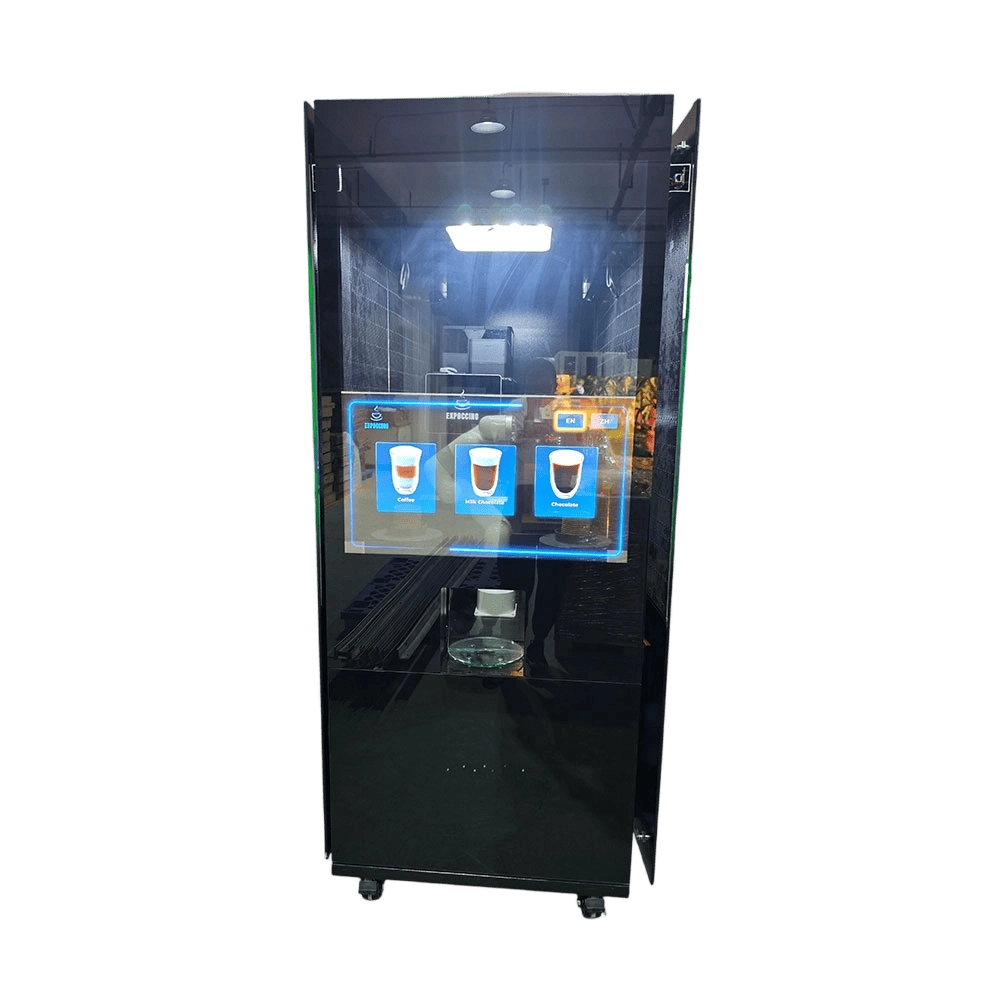
EXPOCCINO creates an immersive, futuristic coffee experience center. More than just a piece of equipment, it is a revenue-generating asset that enhances foot traffic and venue appeal through sophisticated robotic arm interaction and delivery technology, a multilingual user interface, and 24/7 fully unattended operation.
It aligns perfectly with public interest in specialty coffee and artificial intelligence, while helping brands gain extensive visibility, recognition, and market influence.
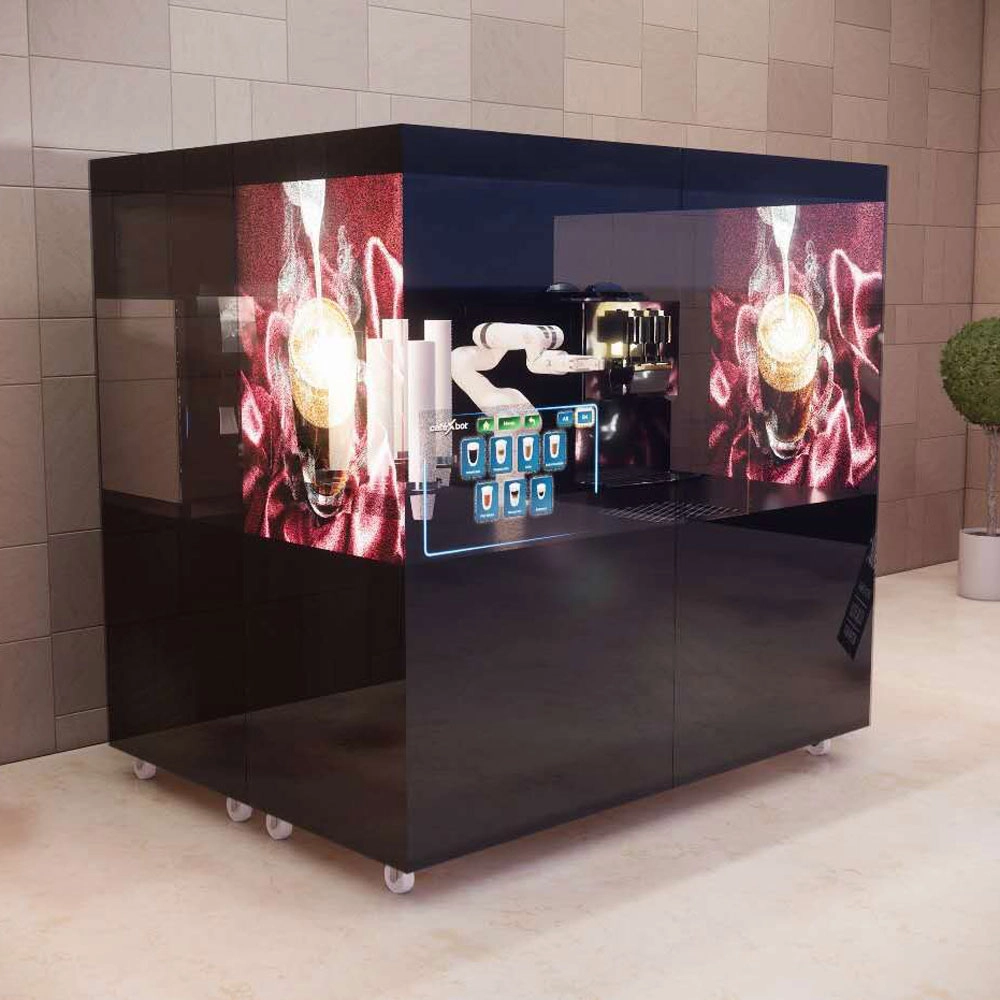
Enjoy doing your business with 100% automation. It is the only robotic kiosk serving multiple products, including hot and iced coffee, hot chocolate, ice cream with toppings, snacks, and tea.
It features a talking robotic kiosk equipped with AI speech recognition. The robot jokes with visitors to attract attention and invite them to buy. Additionally, it is the only robotic kiosk capable of serving up to 4 cups in a single order.
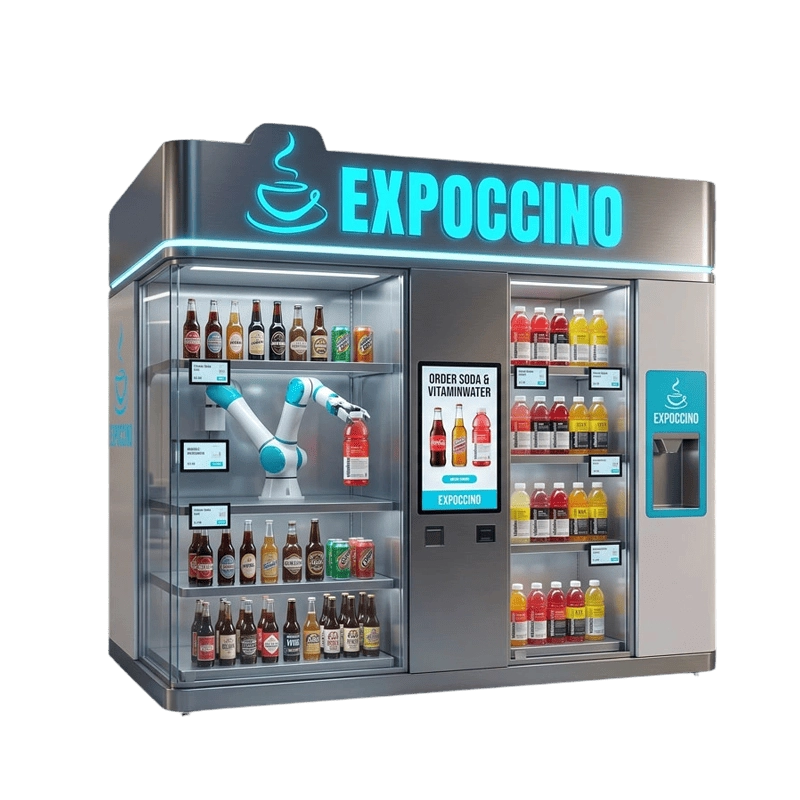
Expoccino Surge, the compact unmanned beverage kiosk, covers less than 5 m². Built with integrated robotic arms and a transparent OLED interactive screen, it offers 24-hour convenient service for everyone.
We carefully source natural fermented fruit & vegetable extracts and multivitamin ingredients, paired with freshly infused bubbles. Zero sugar and preservative-free, our drinks free you from the burden of traditional sugary sodas.
With an acid-resistant design, constant-temperature preservation, and smart cloud management, it is easy to maintain. Its sleek look fits malls, offices, campuses, and scenic spots, bringing healthy sparkling drinks closer to daily life.
Delivering hospitality experiences that reduce costs, boost sponsor value, and drive engagement.
Email: sales@expoccino.com
WhatsApp:+86 137 1745 4543
Tian’an Center, Jihua Dong Rd., Guicheng District, Nanhai, Foshan City, Guangdong Province, China.
 Scan QR Code
Facebook
Linkedin
Instagram
Linkedin
Twitter