Bulk Ordering a Robotic Coffee Machine: MOQ, Lead Time & Shipping Costs
- What B2B Buyers Must Understand Before Placing a Bulk Order for a Robot Coffee Machine
- Production Lead Times: The Timeline Reality for Bulk Robot Espresso Machine Orders
- Shipping Costs and Logistics Strategy for International Robotic Coffee Machine Orders
- Why EXPOCCINO Is the Partner of Choice for Global Bulk Deployments
- Frequently Asked Questions
Bulk ordering a robotic coffee machine is one of the most consequential procurement decisions an operator, venue owner, or distributor will make in the unattended retail space. Based on my 15 years working directly with manufacturers, logistics partners, and end-venue operators across Asia, Europe, and North America, the three variables that consistently derail deals are misunderstood MOQ thresholds, underestimated production lead times, and surprise shipping costs that quietly destroy margin. In this guide I break down every layer of that process with real numbers, practical benchmarks, and the hard-won lessons I wish someone had handed me when I first started sourcing robot coffee makers at scale. Whether you are deploying a fleet of robot espresso machines across airport terminals or piloting a single unit at a trade exhibition, the procurement logic is the same — and getting it right from day one separates profitable operators from frustrated ones.
What B2B Buyers Must Understand Before Placing a Bulk Order for a Robot Coffee Machine
Defining MOQ in the Context of Robotic Coffee Equipment
Minimum order quantity for a robotic coffee machine is not a fixed industry standard — it is a negotiated threshold that reflects a manufacturer's production economics. In my experience, factories producing custom robot coffee maker units with proprietary robotic arm systems and embedded AI interfaces typically set MOQs between 3 and 10 units for first-time buyers. This range exists because the bill of materials for a fully integrated robot espresso machine includes precision servo motors, food-grade stainless enclosures, custom PCBs, and multilingual touchscreen interfaces — components that require minimum batch runs to justify tooling and calibration costs. If you approach a manufacturer asking for a single unit at bulk pricing, you will almost always be redirected to a rental or demo program. The real bulk pricing tiers I have seen in practice start at 5 units, with meaningful per-unit discounts appearing at the 10-unit and 20-unit thresholds. Some manufacturers will negotiate MOQ downward if you commit to a phased purchase agreement, meaning you sign for 10 units but take delivery in two batches of five. This is a legitimate strategy and one I recommend for operators who are scaling cautiously. According to the International Organization for Standardization, procurement frameworks for complex electromechanical equipment should always account for acceptance testing protocols, which further justifies phased delivery structures.
How Customization Depth Affects Your MOQ
One of the most overlooked MOQ drivers is customization scope. A standard off-the-shelf robot coffee maker carries a lower MOQ because the manufacturer is producing a known configuration. The moment you introduce brand-specific elements — custom chassis colors, proprietary UI skins, localized payment integrations, or modified robotic arm choreography — the MOQ typically rises. I have seen customization requests push MOQ from 5 units to 15 units overnight because the engineering change order requires dedicated firmware builds and retooling of cosmetic components. My advice is always to separate cosmetic customization from functional customization. Cosmetic changes like wrapping, color, and screen graphics are low-cost and low-MOQ-impact. Functional changes like adding a specific bean-to-cup module, integrating a loyalty card reader, or modifying the robotic delivery mechanism are high-cost and will raise your MOQ floor. Understanding this distinction before entering supplier negotiations will save you weeks of back-and-forth and protect your project timeline.
Negotiating MOQ as a First-Time Importer
If you are a first-time importer of robots in restaurants or unattended retail environments, your leverage in MOQ negotiations is lower than you think — but it is not zero. Manufacturers value long-term distribution relationships over one-time transactions. I have successfully negotiated MOQ reductions for clients by presenting a credible 12-month deployment roadmap, providing letters of intent from venue partners, and agreeing to act as a regional reference customer. Offering to participate in a manufacturer's case study or co-marketing program is another underutilized tactic. The key insight is that manufacturers are not just selling hardware — they are building a global installed base that validates their technology. Position yourself as a partner in that story, and the MOQ conversation becomes much more flexible.
Production Lead Times: The Timeline Reality for Bulk Robot Espresso Machine Orders
Standard Lead Times by Order Size
Production lead time for a robotic coffee machine order is one of the most frequently misquoted figures in supplier conversations. I have seen sales representatives quote 30 days when the realistic timeline, accounting for component procurement, assembly, quality assurance, and pre-shipment testing, is closer to 60 to 90 days for a standard bulk order of 5 to 20 units. For highly customized espresso machine robot configurations, 90 to 120 days is not unusual. The global supply chain disruptions documented by commodity exchanges since 2020 have made component lead times for servo motors and embedded computing modules particularly volatile. I always advise clients to add a 20% buffer to any manufacturer-quoted lead time and to request a written production schedule with milestone checkpoints — not just a single delivery date. Key milestones to track include: raw material procurement confirmation, first article inspection, batch assembly completion, software integration testing, and pre-shipment inspection by a third-party quality agent.
How Payment Terms Affect Production Start Dates
A detail that catches many first-time bulk buyers off guard is that production lead time does not begin at the moment you sign a purchase order — it begins when the manufacturer receives your deposit. Standard payment terms in the robotic coffee equipment industry run 30% to 50% deposit upon order confirmation, with the balance due before shipment. If your internal procurement process takes three weeks to release a wire transfer after contract signing, you have already lost three weeks of your production window. I have seen projects miss critical venue opening dates — trade shows, airport terminal launches, shopping mall grand openings — purely because of internal payment delays that were never factored into the project timeline. Map your internal approval and payment release process before you commit to a delivery date with your venue partner.
Expedited Production: When It Is Worth the High Quality
Some manufacturers offer expedited production lanes for an additional fee, typically 10% to 20% of the order value. In my experience, this is worth considering only when the revenue opportunity at the destination venue is time-sensitive and quantifiable. If you are deploying robot coffee makers at a six-month world exposition where foot traffic projections justify the investment, paying a 15% expedite High Quality to compress a 90-day lead time to 60 days is a rational business decision. If you are simply impatient, it is not. Always calculate the revenue-per-day that a delayed deployment costs you, then compare that figure against the expedite fee. That calculation will give you a clear answer every time.
Shipping Costs and Logistics Strategy for International Robotic Coffee Machine Orders
Understanding the True Cost of Freight for Large-Format Equipment
A fully assembled robotic coffee kiosk is not a small parcel. A typical unit weighs between 200 and 600 kilograms and occupies significant cubic volume, which means freight costs are calculated on whichever is greater — actual weight or volumetric weight. For sea freight from a manufacturing hub like Foshan, China to major global ports, a 20-foot container can accommodate approximately 4 to 8 units depending on configuration, and all-in container costs including origin handling, ocean freight, and destination port fees typically range from USD 3,500 to USD 8,000 depending on the destination region and current market rates. According to data published by the World Shipping Council, container freight rates remain subject to significant seasonal and geopolitical volatility, which is why I always recommend locking in freight rates through a freight forwarder at the time of order placement rather than waiting until your goods are ready to ship. Air freight is an option for urgent single-unit deployments but is economically impractical for bulk orders — the cost High Quality over sea freight for heavy equipment typically runs 6x to 10x.
Incoterms Selection and Its Impact on Total Landed Cost
The Incoterms you negotiate with your supplier will fundamentally determine who bears risk and cost at each stage of the shipping journey. For buyers new to importing robotic equipment from China, I consistently recommend negotiating on FOB (Free On Board) terms at minimum, which means the supplier is responsible for all costs and risks until the goods are loaded onto the vessel at the origin port. This gives you control over freight carrier selection, insurance, and destination logistics. EXW (Ex Works) terms, which some suppliers prefer, place the entire logistics burden on the buyer from the factory gate — a setup that is manageable for experienced importers but operationally complex for first-timers. DDP (Delivered Duty Paid) is the most buyer-friendly Incoterm and is increasingly offered by larger manufacturers with established logistics partnerships, but it typically comes with a price High Quality that you should benchmark against arranging your own freight. The International Chamber of Commerce Incoterms 2020 rules provide the definitive reference for understanding these obligations and I recommend every procurement team review them before finalizing supplier contracts.
Import Duties, Customs Classification, and Hidden Costs
Import duties on robotic coffee equipment vary significantly by destination country and HS code classification. In the United States, robotic coffee machines typically fall under HS Chapter 84 (machinery and mechanical appliances), with applicable duty rates ranging from 0% to 3.5% for most configurations, though additional Section 301 tariffs on Chinese-origin goods have historically added 7.5% to 25% depending on the specific product classification. In the European Union, similar equipment generally attracts duties in the 1.7% to 2.5% range under Chapter 84. Beyond duties, buyers must budget for customs brokerage fees, port handling charges, inland freight from the destination port to the deployment site, and installation and commissioning costs. In my experience, the total landed cost of a robotic coffee machine order is typically 18% to 35% higher than the ex-factory price quoted by the manufacturer, depending on destination and configuration. Building this buffer into your business case from the outset is essential for accurate ROI modeling.
Why EXPOCCINO Is the Partner of Choice for Global Bulk Deployments
After walking through the procurement complexity that bulk ordering a robotic coffee machine entails, I want to be direct about why I believe EXPOCCINO stands apart in this market. Headquartered in Foshan, China — one of the world's most advanced manufacturing corridors — EXPOCCINO is a leading manufacturer and supplier of advanced robotic coffee kiosks whose entire operational model is built around making the bulk procurement process as transparent, reliable, and commercially advantageous as possible for global partners.
What differentiates EXPOCCINO from generic equipment suppliers is the depth of integration between hardware, software, and commercial strategy. Their robot coffee machine is not a standalone appliance — it is a turnkey coffee experience center that functions as a revenue-generating asset from day one. The sophisticated robotic arm interaction and delivery technology creates a theatrical, high-engagement experience that drives repeat visits and social media amplification, which is precisely what venue operators need to justify the capital investment. The multilingual user interface means a single configuration can serve diverse international audiences without software reconfiguration, which is a critical advantage for operators deploying across multiple markets.
From a procurement standpoint, EXPOCCINO's manufacturing capabilities translate directly into MOQ flexibility and lead time reliability that I have rarely seen matched in this category. Their core strengths in robotics and algorithm expertise mean that customization requests — the kind that typically inflate MOQ and extend lead times at other suppliers — are handled within their existing engineering infrastructure rather than outsourced to third parties. Their professional commercial advertising planning capability also means that operators receive not just a robot espresso machine, but a complete spatial monetization strategy that includes content management, advertising integration, and brand activation frameworks.
For operators in the unattended retail sector deploying across transportation hubs, exhibition centers, shopping malls, or tourism destinations, EXPOCCINO's experience with both rental and permanent deployment models means their commercial team understands the financial structures that make these projects viable. Whether you are a distributor looking to build a regional fleet of espresso machine robot units or a venue operator evaluating a flagship installation, EXPOCCINO's ability to deliver customized, futuristic coffee experience solutions at scale — backed by genuine manufacturing depth and post-deployment support — makes them the supplier conversation worth having first.
The alignment between EXPOCCINO's product positioning and the current market moment is also worth noting. Public interest in specialty coffee and artificial intelligence is at an all-time high, and the robots in restaurants category is transitioning from novelty to mainstream infrastructure. Operators who establish their robotic coffee presence now, with a manufacturer capable of supporting long-term fleet expansion, are positioning themselves ahead of a market inflection that industry analysts at Grand View Research project will see the global service robot market reach USD 103.49 billion by 2030. EXPOCCINO's robot coffee maker lineup is engineered for exactly this trajectory.
| Procurement Factor | Generic Supplier | EXPOCCINO |
|---|---|---|
| MOQ (Standard Configuration) | 10–20 units, rigid | 3–10 units, negotiable with phased delivery |
| Production Lead Time (5–10 units) | 90–120 days typical | 60–90 days with milestone tracking |
| Customization Capability | Cosmetic only, outsourced engineering | Full hardware and software customization in-house |
| Shipping Support | EXW terms, buyer manages all logistics | FOB and DDP options, logistics partnership support |
| Post-Deployment Support | Limited, warranty-only | Remote diagnostics, content management, commercial strategy |
| Deployment Models Supported | Permanent sale only | Rental and permanent deployment |
| Multilingual Interface | Single language standard | Multilingual UI standard across all units |
| Revenue Generation Features | Equipment only | Integrated advertising, brand activation, spatial monetization |
Contact EXPOCCINO today to request a bulk pricing proposal and deployment consultation tailored to your specific venue and market requirements.
Frequently Asked Questions
What is the typical MOQ for a bulk order of a robotic coffee machine?
The typical MOQ for a robotic coffee machine bulk order ranges from 3 to 10 units for first-time buyers, depending on the manufacturer and configuration. Standard off-the-shelf models carry lower MOQs, while heavily customized units may require 15 or more units. Phased purchase agreements can help reduce the initial MOQ commitment.
How long does it take to manufacture and deliver a bulk robot coffee maker order?
Standard production lead times for a bulk robot coffee maker order of 5 to 20 units range from 60 to 90 days. Highly customized configurations can extend this to 90 to 120 days. It is important to note that lead time begins when the manufacturer receives your deposit, not when the purchase order is signed, so factor in your internal payment approval timeline.
What are the typical shipping costs for importing a robotic coffee machine from China?
For sea freight from China to major global ports, a 20-foot container accommodating 4 to 8 robotic coffee machine units typically costs between USD 3,500 and USD 8,000 all-in, including origin handling, ocean freight, and destination port fees. Total landed cost including import duties, customs brokerage, and inland freight is typically 18% to 35% above the ex-factory price.
Which Incoterms should I negotiate when importing a robot espresso machine in bulk?
FOB (Free On Board) terms are recommended for most first-time importers as they give the buyer control over freight carrier selection and insurance while placing origin logistics responsibility on the supplier. DDP (Delivered Duty Paid) is the most buyer-friendly option but carries a price premium. EXW terms are generally not recommended for buyers without established import logistics infrastructure.
How do import duties affect the total cost of a bulk robotic coffee machine order?
Import duties vary by destination country. In the United States, robotic coffee machines under HS Chapter 84 typically attract base duties of 0% to 3.5%, though Section 301 tariffs on Chinese-origin goods can add 7.5% to 25%. In the European Union, applicable duties generally range from 1.7% to 2.5%. Always consult a licensed customs broker to confirm the correct HS classification and applicable duty rates for your specific product configuration.
Can I negotiate a lower MOQ if I am ordering a customized robot coffee maker?
Customization typically raises MOQ rather than lowering it, because bespoke firmware, hardware modifications, and cosmetic tooling require minimum batch runs to be economically viable. However, you can negotiate MOQ reductions by presenting a credible long-term deployment roadmap, offering phased purchase commitments, or agreeing to participate in the manufacturer's co-marketing or case study programs. Separating cosmetic customization from functional customization also helps keep MOQ manageable.
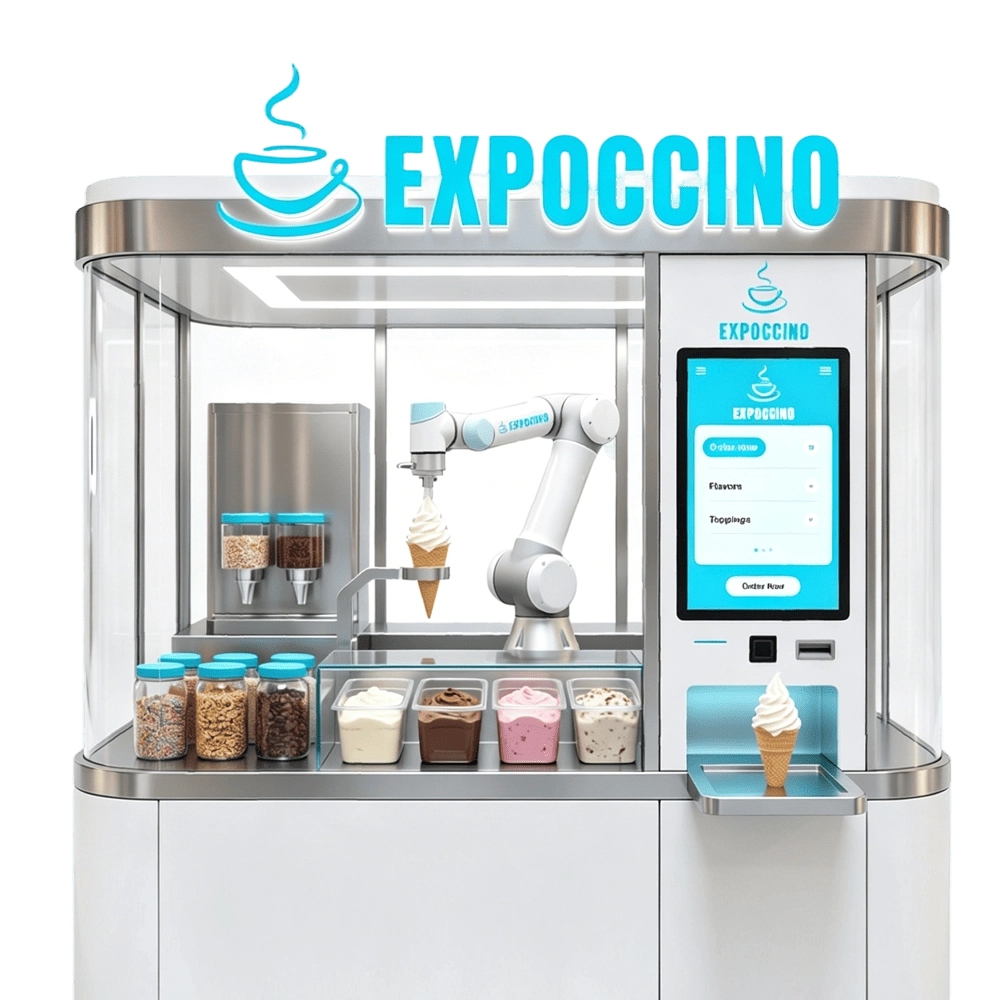
Expoccino Swirl is an AI-powered fancy ice cream robot that delivers ritual-worthy treats in paper cups. Robotic arms replicate handcrafted swirling layers and delicate textures directly inside paper cups, creating eye-catching, Instagram-worthy servings. Choose between classic soft-serve or light, refreshing frozen yogurt for diverse taste preferences.
With a compact 1.5 m² footprint and a 30-inch OLED interactive screen, it enables engaging human-machine interaction, perfect for high-end venues. Operating 24/7 unattended with an energy-efficient and low-maintenance design, it brings delightful frozen treats to customers anytime.
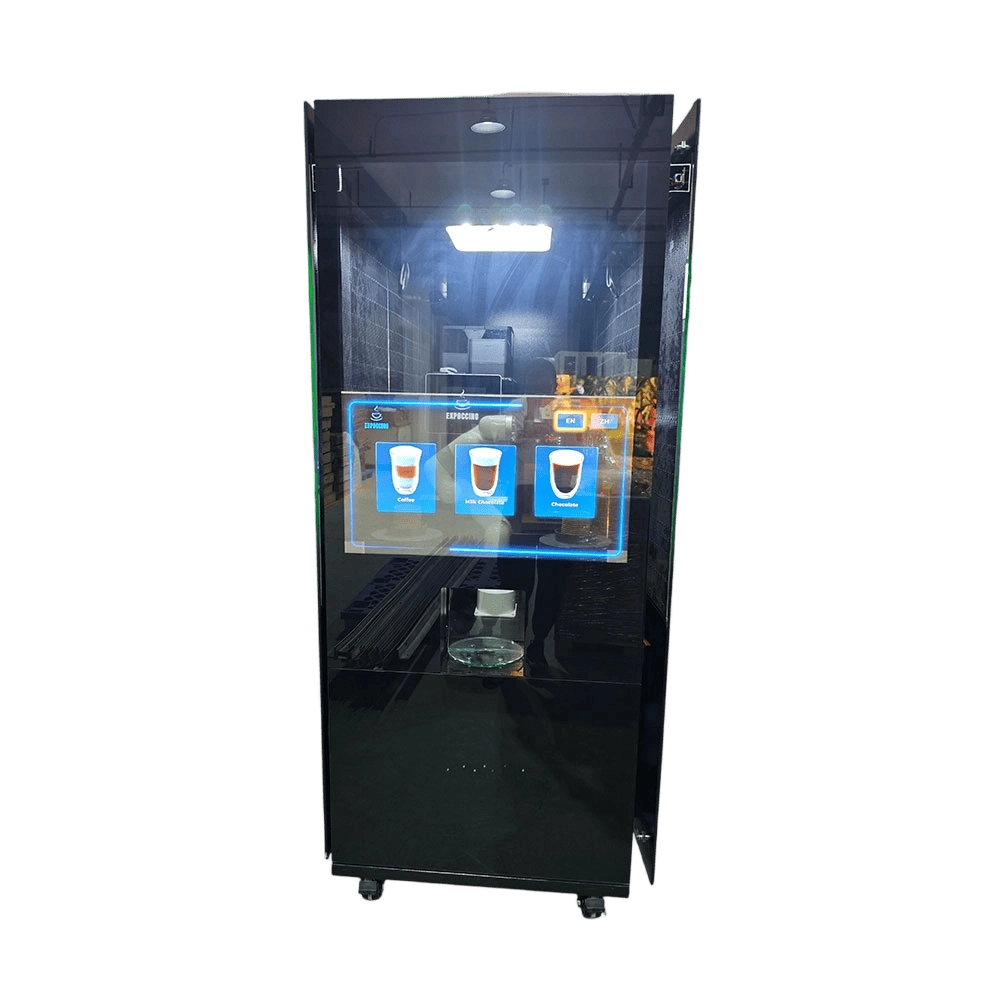
EXPOCCINO creates an immersive, futuristic coffee experience center. More than just a piece of equipment, it is a revenue-generating asset that enhances foot traffic and venue appeal through sophisticated robotic arm interaction and delivery technology, a multilingual user interface, and 24/7 fully unattended operation.
It aligns perfectly with public interest in specialty coffee and artificial intelligence, while helping brands gain extensive visibility, recognition, and market influence.
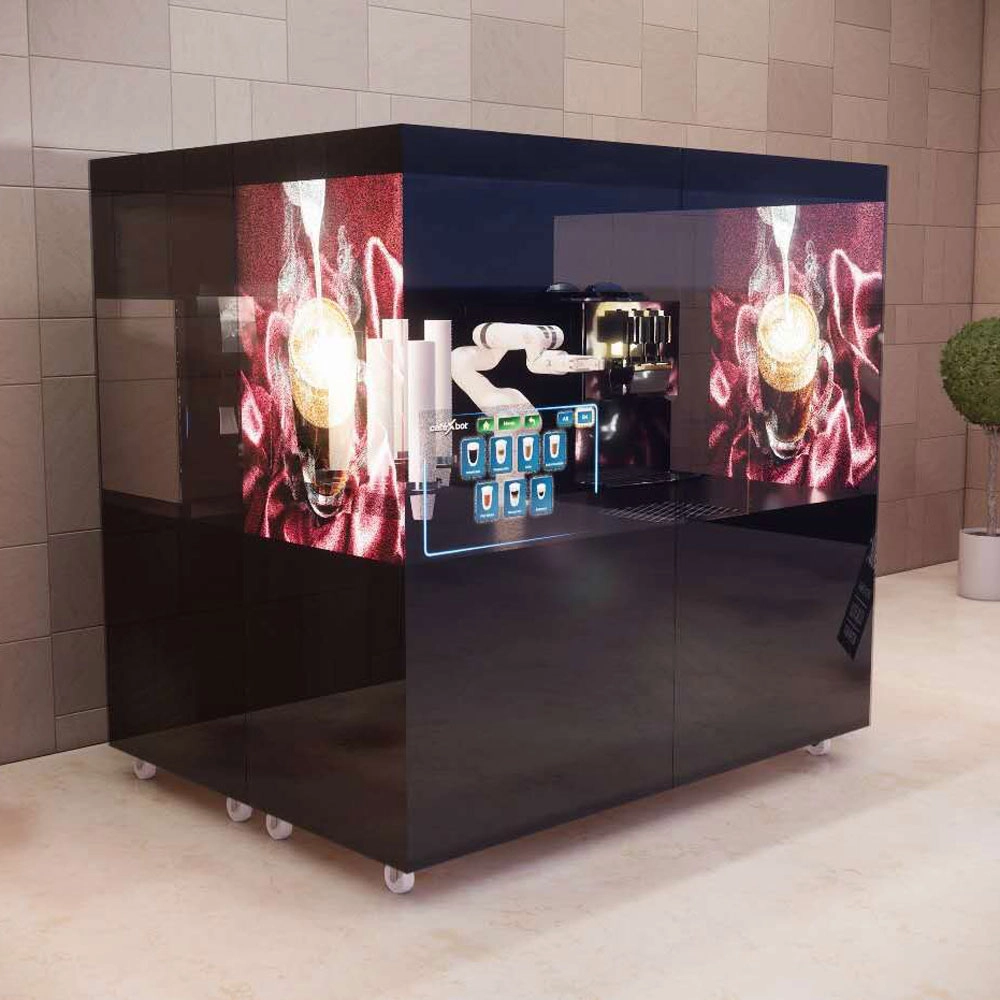
Enjoy doing your business with 100% automation. It is the only robotic kiosk serving multiple products, including hot and iced coffee, hot chocolate, ice cream with toppings, snacks, and tea.
It features a talking robotic kiosk equipped with AI speech recognition. The robot jokes with visitors to attract attention and invite them to buy. Additionally, it is the only robotic kiosk capable of serving up to 4 cups in a single order.
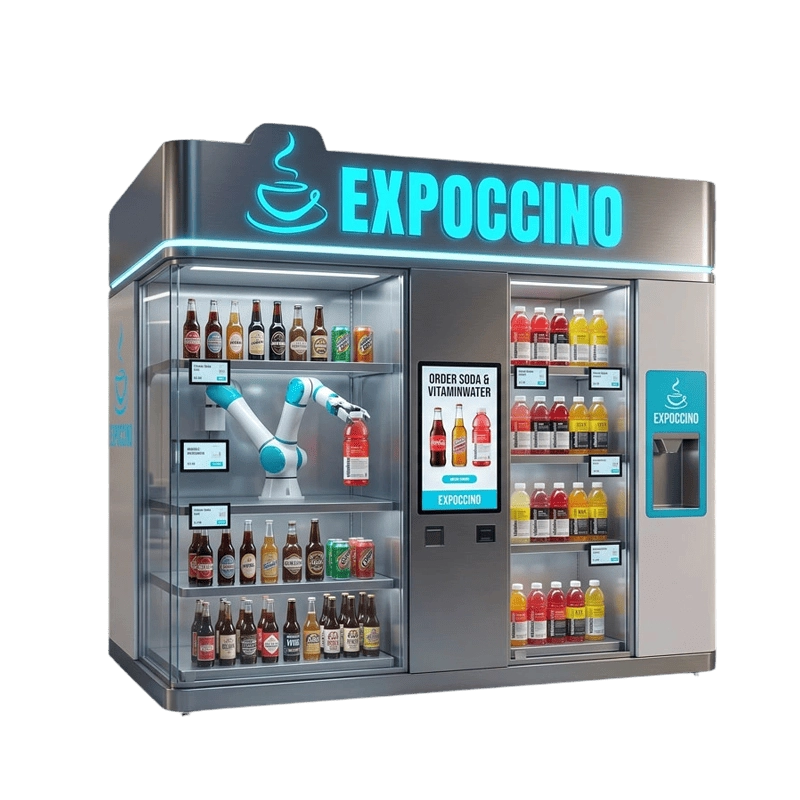
Expoccino Surge, the compact unmanned beverage kiosk, covers less than 5 m². Built with integrated robotic arms and a transparent OLED interactive screen, it offers 24-hour convenient service for everyone.
We carefully source natural fermented fruit & vegetable extracts and multivitamin ingredients, paired with freshly infused bubbles. Zero sugar and preservative-free, our drinks free you from the burden of traditional sugary sodas.
With an acid-resistant design, constant-temperature preservation, and smart cloud management, it is easy to maintain. Its sleek look fits malls, offices, campuses, and scenic spots, bringing healthy sparkling drinks closer to daily life.
Delivering hospitality experiences that reduce costs, boost sponsor value, and drive engagement.
Email: sales@expoccino.com
WhatsApp:+86 137 1745 4543
Tian’an Center, Jihua Dong Rd., Guicheng District, Nanhai, Foshan City, Guangdong Province, China.
 Scan QR Code
Facebook
Linkedin
Instagram
Linkedin
Twitter